Buying guides
Best Miter Saw for Dust Collection: 3 Verified Picks
Three research-based saw picks ranked by documented source-capture design—not unsupported claims that any miter saw is dust-free.
The quick answer
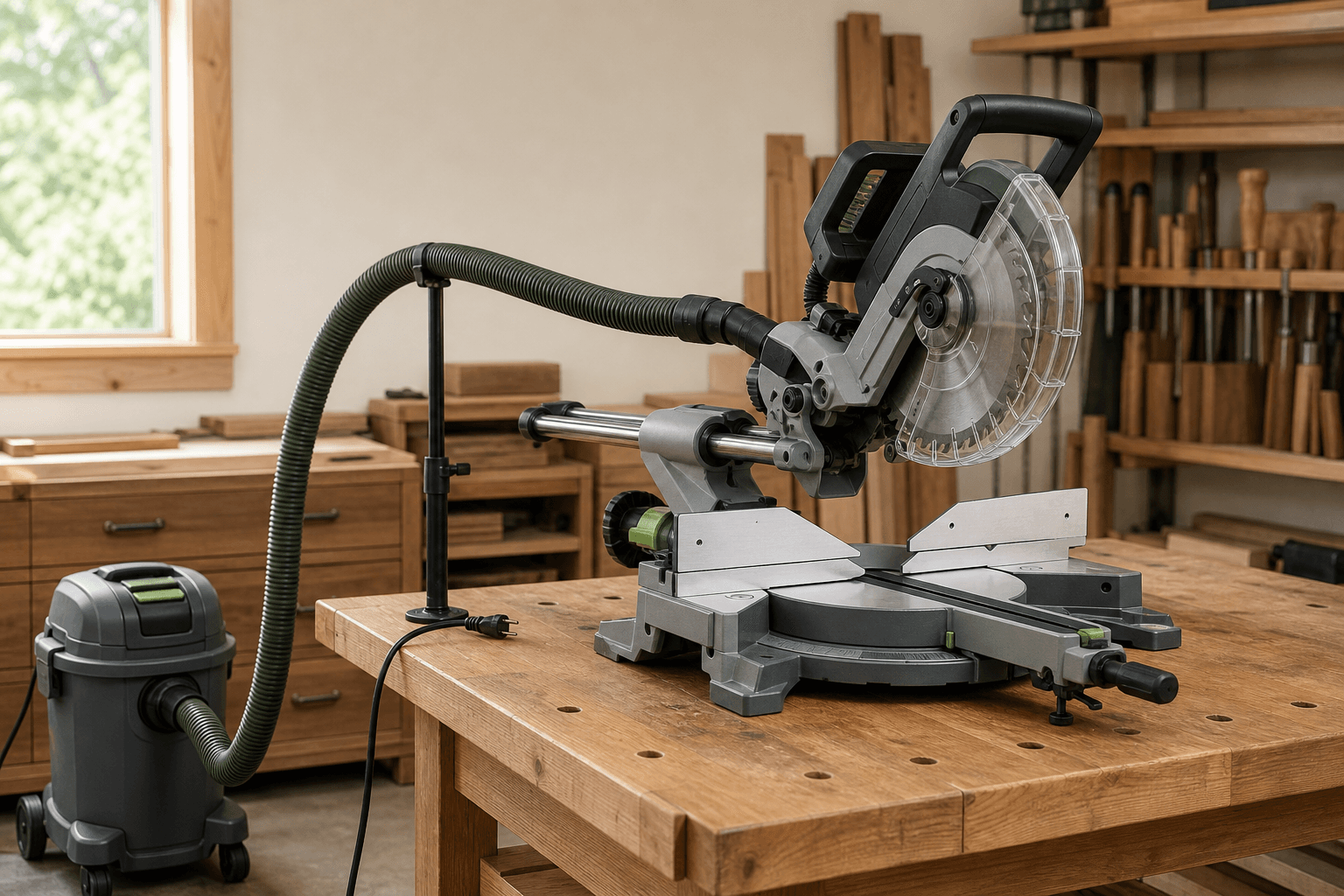
The Bosch GCM12SD is our research-based option for vacuum-assisted source capture because Bosch publishes a 90 percent collection claim when the saw is connected to a vacuum and optimized for cutting 2x material. That is a manufacturer result under stated conditions, not our independent test score, and capture will change with cut position, stock, hose, airflow and maintenance.
Choose the Makita LS1019L when dual collection ports and a wall-side 10-inch trim station fit the work, or the DeWalt DWS779 when you want broad 12-inch capacity with a manufacturer claim of more than 75 percent capture. No miter saw captures every particle; a compatible vacuum, short supported hose, clean filters and—where needed—a safe rear hood remain part of the system.
How this guide has been updated
- Clarified that manufacturer collection percentages are not comparable test results.
Share this page
Use this article with our best miter saw shortlist, then check the safe operating guide before planning the cut.
Relevant options
Three saws with documented dust-capture systems
Research-based recommendations, not hands-on tests. Compare the exact model, package and manufacturer specifications before ordering.
Documented vacuum-assisted capture
Bosch GCM12SD
Best for: A fixed high-capacity station using a compatible vacuum and frequently cutting 2x material.
- Combination dust chute and vacuum adapter
- Up to 90% manufacturer claim under stated conditions
- 12-inch dual-bevel Axial-Glide design
Review context: Bosch equips the saw with a combination dust chute and vacuum adapter and publishes up to 90 percent collection when optimized for cutting 2x material with a vacuum.
Consider: The claim is condition-specific, the 65-pound saw is workshop-first and compound positions can change real capture.
Official specificationsChecked August 26, 2026
Best dual-port trim-station design
Makita LS1019L
Best for: A wall-side 10-inch station cutting trim and wide boards with an extractor or the included bag.
- Dual dust-collection ports
- Bag included; vacuum sold separately
- Forward rail design for wall-side operation
Review context: Makita documents dual collection ports and use with either the included bag or a vacuum sold separately. Its forward rail system also allows operation close to a wall.
Consider: Makita does not publish a directly comparable capture percentage on the current page, and the saw weighs 57.9 pounds.
Official specificationsChecked August 26, 2026
Best broad-capacity value configuration
DeWalt DWS779
Best for: A full-size sliding station where 12-inch capacity and a documented factory dust system are both priorities.
- More than 75% manufacturer capture claim
- Factory dust bag included
- 12-inch dual-bevel sliding design
Review context: DeWalt states that the DWS779 dust system captures more than 75 percent of dust generated and lists the factory dust bag with the saw.
Consider: That is a manufacturer claim rather than our test, and rear rail travel plus the hose require substantial station clearance.
Official specificationsChecked August 26, 2026
Why this is not another general miter-saw roundup
The overall best saw balances capacity, accuracy features, portability, bevel range, footprint and cost. This guide narrows the decision to dust generated at a stationary crosscut: how the guard channel receives the plume, where the factory port sits, whether a vacuum adapter is supplied, how the hose moves and what the manufacturer actually documents.
A saw can be excellent overall yet difficult to capture from at some miter or bevel positions. Conversely, a well-designed chute does not make an undersized or poorly supported saw right for the material list. First verify blade, capacity and cut configuration; then use this shortlist to compare the dust path.
What is the best dust-collection system for a miter saw?
Start at the blade with the factory guard channel and approved port, connect a suitable high-airflow vacuum or extractor through the shortest smooth adapter, support the hose independently and keep filters and the collection container within their service limits. Add a rear hood only when it preserves full slide, miter, bevel, guard, motor-cooling and stock clearance.
A large workshop dust collector is not automatically better than a vacuum at a small saw port. Static pressure, airflow, hose diameter, filter condition and the restrictions in adapters all matter. Follow both machine manuals and use our shop-vac-versus-dust-collector guide to match the source to the port instead of choosing by motor size alone.
How to read manufacturer capture claims
Bosch states up to 90 percent collection for the GCM12SD when optimized for cutting 2x material with a vacuum. DeWalt states that the DWS779 system captures more than 75 percent of dust generated. Those claims use different wording and test contexts, so they are not a controlled head-to-head percentage ranking.
Makita describes dual dust-collection ports on the LS1019L and says they provide excellent extraction performance, but its current product page does not provide a directly comparable percentage. We therefore rank documented architecture and scenario fit without converting marketing statements into a synthetic score.
How effective is miter-saw dust collection?
Effectiveness changes across square crosscuts, full slide cuts, miters and bevels because the blade throws debris through different paths. The same system can collect well in a narrow square 2x cut and leave more debris during a wide sliding compound cut. Fine airborne dust and heavier chips also behave differently.
Use a repeatable workshop check: begin with an empty extractor and clean filter, inspect every connection, make representative cuts in scrap using normal safe technique, then examine the table, fence, rear plume and surrounding floor. This is a setup diagnostic, not a substitute for exposure monitoring or required respiratory controls.
Are dust extractors worth it for miter saws?
Powered extraction is usually worthwhile for repeated indoor cutting because it creates airflow at the source and can reduce the debris that a passive bag leaves on the bench. It still needs a compatible port, hose and filter, and it must not overload the electrical supply or pull against the saw head.
For a few outdoor cuts, a factory bag may help with chips, but outdoor air disperses fine dust rather than making it harmless. For an occupied remodel or daily shop station, a suitable extractor plus housekeeping is the more controlled plan. Follow applicable ventilation, exposure and respiratory-protection requirements.
How to improve dust collection on a miter saw
Disconnect power, then inspect the guard channel, chute, port and bag or hose for blockages and damage. Empty the container, service filters as directed, seal only approved connection leaks, remove unnecessary adapter steps and support the hose so it cannot steer the slide or bevel mechanism.
Next, move the powered-off saw through every intended angle. A hose that works at square may kink at full miter or collide during bevel. If the rear plume still escapes, consider a model-specific or carefully designed hood that remains outside the complete motion and stock envelope. Never narrow an opening, modify a guard or enclose motor ventilation to chase more capture.
Adapter size and hose routing can erase a good saw design
Measure actual inside and outside diameters rather than relying on nominal hose labels. An abrupt reduction, internal ridge or loose joint can restrict flow or leak. Use the shortest smooth transition that the equipment instructions allow and provide strain relief before the hose reaches the saw port.
Route power and extraction separately from walkways and the stock path. If the saw and vacuum share a circuit, verify the simultaneous electrical load and manual requirements. An auto-start outlet is useful only when its rating covers the exact saw and extractor combination.
When a rear dust hood adds useful secondary capture
A hood can intercept debris that passes the factory chute, especially behind a sliding saw. It should complement source capture rather than replace the guard and port. Shape and opening size affect airflow, and a large open box connected through a small hose may provide little velocity where the plume travels.
Build around the actual saw, not a plan for another model. Check head travel, rear rails or glide arm, bevel motor position, fence movement, clamp access and long-stock clearance with power isolated. Make the hood removable for cleaning and inspection; accumulated dust near motors, outlets or hot work is a maintenance and fire concern.
Dust control does not replace safe cutting practice
Keep the lower guard intact, support stock level with the table, clamp where directed and maintain the manufacturer’s no-hand zone. Never hold a hose close to the blade during a cut or reach behind the fence while the blade is moving. Wait for complete blade stop before raising the head.
OSHA identifies wood dust as a health concern and describes engineering controls, local exhaust ventilation and housekeeping as parts of exposure control. Use eye and face protection and any required hearing or respiratory protection. Never use compressed air to create a dust cloud or send sparks and hot metal debris into a wood-dust system.
At a glance
What the shortlist verifies
- Each pick has manufacturer-documented capture features
- Claims retain their stated conditions and limitations
- Vacuum, adapter and hood choices are treated as one system
- Maintenance and material safety are connected to the purchase
What still requires a complete setup
- No miter saw captures all dust
- Manufacturer percentages are not directly comparable
- Hoses and adapters can restrict airflow
- Compound and sliding cuts can change the plume
Frequently asked questions
What is the best dust collection system for miter saws?
Use the saw’s factory guard channel and approved port with a compatible powered extractor, short smooth adapter and independently supported hose. Add a safe rear hood only when factory source capture cannot contain the plume.
How effective is miter saw dust collection?
It can substantially reduce debris, but effectiveness varies by saw, stock, angle, hose, airflow and filter condition. Manufacturer percentages apply only to their stated test conditions and do not mean dust-free operation.
Are dust extractors worth it for miter saws?
Yes for repeated indoor work when the extractor, filter, hose, port and electrical supply are compatible. Powered source capture generally controls more debris than a passive bag, but it does not replace ventilation, housekeeping or required PPE.
How can I improve dust collection on my miter saw?
Clean the chute and filters, empty the container, remove restrictive adapter steps, support and straighten the hose, test every saw position and add a safely designed hood only if the rear plume still escapes.
Sources and verification
Specifications and material guidance were checked on the dates shown. Always confirm the current manual for your exact saw, blade and decking product.
- Bosch GCM12SD official specificationsChecked August 26, 2026
- Makita LS1019L official specificationsChecked August 26, 2026
- DeWalt DWS779 official specificationsChecked August 26, 2026
- OSHA wood-dust exposure and controlsChecked August 26, 2026
- OSHA miter-saw guarding and safety measuresChecked August 26, 2026