How to use a miter saw safely
A miter saw is easiest to control when the setup is deliberate: stable saw, supported stock, locked settings, clear hands, and no movement until the blade stops. If the machine itself is still undecided, start with the miter saw buying guide; otherwise, this nine-step sequence shows what safe operation looks like.
Share this page
Prepare the saw, the stock, and yourself
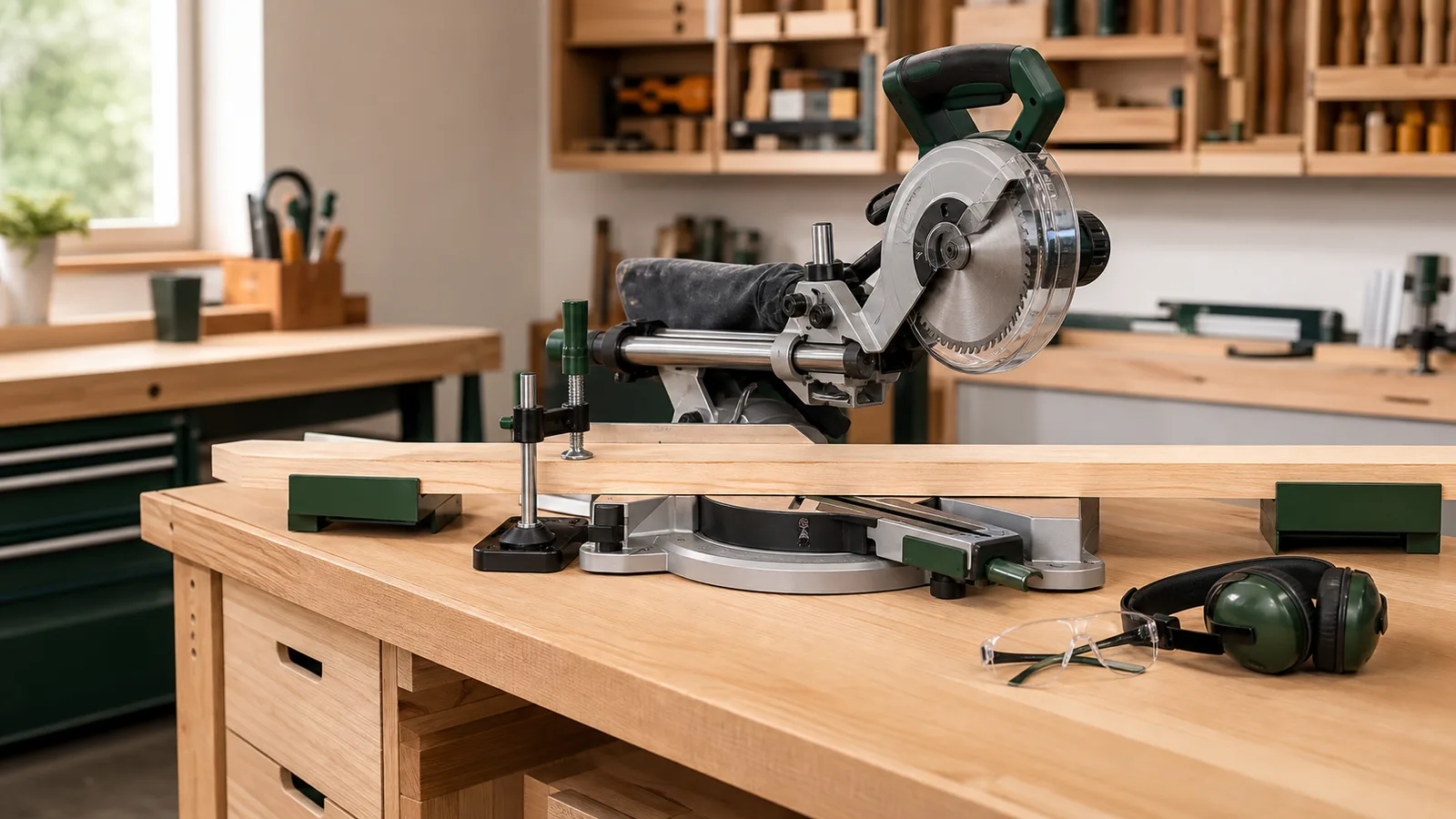
Most beginner errors happen before the blade enters the wood. Give the saw a firm, level base; clear the table; and support long stock at the same height as the saw table. Confirm that the lower guard moves freely and closes, and that the blade is designed for both your saw and the material you intend to cut.
- Eye protection is on; hearing and dust protection are ready as needed.
- The workpiece is straight enough to sit securely against table and fence.
- Nails, screws, staples, and other hidden objects have been ruled out.
- Long or wide stock has stable support and the floor is clear of trip hazards.
- Loose clothing, jewelry, hair, and gloves cannot reach the moving blade.
About hand clearance: there is no responsible universal number for every miter saw. Manuals from major manufacturers specify different distances. Obey the no-hands zone marked on your saw and the distance in its manual.
How to use a miter saw in 9 steps
Read the manual for your exact saw
Find the power switch, head lock, angle locks, guard, clamp points, and the marked no-hands zone. Controls and safe clearances differ by model, so the manual takes priority over any general guide.
Set the saw on stable support
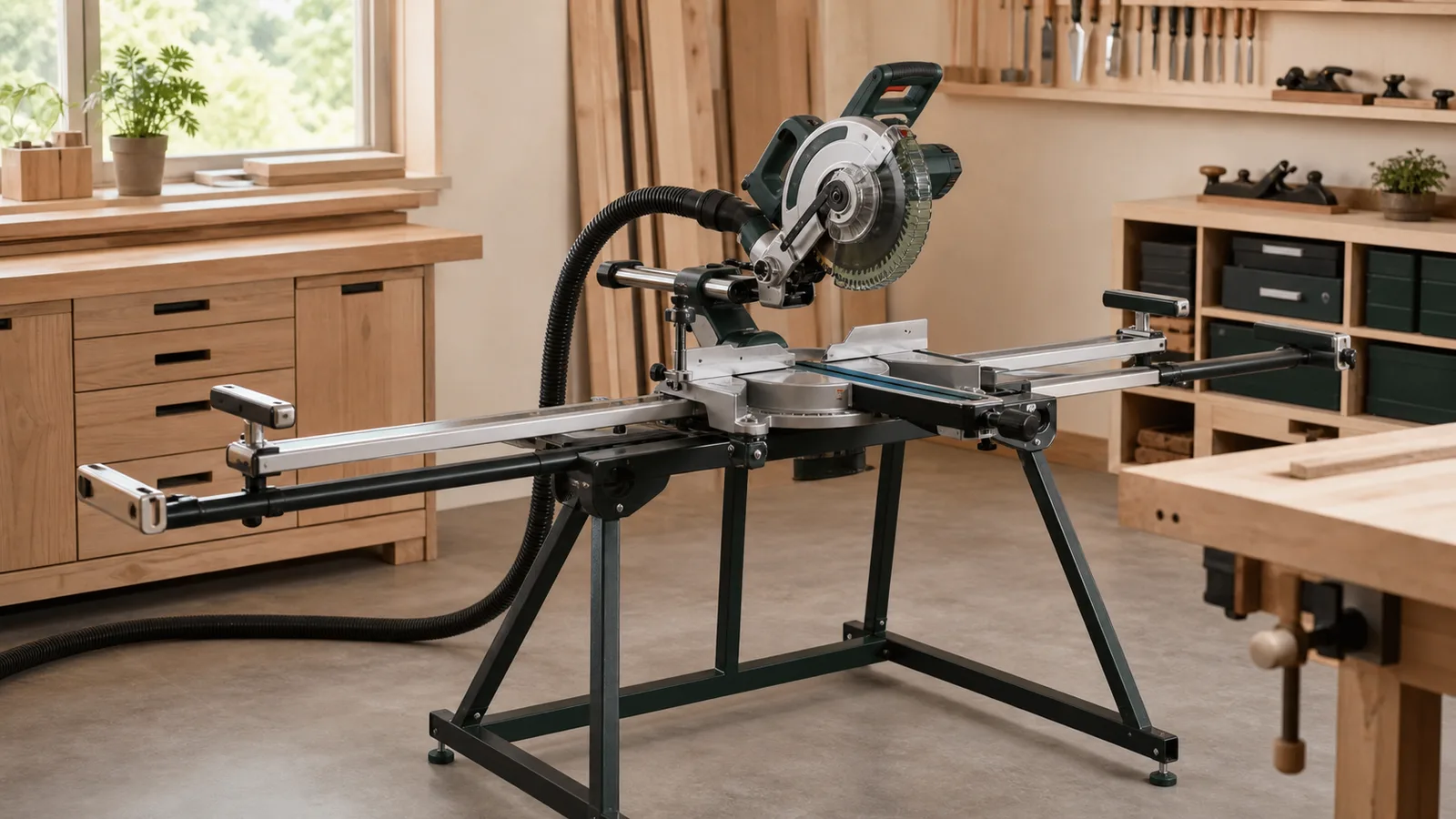
Place or mount the saw on a firm, level surface. Support long or wide stock so it stays level with the saw table and cannot tip during the cut.
Inspect the saw and workpiece
With power disconnected, check that the blade is suitable for the material, the guard moves and closes correctly, and the table is clear. Do not cut stock that contains nails, screws, or other hidden objects.
Put on the right protection
Wear eye protection. Add hearing and respiratory protection when the tool, material, or dust conditions call for it, and connect dust collection where available. Avoid loose clothing, jewelry, and anything that can reach the blade.
Mark, set, and dry-run the cut
Disconnect power before changing settings. Mark the waste side, set the miter and bevel angles, lock each adjustment, then lower the unplugged or battery-removed saw head to confirm blade position and clearance.
Seat and secure the workpiece
Hold the stock flat on the table and firmly against the fence. Clamp it whenever practical. Never make a freehand cut, cross your arms, or put a hand inside the danger zone specified for your model.
Start the blade clear of the stock
Keep the blade away from the workpiece, start the saw, and let the motor reach full speed before the teeth touch the material.
Make one smooth, controlled cut
Lower the head without forcing it. If you have a sliding saw, follow the cutting direction in its manual; the correct push-or-pull sequence is not universal across every design.
Wait for a complete stop
Finish the cut, release the trigger, and keep the head down until the blade has stopped completely. Only then raise the head and remove the workpiece or offcut. Never rely on the blade brake alone.
The four basic miter saw cuts
The name of the cut tells you which part of the saw moves. Practice a square crosscut first, using clean scrap that sits securely against the fence.
Crosscut
Miter 0° · Bevel 0°Cuts straight across the width of the board. This is the clearest first practice cut on straight scrap stock.
Miter cut
Table rotated · Head uprightCreates an angle across the face of the board, such as a corner joint in flat trim or a picture frame.
Bevel cut
Table at 0° · Head tiltedTilts the blade through the thickness of the stock. Check which side or sides your model is designed to bevel toward.
Compound cut
Mitered · BeveledCombines both settings. It is useful for some molding work, but demands a careful dry run for fence and guard clearance.
Common miter saw mistakes
Speed is rarely the useful shortcut. A repeatable cut comes from controlling the stock and knowing exactly where the blade will travel before power is connected.
Cutting freehand
Keep the workpiece flat against the table and fence, and clamp it whenever practical.
Raising a spinning blade
Release the trigger and hold the saw head down until the blade has completely stopped.
Using one universal hand-distance rule
Follow the no-hands markings and clearance stated in the manual for your exact model.
Crossing your arms
Reposition the stock, clamp, or approach so each hand remains on its natural side of the cut line.
Forcing a sliding cut in the wrong direction
Use the sliding sequence specified by the manufacturer; designs and instructions can differ.
Cutting unsupported long stock
Add supports level with the saw table so the board cannot lift, drop, or pivot.
Clearing a jam while connected to power
Switch off, wait for all movement to stop, disconnect power, and only then investigate.
Assuming the brake makes the blade safe
Treat the brake as a convenience, not a substitute for waiting for a full stop.
How to use a miter saw for trim
Start by measuring the opening and marking the visible face and waste side of the trim. Place the piece on the saw in the same orientation you used when measuring. For a flat miter, rotate the table; for a bevel or compound cut, follow the setup appropriate to the molding and your saw.
- Make a powered-off dry run to confirm blade position and fence clearance.
- Clamp without bowing delicate trim away from the fence.
- Cut slightly proud of the line when final fit is uncertain.
- Test the joint before repeating the setup on matching pieces.
Crown molding can be cut nested or flat depending on the profile, saw capacity, and method. Treat that as a separate setup and follow the saw and molding manufacturer's instructions.
What first-time users usually ask
Is a miter saw easy to use?
The basic crosscut is straightforward after you understand the controls, but the blade can cause severe injury. Learn the model-specific safety rules, practice the full sequence on scrap, and do not rush setup or blade stop time.
Should I push or pull a sliding miter saw?
Follow the manual for your exact model. For example, Bosch instructs users of the GCM12SD to extend the head before starting and push it through the cut, and warns against cutting on the pull stroke. Do not assume that wording applies to every sliding mechanism.
Can I hold a small piece by hand?
If holding it would put any part of your hand inside the marked danger zone, do not make the cut that way. Use an appropriate clamp or a safer cutting method described by the manufacturer; never freehand a workpiece.
When can I lift the saw head?
Keep the head down after the cut until the blade has stopped completely. Then lift the head and remove the workpiece or offcut. A blade brake does not change that sequence.
Official safety and manufacturer sources
This is research-based editorial guidance, not a claim of hands-on testing. We checked the process against government safety guidance and two current manufacturer manuals to identify both common rules and model-specific differences.