Shop vac vs dust collector for a miter saw
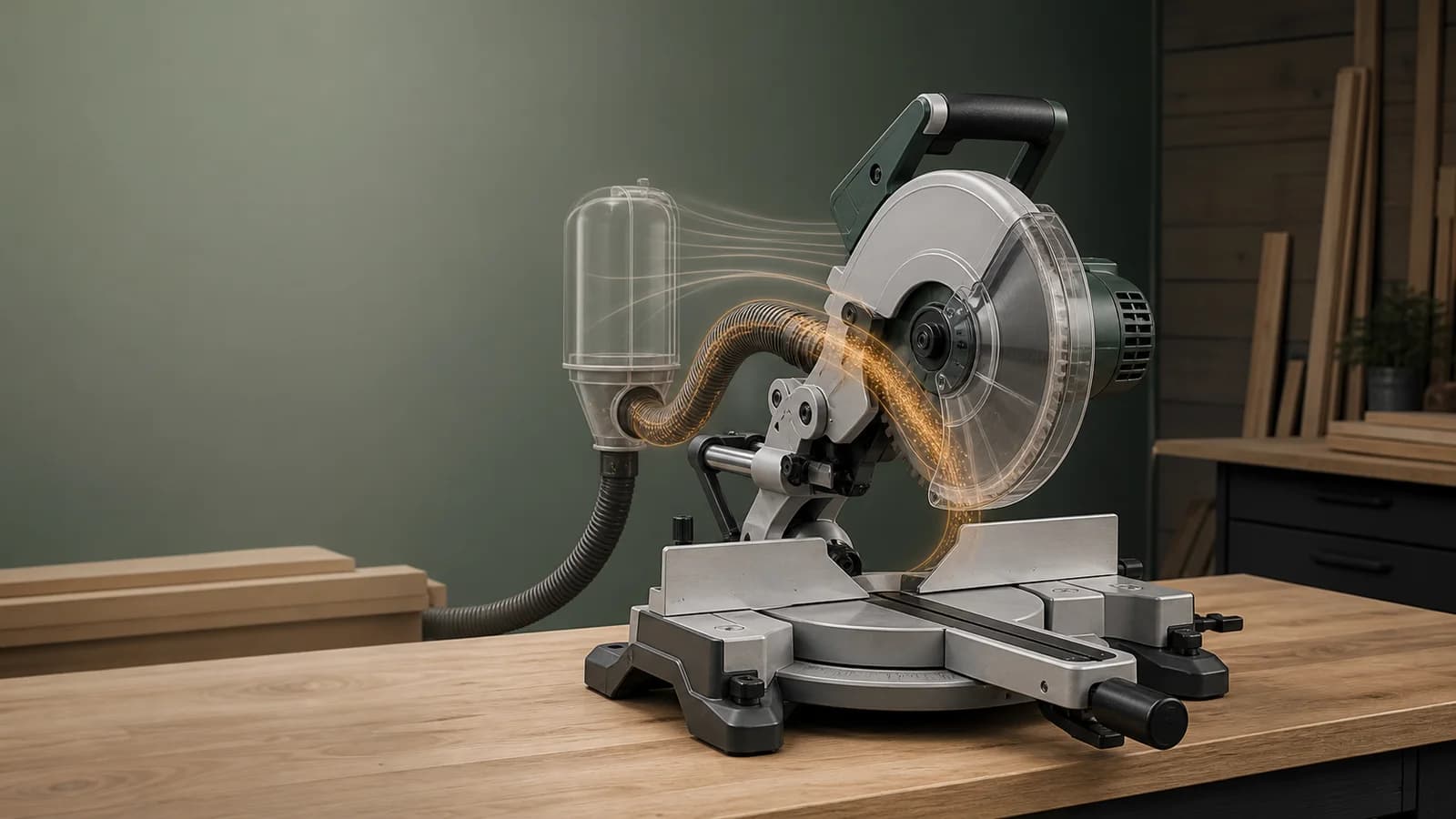
A shop vacuum favors higher pressure through smaller hoses. A dust collector favors larger airflow through larger ducts. The saw’s small port and an open hood may benefit from different sides of that trade.
How this guide has been updated
- Guidance published with safety and manufacturer references.
Share this page
Pressure and airflow solve different restrictions.
A shop vacuum or dust extractor is designed to maintain useful flow through a relatively small hose and restrictive tool port. A traditional dust collector usually moves more air at lower pressure through larger ducting, which suits open hoods only when the opening and duct preserve that airflow.
Marketing peak horsepower, sealed suction, or free-air CFM cannot be compared directly across systems. Useful capture is measured at the working port with the actual hose, bends, adapter, filter, and container condition.
Smaller and flexible
Larger duct
Overcomes small-port resistance
Moves volume through larger openings
Factory on-tool port
Well-designed rear hood
Loaded small filter or long hose
Undersized duct or open enclosure
Small guard ports usually favor high-pressure extraction.
The guard channel and rear outlet are narrow and move with the head. A suitable extractor can maintain flow through that resistance, especially with a short smooth hose and correctly sized adapter.
Check automatic tool-start ratings, hose support, filter cleaning, dust class, and duty cycle. A household vacuum may lack filtration, durability, static control, or accessory compatibility required for repeated workshop dust.
Open enclosures need volume across their face.
A surrounding hood has a much larger opening than the factory port. A dust collector can suit that geometry when its duct remains large and the hood narrows the active capture zone around the plume.
Reducing a large collector to a tiny port may sacrifice its airflow advantage, while attaching a shop vacuum to a giant open box may create too little face velocity. Design the opening and source together.
Use the least complex system that controls escape.
Start with the saw maker’s approved extraction connection, then observe where dust escapes. Improve adapters, hose routing, filter maintenance, and the rear capture shape before adding another motor.
For frequent work, consider measured airflow or professional exposure assessment. Maintain housekeeping and ventilation because no miter-saw capture setup is perfect across every compound angle and stock shape.
Questions readers ask before they start
Is a dust collector better than a shop vac for a miter saw?
Not universally. Small factory ports often suit higher-pressure extractors; large hoods can benefit from higher-volume collectors.
Can I use both?
Some stations use an extractor on the factory port and a collector on a rear hood, provided both systems and their electrical loads are safely designed.
Does HEPA filtration improve capture?
Filtration controls what exits the machine, while airflow and hood geometry control capture. Both matter and filters must be maintained.
Check the exact saw manual before changing or adjusting anything.
This guidance combines NIOSH engineering-control principles with the manufacturer instructions for the saw connection. It does not replace exposure assessment or workplace rules.