Saw comparisons
Corded vs Cordless Miter Saw: Which Power Source Fits Your Work?
A practical power-source decision guide that separates outlet access and mobility from blade size, capacity and cutting features.
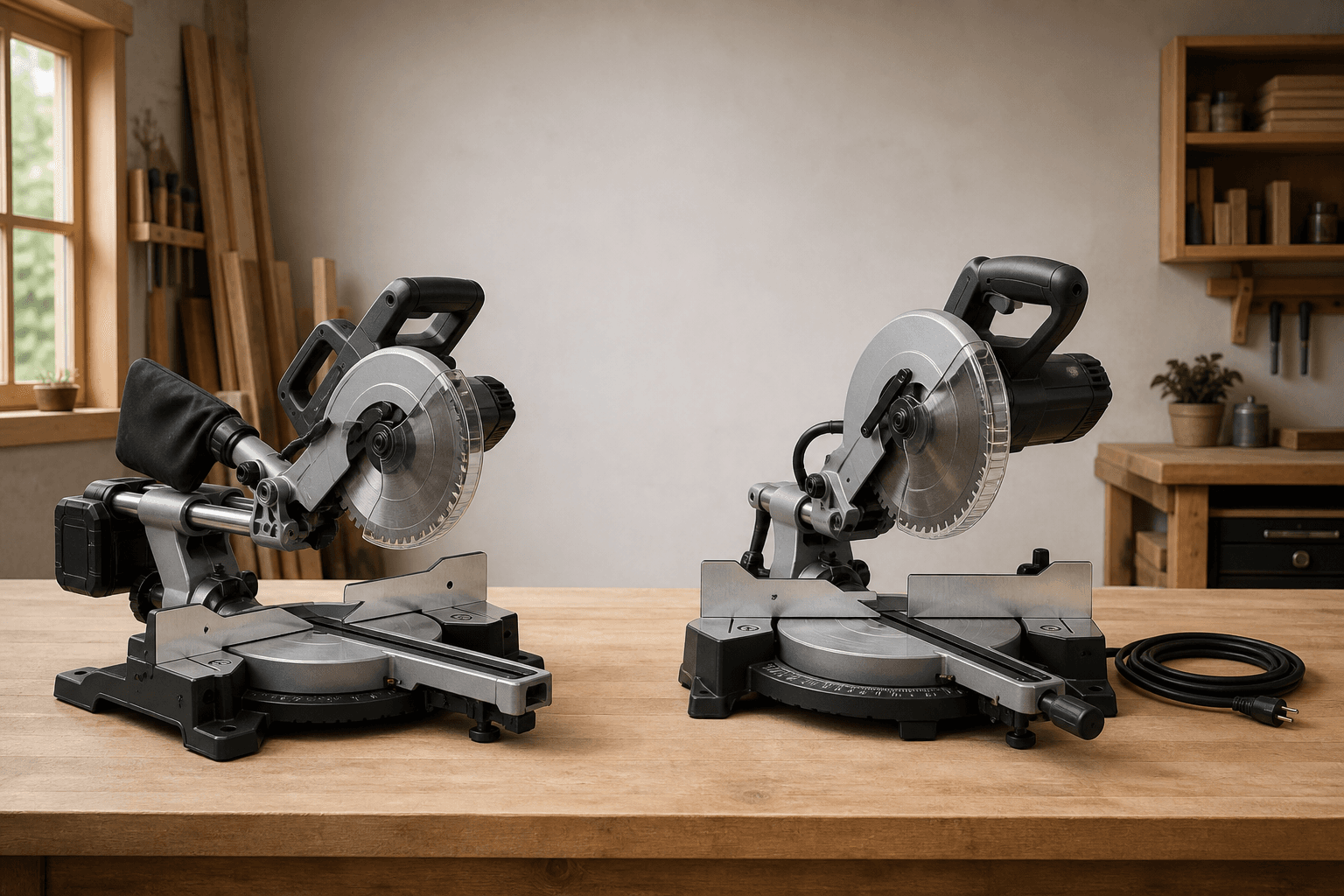
The quick answer
Choose a cordless miter saw when you regularly carry the saw between rooms or jobsites, work before temporary power is ready, or want to remove an extension cord from the setup. Choose corded when the saw stays near a suitable outlet and you want continuous operation without managing batteries and chargers.
Power source does not determine cut capacity or accuracy. Compare blade diameter, fixed or sliding travel, bevel range, fence geometry and published capacities separately. A compact cordless 6-1/2-inch saw and a corded fixed 10-inch saw solve very different cut lists even before the cable or battery enters the decision.
How this guide has been updated
- Consolidated the overlapping guide into this article and added a practical decision checklist.
Use this article with our best miter saw shortlist, then check the safe operating guide before planning the cut.
Relevant options
Four verified corded and cordless examples
Research-based recommendations, not hands-on tests. Compare the exact model, package and manufacturer specifications before ordering.
Best mobile wide-cut example
DeWalt DCS361B
Best for: Room-to-room trim and remodel work that needs sliding reach without an outlet at every setup.
- 7-1/4-inch sliding cordless design
- Published 2 x 8-inch capacity at 0°
- Tool only; battery and charger sold separately
Review context: DeWalt describes this as a 20V MAX cordless 7-1/4-inch sliding miter saw and documents 2-by-8-inch capacity at zero miter and bevel.
Consider: The listed 30-pound tool weight plus batteries and charger makes it less compact to carry than the smallest cordless examples.
Official specificationsChecked August 24, 2026
Best compact cordless example
Makita XSL05Z
Best for: Small trim and punch-list work where low carry weight matters more than wide-board reach.
- 14.6 pounds with battery
- Published 1-13/16 x 3-5/8-inch capacity at 90°
- Tool only; battery and charger sold separately
Review context: Makita lists this 18V LXT 6-1/2-inch dual-bevel saw at 14.6 pounds with battery and publishes 1-13/16 by 3-5/8-inch capacity at 90 degrees.
Consider: Its compact blade and published width are not intended to replace a larger slider for shelving or wide dimensional lumber.
Official specificationsChecked August 24, 2026
Best lightweight corded example
Metabo HPT C10FCG2
Best for: Garage and mobile stations with suitable power and common 2x lumber or trim within fixed-head capacity.
- 120V, 15-amp corded motor
- 24-pound manufacturer-listed weight
- Published 2x6 capacity at 90°
Review context: Metabo HPT lists a 120V, 15-amp fixed 10-inch compound saw at 24 pounds, with 2x6 capacity at 90 degrees and 2x4 at 45 degrees.
Consider: It requires cord and circuit planning and does not provide sliding width or right-bevel convenience.
Official specificationsChecked August 24, 2026
Best straightforward corded workhorse
DeWalt DWS713
Best for: A fixed shop or renovation station making common crosscuts, miters and occasional left bevels.
- 10-inch fixed compound design
- 15-amp corded motor
- Published 2x6 capacity at 90°
Review context: DeWalt identifies the DWS713 as a corded 15-amp, 10-inch single-bevel compound saw and publishes 2x6 capacity at 90 degrees.
Consider: Its fixed head and predominantly left bevel are less efficient for wide shelving and repeated opposing bevels.
Official specificationsChecked August 24, 2026
Start with the place where the saw actually works
For installed trim on several floors, cordless can remove repeated searches for an outlet and reduce the cable that must be routed through finished rooms. For a garage station that remains beside a verified circuit, a corded saw avoids charging logistics and is ready whenever the outlet is available.
Do not treat cordless as permission to set up anywhere. Both types need a stable, level support, room for full miter and bevel travel, controlled stock support and a clear operator position. A battery removes one lead; it does not remove the rest of the workstation.
Plan cordless runtime without trusting a universal cut count
Runtime varies with battery capacity and condition, blade, material, stock dimensions, temperature and feed. Manufacturer cut-count claims only describe their stated test conditions, so they are not a promise for your project. Use the exact saw manual and battery system guidance, then plan charging around the real cut list.
For a day of room-to-room casing work, one battery in the tool and a compatible charged spare can preserve mobility. For repeated deck or framing crosscuts at one station, a suitable corded supply may be simpler. Never continue with a damaged, hot or incompatible battery merely to finish a batch.
Capacity is independent of the cord
DeWalt publishes 2-by-8-inch capacity at zero miter and bevel for the cordless 7-1/4-inch DCS361. Metabo HPT publishes 2x6 at 90 degrees for the corded fixed 10-inch C10FCG2. Those examples show why blade size, slide travel and machine geometry matter more than a generic claim that one power source cuts larger material.
Write down the widest square crosscut, widest 45-degree miter, tallest base and crown orientation you repeat. Match each dimension to the manufacturer table at the intended angles. Do not flip a wide board for an improvised two-pass cut unless the manual explicitly permits the setup and the work can remain registered and controlled.
Compare the complete carry system
Tool weight alone can hide the real transport burden. DeWalt lists the DCS361 tool at 30 pounds, while Makita lists the compact XSL05Z at 14.6 pounds with battery. A cordless setup also includes one or more batteries and a charger; a corded setup may require a correctly rated extension lead and cable storage.
Walk the actual route from storage to the work area. Stairs, doorways, a stand and long stock may matter more than a few pounds on the saw label. Disconnect the battery or unplug the saw before carrying or changing the setup, and use the manufacturer-designated carry points.
Corded still needs a suitable power plan
A corded saw offers continuous power only when the circuit, outlet and extension cord are suitable for the tool and work environment. Follow the saw manual for voltage, grounding or double-insulation requirements and extension-cord sizing. Route the lead away from the blade, stock path, feet and moving stand parts.
For a fixed shop, a nearby outlet and supported dust hose can make the cord unobtrusive. On a renovation site with doors, stairs and multiple trades, cord routing can add setup work and trip exposure. Never defeat a plug, use a damaged lead or assume any available outlet is adequate.
Include batteries, chargers and platform fit in the decision
A tool-only cordless saw may be attractive when you already own compatible batteries and a charger. If you do not, compare the complete working system rather than the bare tool. Battery compatibility is manufacturer- and platform-specific; matching voltage language or a similar connector shape is not proof of compatibility.
Corded tools avoid platform lock-in, but the saw still has blades, dust equipment, stands and other accessories to verify. For either type, prioritize the cut configuration first and treat the power system as one part of total ownership—not as a substitute for capacity or guarding.
Four concrete buying scenarios
For an installer moving a compact saw through occupied rooms, the Makita XSL05Z illustrates a light cordless format for small trim within its published capacity. For mobile remodel work that includes wider boards, the sliding DeWalt DCS361 provides more reach but weighs more. Neither example replaces checking the exact molding dimensions.
For a garage user cutting common 2x material near an outlet, the corded Metabo HPT C10FCG2 is a lightweight fixed 10-inch example. For a permanent bench where continuous operation and repeatable common crosscuts matter, the corded DeWalt DWS713 is another straightforward configuration. The right choice is the smallest complete setup that safely covers the recurring cut list.
Is corded or cordless better for a circular saw?
The same location and runtime questions apply, but a circular saw moves through the work while a miter saw brings the work to a fixed cutting station. That makes cord drag especially relevant for a handheld circular saw and workstation stability especially relevant for a miter saw.
Do not transfer a decision automatically between tool categories. A user may reasonably choose a cordless circular saw for sheet breakdown and a corded miter saw that remains on a bench. Evaluate each tool by its movement, material, duty cycle and available power.
What should you never cut with a miter saw?
Never cut material the manufacturer does not approve, and never use the saw for rip cuts or freehand work. Do not cut stock that cannot sit firmly against the table and fence or that places your hands inside the manual’s no-hand zone. Metal, masonry and plastics require an exact saw-and-blade approval; a blade that physically fits is not enough.
OSHA emphasizes effective guarding, sharp blades, safe hand distance and eye and face protection. Remove the battery or unplug the cord before adjustments or blade changes, clamp and support work as directed, let the blade reach full speed before the cut, and wait for complete blade stop before raising the head.
Compare the complete power package
This article now includes the practical checks from our shorter power-source guide. Compare one complete working package against another: tool, required batteries, charger, carrying arrangement and approved supply. Do not compare a tool-only cordless listing with a ready-to-use kit.
For occasional remote work, record how often moving the station would interrupt cutting. For a fixed workshop, record dependable outlet access. Neither the voltage label nor a cuts-per-charge headline tells you how a different material and battery combination will perform.
| Work constraint | Corded check | Cordless check |
|---|---|---|
| Supply | Approved outlet and extension-cord arrangement | Compatible battery models and required count |
| Work duration | Location and continuity of supply | Charging access and battery rotation plan |
| Purchase comparison | Tool and necessary supply accessories | Tool-only versus included batteries and charger |
At a glance
Where each power source works well
- Cordless removes outlet dependence at mobile setups
- Corded supports continuous stationary use
- Both formats include useful compact and sliding options
- A cut-list comparison prevents power-source overbuying
Trade-offs to plan before buying
- Cordless requires battery and charger planning
- Corded requires safe circuit and cable management
- Power source alone says nothing about capacity
- Complete transport weight can exceed tool-only weight
Frequently asked questions
Is it worth getting a cordless mitre saw?
Yes when outlet-free setup, frequent transport or eliminating a cable materially improves your work. For a saw that stays beside a suitable outlet, corded operation may be simpler and avoids battery management.
What should you never cut with a miter saw?
Never cut unapproved materials, unsupported or irregular work that cannot register against the table and fence, or perform rip and freehand cuts. Follow the exact saw and blade manuals for permitted materials.
Is it better to have a corded or cordless circular saw?
Cordless often suits mobile sheet and framing cuts, while corded suits repeated work near suitable power. That decision does not determine the best miter-saw power source because the tools move and set up differently.
Who makes the best corded miter saw?
There is no single best maker for every cut list. Compare current models from established manufacturers by verified capacity, bevel and slide configuration, support, safety instructions and fit for your workstation.
Sources and verification
Specifications and material guidance were checked on the dates shown. Always confirm the current manual for your exact saw, blade and decking product.
- DeWalt DCS361B official specificationsChecked August 24, 2026
- DeWalt DCS361 instruction manualChecked August 24, 2026
- Makita XSL05Z official specificationsChecked August 24, 2026
- Metabo HPT C10FCG2 official specificationsChecked August 24, 2026
- DeWalt DWS713 official specificationsChecked August 24, 2026
- OSHA miter-saw guarding and safety measuresChecked August 24, 2026