Workshop setup
Miter Saw Stand vs Workbench: Which Setup Fits Your Work?
Choose between a folding stand and permanent bench by how the saw, stock and workspace actually move—not by workshop photos alone.
The quick answer
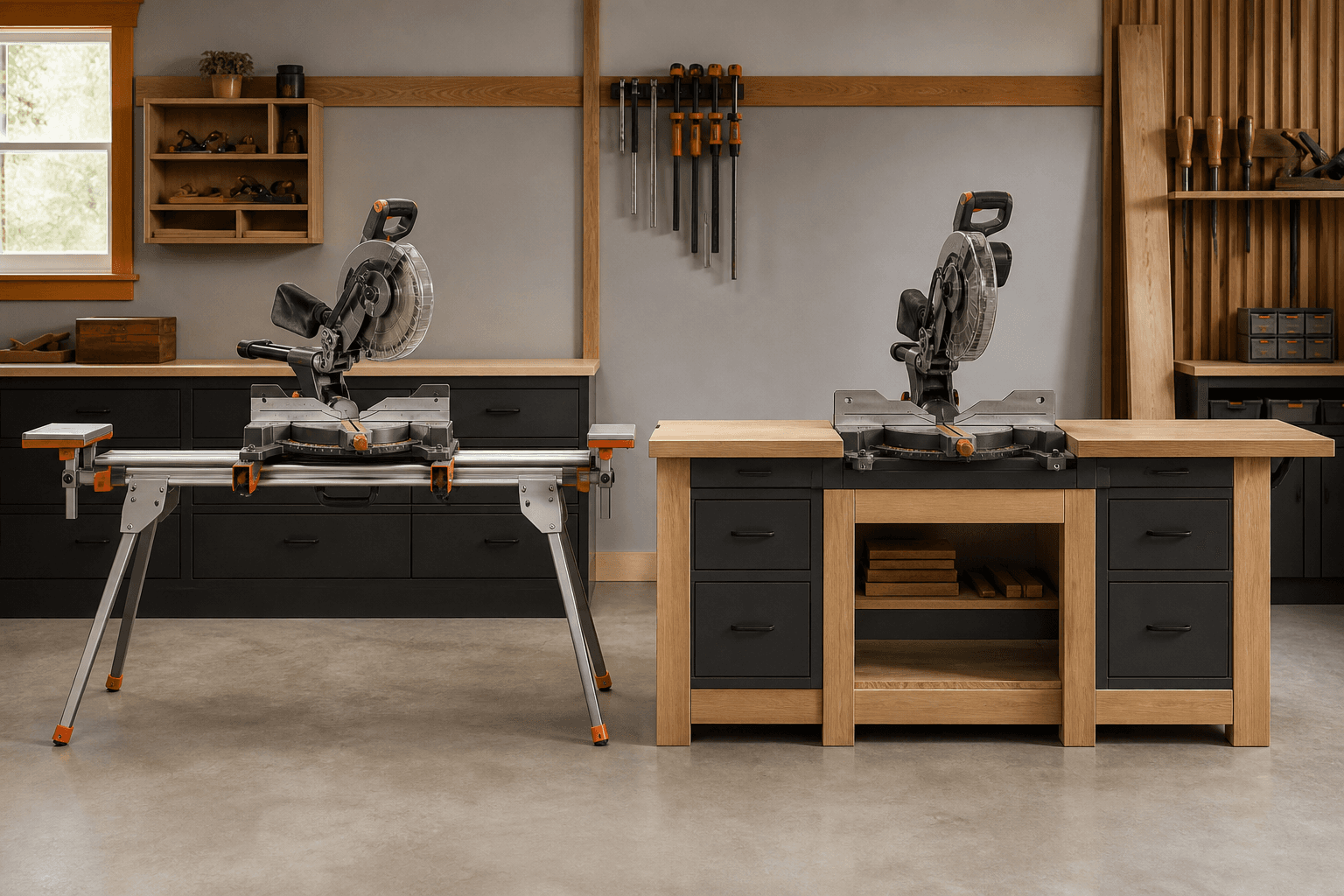
Choose a miter saw stand when the saw moves between storage, rooms or jobsites and you need integrated extensions for long stock. Choose a workbench when the saw stays in one shop and you value a large continuous surface, drawers, fixed dust routing and repeatable fences. Either can be safe and accurate only when the saw is firmly mounted and the stock remains level with the saw table.
For a shared garage, a folding stand often wins because it clears floor space after the cut. For a dedicated trim shop, a bench can turn the saw into a permanent station. Do not assume a heavy bench is automatically stable or that “universal” stand brackets fit without measurement; verify the saw footprint, mounting holes, full head travel, combined load and support height.
How this guide has been updated
- Article published with product references and related reading.
Share this page
Use this article with our best miter saw shortlist, then check the safe operating guide before planning the cut.
Relevant options
Three verified portable stand examples
Research-based recommendations, not hands-on tests. Compare the exact model, package and manufacturer specifications before ordering.
Best broad folding support
BORA PM-4000
Best for: Garage and jobsite users who need a folding steel stand with wide extensions for long trim.
- 114-inch material-support span
- 36-inch work height
- Manufacturer-rated 500-pound capacity
Review context: BORA publishes a 36-inch work height, 114 inches of material support, universal tool mounts and a 500-pound rated capacity. Those figures make it a useful stand-side comparison with a permanent bench.
Consider: Its optional wheels are separate, and universal mounts still require checking the exact saw footprint and fasteners.
Official specificationsChecked August 18, 2026
Best compact transport choice
DeWalt DWX724
Best for: Installers who carry the stand frequently and want aluminum construction with long-stock extensions.
- 29.8-pound manufacturer-listed weight
- Supports material up to 10 feet
- Manufacturer-rated 500-pound capacity
Review context: DeWalt lists the stand at 29.8 pounds and says its 40-inch beam extends to support material up to 10 feet. The current manual documents secure mounting and a plywood method for non-DeWalt saws.
Consider: A portable beam offers less continuous work surface and storage than a bench, and stock beyond its support plan still needs additional control.
Official specificationsChecked August 18, 2026
Best straightforward garage stand
WEN MSA200
Best for: Occasional DIY work where flat folding and a clearly measurable mounting limit matter.
- 36-to-80-inch support-arm range
- 31-inch work height
- Manufacturer-rated 350-pound capacity
Review context: WEN documents a 31-inch working height, support arms adjustable from 36 to 80 inches and support for boards up to eight feet. It also states the front-to-back mounting-hole fit limit.
Consider: Its 350-pound rating and 80-inch maximum arm span are lower than the two larger examples, so heavy saws and longer stock need careful planning.
Official specificationsChecked August 18, 2026
Stand versus bench at a glance
A stand concentrates on transport and deployable material support. A bench concentrates on working surface, storage and integration. The right answer follows the workflow: list where the saw is used, the longest recurring stock, how often it is stored, and whether other bench work must share the same area.
Example: an installer carrying a 10-inch saw into finished rooms benefits from a 29.8-pound aluminum stand such as the DeWalt DWX724, provided the complete carry plan and floor are suitable. A garage woodworker cutting frame molding every weekend may gain more from a bench with permanent stop tracks and enclosed storage.
- Stand: faster relocation, folding storage, purpose-built extensions.
- Workbench: larger surface, fixed dust hose, storage and repeat stops.
- Hybrid: saw on quick-release brackets docking into a level shop station.
- Neither: unsupported stock, loose mounting or blocked guard travel is acceptable.
Stability depends on mounting and floor contact
A broad bench can still rack, tip or shift if it is lightly built or not level. A rated stand can be stable on a flat floor when every leg, latch, bracket and extension is locked. Before connecting power, push gently at the saw handle and both stock supports; movement at the base or bracket is a setup failure, not something accuracy can compensate for.
The DeWalt DWX724 manual requires the saw to be fully anchored and describes a plywood mounting method for non-DeWalt saws. That is a useful compatibility example: a universal claim does not eliminate model-specific mounting instructions. Never drill an improvised adapter that leaves the saw base flexing or fasteners close to moving parts.
Long boards need support, not just table width
The extension’s top must be coplanar with the miter-saw table. If it sits high, it can lift stock away from the table; if low, a long board can lever the work away from the fence. DeWalt instructs users to always support long pieces and not use another person as a substitute for an extension.
For a 12-foot baseboard, a stand advertised for ten-foot material does not magically support the entire board. Position additional stable support where the remaining span needs it and verify that the cutoff will not fall, pinch or pull. On a bench, the same rule applies beyond the wings: cabinet length is not proof that the board remains controlled through the cut.
Compare stored footprint with operating envelope
A folding stand saves space only if there is a safe place for the folded stand, saw and brackets. A workbench consumes permanent wall length, but can replace separate storage and assembly surfaces. Measure the saw with its head at full slide, both miter extremes and both bevel directions; include the dust hose, clamp, handle, cord and stock path.
In a one-car garage, a stand that folds flat after use may preserve parking space. In a 12-foot shop wall, a fixed station can provide flush wings while keeping the saw below a continuous cover when not in use. Do not bury controls or force the operator into an aisle simply to make the station look compact.
Which setup is better for repeat cuts?
A bench makes a long fixed fence and calibrated stop convenient, but only if the fence is straight and does not interfere with bevel, miter, clamp or offcut clearance. Portable stands often include repositionable work supports that double as stops; they are useful for construction batches but need rechecking after folding and transport.
For twenty casing legs, prove the first length against the opening, set the stop on the reference side and keep the cutoff free. Check the support height and stop after the first few pieces. A permanent scale is not trustworthy after the saw, fence or blade changes unless it is recalibrated to the current kerf and reference.
A workbench simplifies dust routing—but can trap debris
A fixed station can keep a vacuum hose supported and provide room for a manufacturer-compatible hood. It can also accumulate chips behind the fence, changing stock registration or obstructing slide and bevel travel. Design access for inspection and cleanup rather than sealing the saw into cabinetry.
A stand usually leaves the saw more open and easier to inspect, but the hose and power lead must not cross walkways or catch during folding. Keep extraction components outside the motion envelope and follow the saw and extractor instructions. Neither setup replaces eye and face protection or an intact self-adjusting guard.
Check these six dimensions before buying or building
Record the saw base width and depth, mounting-hole pattern, tool weight, table height, rear travel and widest operating envelope. Then compare the stand’s bracket limits or design the bench opening around the actual machine. Include the combined saw and workpiece load rather than treating a headline stand rating as permission for every setup.
WEN gives a concrete compatibility check for the MSA200: the front-to-back mounting-hole distance must be less than 15 inches on a centerline. DeWalt provides a separate plywood procedure for non-DeWalt saws on the DWX724. Follow the exact product manual rather than blending two manufacturers’ instructions.
- Base footprint and all mounting holes.
- Saw weight plus realistic stock and accessory load.
- Saw-table height above the mounting surface.
- Full slide, miter, bevel and guard envelope.
- Support span, adjustment range and lock design.
- Folded dimensions, carry points and storage route.
Will a miter saw stand work for a table saw?
Do not assume it will. A miter saw directs a supported crosscut through a fixed table slot; a table saw needs infeed, outfeed, side support, fence clearance and controls designed around rip work. A stand marketed for several benchtop tools is only suitable when the exact manufacturer approves the tool and mounting method.
The BORA PM-4000 lists compatibility with multiple benchtop tool categories, but that does not convert its narrow miter-saw extensions into a complete table-saw outfeed system. Verify the table saw, stand and guarding instructions as one system. If any required support, stability or control is missing, use a purpose-built table-saw stand.
Choose from three real workshop scenarios
Choose a folding stand for renovation work when the saw travels, boards need deployable support and the stand can sit on a flat level floor. Choose a fixed bench for a dedicated shop where the saw remains installed and storage, dust routing and repeat fences justify permanent space. Choose a docking hybrid when the same saw moves occasionally but must align to fixed wings at home.
For each scenario, perform an unplugged setup check before the first cut: lock the base, level the supports, move the head through every intended angle, inspect the guard, secure the work as directed and confirm that the offcut cannot be trapped. The better platform is the one that makes this complete setup repeatable in your real space.
At a glance
Where each setup earns its space
- Portable stands clear shared floor space
- Integrated extensions support mobile trim work
- Fixed benches add storage and dust routing
- Permanent wings simplify calibrated stops
Trade-offs that still need solving
- Universal brackets still require measurement
- Stand alignment must be rechecked after transport
- Benches consume permanent wall space
- Poorly designed wings can obstruct the saw
Frequently asked questions
Is it worth getting a miter saw stand?
Yes when the saw moves or long stock must be supported away from a permanent bench. Verify mounting compatibility, load rating, support range, floor stability and folded storage before buying.
Will a miter saw stand work for a table saw?
Only when the stand and table-saw manufacturers approve the exact mounting and support system. Miter-saw extensions are not automatically suitable infeed, outfeed or rip support.
Can I put a miter saw on a work bench?
Yes. Bolt it to a stable, level surface, keep the saw table aligned with any wings, and preserve full guard, slide, miter, bevel, clamp, hose and offcut clearance.
What are the benefits of using a miter saw stand?
A purpose-built stand can provide quick mounting, portable long-stock support, repeat stops and compact storage. Those benefits depend on correct fit, locked adjustments and a suitable level floor.
Sources and verification
Specifications and material guidance were checked on the dates shown. Always confirm the current manual for your exact saw, blade and decking product.
- DeWalt DWX724 official specificationsChecked August 18, 2026
- DeWalt DWX724 instruction manualChecked August 18, 2026
- BORA PM-4000 official specificationsChecked August 18, 2026
- WEN MSA200 official specificationsChecked August 18, 2026
- OSHA miter-saw guarding and safety measuresChecked August 18, 2026