Buying guides
Best Miter Saw for Trim Work: 4 Verified Picks
Four research-based picks for casing, baseboard, crown and mobile punch-list work—matched to measured trim rather than blade size alone.
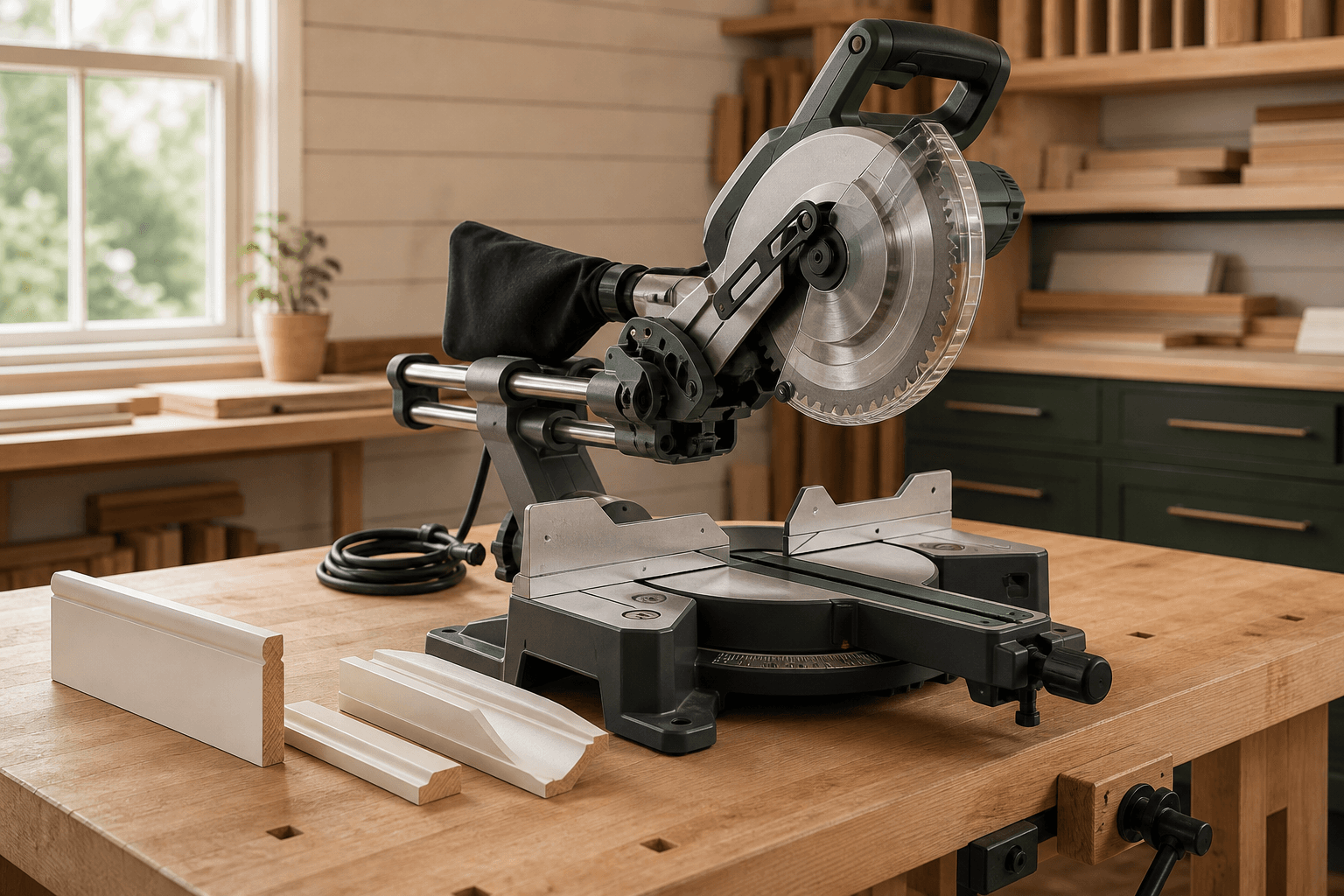
The quick answer
The best miter saw for most stationary trim work is a 10-inch dual-bevel slider whose published capacities cover the exact casing, baseboard and crown profiles on the cut list. The Makita LS1019L is our strongest workshop-fit example because it combines a wall-side rail layout, dual bevel, a 12-inch square crosscut and substantial vertical molding capacity. It is heavy, so it is not our mobile pick.
Choose the lighter Makita XSL05Z for narrow casing and punch-list work, the fixed DeWalt DWS713 for straightforward baseboard and casing within its limits, or the Bosch GCM12SD for a permanent high-capacity trim station. These are research-based recommendations from current manufacturer documentation, not claims of hands-on testing.
How this guide has been updated
- Article published with product references and related reading.
Share this page
Use this article with our best miter saw shortlist, then check the safe operating guide before planning the cut.
Relevant options
Four miter saws matched to real trim workflows
Research-based recommendations, not hands-on tests. Compare the exact model, package and manufacturer specifications before ordering.
Best overall for a trim workshop
Makita LS1019L
Best for: A wall-side station cutting casing, tall baseboard and crown with frequent left and right bevels.
- 10-inch dual-bevel sliding design
- Published 5-1/4-inch vertical base capacity
- Published 6-5/8-inch nested crown capacity
Review context: Makita documents a 10-inch dual-bevel slider with a forward rail layout, 2-13/16 by 12-inch square capacity, 5-1/4-inch vertical base and 6-5/8-inch nested crown capacity.
Consider: At a manufacturer-listed 57.9 pounds, it is workshop-compact rather than carry-light.
Official specificationsChecked August 26, 2026
Best compact cordless pick
Makita XSL05Z
Best for: Punch-list work, shoe molding and narrow casing across multiple rooms.
- 14.6 pounds with battery
- 6-1/2-inch dual-bevel design
- Tool only; battery and charger sold separately
Review context: Makita lists this 18V LXT 6-1/2-inch dual-bevel saw at 14.6 pounds with battery and publishes 1-13/16 by 3-5/8-inch maximum capacity at 90 degrees.
Consider: The compact capacity excludes many tall baseboards, wide boards and larger crown profiles.
Official specificationsChecked August 26, 2026
Best straightforward fixed option
DeWalt DWS713
Best for: Common casing and baseboard in a shop or powered jobsite where sliding width is unnecessary.
- 10-inch fixed compound design
- 14 positive miter stops
- Supports 4-1/4-inch baseboard vertically
Review context: DeWalt lists a 10-inch single-bevel compound design with 14 positive miter stops, 2x6 dimensional-lumber capacity at 90 degrees and support for 4-1/4-inch baseboard vertically.
Consider: The fixed head and primarily left bevel are less efficient for wide stock and repeated opposing bevels.
Official specificationsChecked August 26, 2026
Best high-capacity stationary pick
Bosch GCM12SD
Best for: A permanent trim station handling large crown, tall base and wide stock near a wall.
- Published 6-1/2-inch nested crown capacity
- Published 6-1/2-inch vertical base capacity
- 65-pound manufacturer-listed weight
Review context: Bosch publishes 6-1/2-inch vertical base and nested-crown capacities, a 3-1/2 by 13-1/2-inch square capacity and an Axial-Glide arm that avoids conventional rear rails.
Consider: The manufacturer-listed 65-pound weight and full-size 12-inch platform are excessive for routine room-to-room carrying.
Official specificationsChecked August 26, 2026
Why the shortlist changes with the trim
“Trim” covers small door casing, tall baseboard, chair rail, picture-frame molding and crown installed at a spring angle. A saw that handles 2-1/4-inch casing easily may not hold 6-inch base vertically or a large crown profile nested against the fence. Measure the real profile in its intended cutting orientation before comparing saws.
For example, a room of narrow casing rewards low carry weight and repeatable miters. A full house of tall baseboard rewards vertical fence capacity and dual bevel. Large crown can demand published nested-crown clearance or a documented flat-cut compound workflow. The award on each product card therefore names a scenario rather than declaring one machine universally best.
What size miter saw should you use for trim?
A 10-inch saw is the practical middle ground for many trim lists because blades are widely available and current fixed and sliding machines cover common casing and baseboard. A 6-1/2- or 7-1/4-inch cordless saw can be more convenient for small profiles, while a 12-inch machine provides added vertical and crosscut capacity for large molding.
Blade diameter is not a capacity table. The compact Makita XSL05Z publishes a maximum 90-degree capacity of 1-13/16 by 3-5/8 inches, while the 10-inch LS1019L publishes 2-13/16 by 12 inches at 90 degrees. Compare the height and width at the required miter and bevel, not just the number printed on the blade.
Best miter saw configuration for baseboards
For baseboard cut standing against the fence, vertical capacity matters. DeWalt documents support for baseboard up to 4-1/4 inches vertically on the DWS713, while Makita publishes 5-1/4-inch vertical baseboard capacity for the LS1019L. Taller profiles may need to be cut flat using verified bevel and miter settings or handled by another approved method.
A single-bevel saw can make baseboard joints, but the operator may need to reorient long stock for the opposite bevel. Dual bevel reduces that flipping when many left and right returns repeat. Our dedicated baseboard guide owns profile-specific product rankings and corner workflow; this page uses baseboard as one part of the broader trim decision.
Best configuration for crown molding
Crown can be cut nested against the fence or flat with compound settings when the exact saw manual supports the method. Bosch publishes 6-1/2-inch nested-crown capacity for the GCM12SD, and Makita publishes 6-5/8 inches for the LS1019L. Those figures are useful only when the actual molding, spring angle, fence setup and clamp clearance match.
For one small room of narrow crown, a lighter saw that fits the profile may save carrying effort. For repeated large crown in a shop, dual bevel and verified nested capacity can reduce stock flipping. Make trial joints from offcuts before cutting finished lengths; room corners are rarely perfect merely because the saw detent is precise.
What is a good small miter saw for trim work?
The Makita XSL05Z is the clearest compact example in the active shortlist: Makita lists it at 14.6 pounds with battery. Its 6-1/2-inch blade and limited width make it appropriate for small casing, shoe molding and punch-list pieces that fit the published table—not tall baseboard or wide shelving by assumption.
A portable trim setup still needs a stable surface and stock support. Carry the saw, battery, charger, stand, clamps, extraction and long molding as one system. A 30-pound saw on a heavy stand may be less convenient than a heavier stationary saw that remains set up in the shop.
Which miter saw is best for jobsite trim?
Choose by the route through the building and the cuts made at each setup. A compact cordless saw suits narrow profiles across several rooms when its battery and capacity cover the list. A corded fixed 10-inch saw can be the better mobile station when suitable power is available and broader common trim capacity matters more than eliminating the cable.
For a door-and-window casing job, stage a stop system for repeated legs only after the saw and supports are level. For a mixed package with 5-inch base, large crown and wide stool stock, one portable small saw may force too many secondary methods. That is when a planned 10- or 12-inch slider earns its transport burden.
Use a finish blade that matches the exact saw and material
Trim quality depends on a sharp, approved blade with the correct diameter, arbor, kerf, tooth geometry, application and maximum speed. A higher tooth count can support a cleaner crosscut in suitable wood trim, but it is not a universal guarantee and must not replace the saw and blade manufacturer instructions.
Support the molding so the face and reference edge remain registered. Use an offcut of the same primed wood, hardwood or composite profile to check surface quality and joint fit. If the cut burns, chips or wanders, stop and inspect blade condition, suitability, alignment, feed and stock stability rather than forcing the head faster.
Accuracy comes from the complete trim workflow
Factory detents speed common angles, but tight trim joints also depend on fence alignment, bevel calibration, blade condition, stable extensions, a repeat stop and consistent reference faces. Verify the first assembled corner instead of assuming two nominal 45-degree cuts will fit an out-of-square opening.
For ten equal casing legs, establish one reference end, make a test piece, then set a stop on the supported reference side. Keep the cutoff free so it cannot be trapped. For compound crown, label top, wall edge and room corner on each trial piece; this prevents orientation errors that a more expensive saw cannot correct.
Trim work still requires full miter-saw safety
Short returns and narrow profiles can bring hands dangerously close to the blade. Never hold a piece inside the no-hand zone, cut freehand or defeat the guard. Use a manufacturer-approved clamping or jig method that keeps the work registered and preserves full guard travel, or choose another safe tool and method.
OSHA emphasizes guarding, sharp blades, safe hand distance and eye and face protection. Unplug the cord or remove the battery before adjustments and blade changes. Support long molding level with the table, wait for the blade to stop completely before raising the head and keep loose offcuts out of the blade path.
At a glance
What this shortlist solves
- Four picks address genuinely different trim workflows
- Published molding capacities guide the ranking
- Compact and stationary options are both represented
- Every recommendation includes an explicit limitation
What no shortlist can remove
- No single saw fits every molding profile
- Large-capacity sliders are heavy
- Compact saws can exclude tall or wide trim
- Finish quality still depends on blade and setup
Frequently asked questions
What size miter saw should I use for cutting trim?
A 10-inch saw is a versatile starting point for many trim lists, but use the exact molding dimensions and published capacity at the required angles. Compact blades suit smaller profiles; 12-inch saws add capacity for large molding.
What miter saw is best for baseboards?
Choose a saw whose published vertical or flat-cut capacity covers the exact baseboard. Dual bevel is useful for repeated opposing bevels; a fixed single-bevel saw remains sufficient when the profile fits and stock can be safely reoriented.
What is a good small miter saw for trim work?
The Makita XSL05Z is a source-verified compact example for narrow casing and punch-list work. Its published capacity must be checked carefully because low weight and a small blade also limit the profiles it can cut.
Which miter saw is best for jobsite use?
The best jobsite saw is the lightest complete setup that safely covers the recurring trim. Include the stand, power system, extraction, clamps and stock supports when comparing portability.
Sources and verification
Specifications and material guidance were checked on the dates shown. Always confirm the current manual for your exact saw, blade and decking product.
- Makita LS1019L official specificationsChecked August 26, 2026
- Makita XSL05Z official specificationsChecked August 26, 2026
- DeWalt DWS713 official specificationsChecked August 26, 2026
- Bosch GCM12SD official specificationsChecked August 26, 2026
- OSHA miter-saw guarding and safety measuresChecked August 26, 2026