The Best Miter Saw for Picture Framing
Choose a framing saw by molding capacity, repeatable setup and working space. A marking light helps locate a cut; matching lengths and a dry-fitted four-corner frame establish whether the setup works.
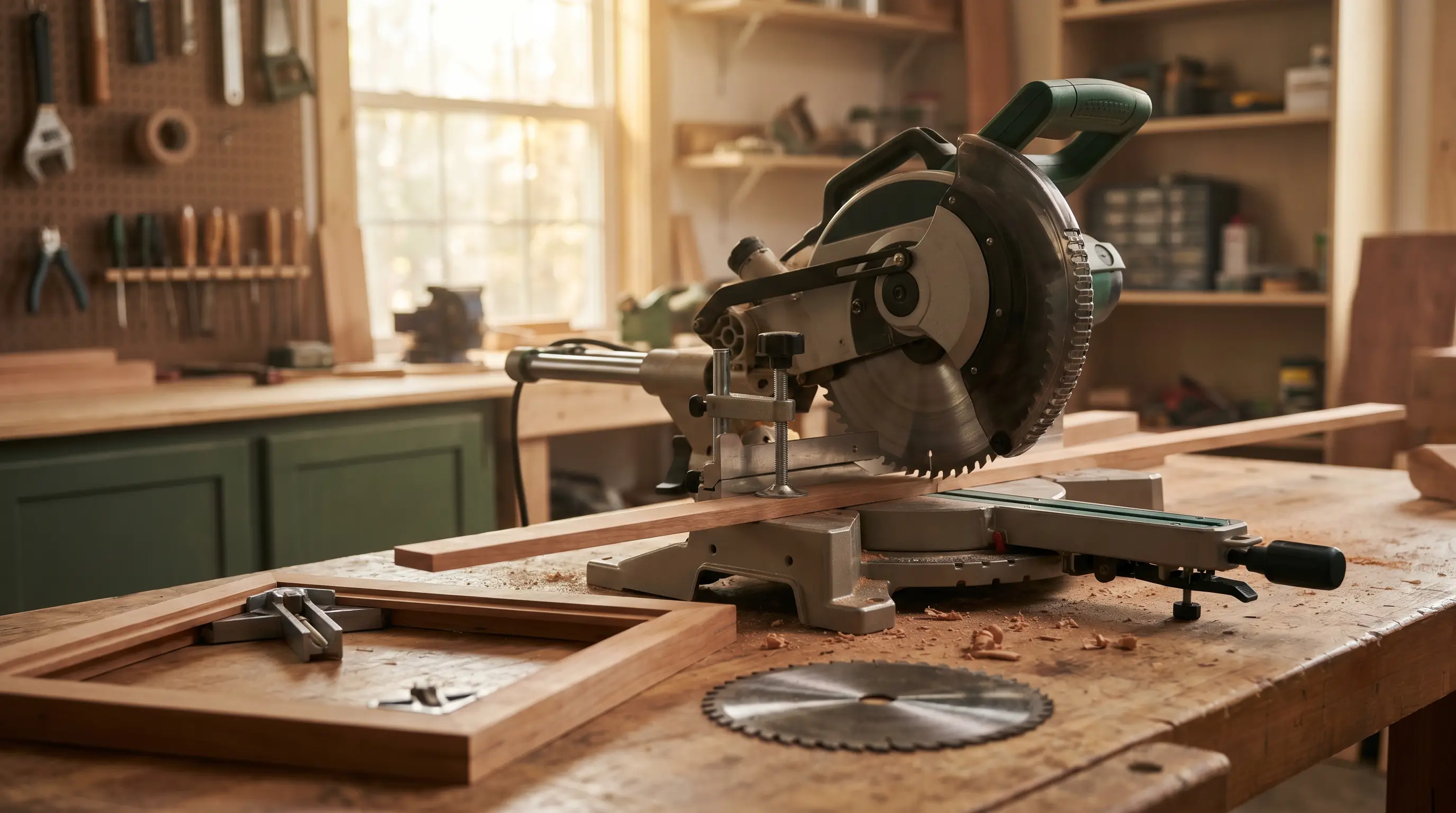
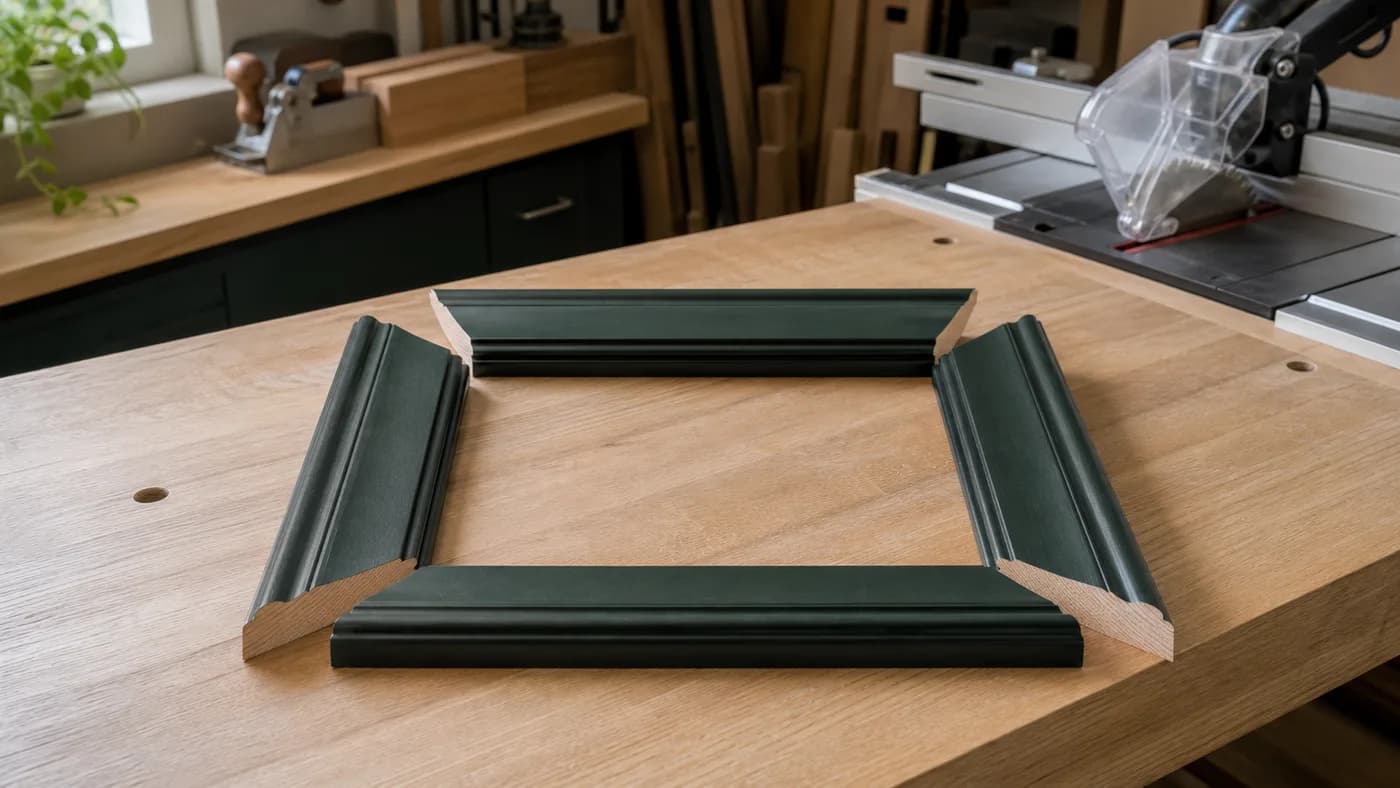
A rectangular frame has four corners and eight mitered ends. Diagnose repeated gaps through angle, reference face and matched opposite lengths. Blade deflection has not been measured in this comparison, so use a four-corner scrap frame to evaluate the complete setup.
Be honest with yourself about volume first. Serious framers often use a dedicated miter trimmer or a guillotine for the cleanest corners. But for most people, a quality miter saw fitted with an 80- to 90-tooth blade, a zero-clearance backer board, and a stop block cuts frames that go together tight. These five are the saws we'd reach for, ranked for fine frame work. Picks are research-based, not lab-tested.
Want the best all-round saw instead? See our best miter saw guide.
How this guide has been updated
- Inherited corrected manufacturer specifications from the shared saw comparison. This is not a new full-page audit.
- Removed unsupported price/rating comparisons, clarified selection criteria and added a project-fit checklist. Research-based; no new hands-on testing.
Share this page
What will keep all four corners consistent?
Use these checks to narrow the shortlist. They explain our selection logic; they are not measured performance scores.
| Your situation | Check before ordering | Avoid this assumption |
|---|---|---|
| Small occasional frames | Stable molding reference and suitable fine-cut blade | Avoid oversized machinery for stock that cannot be controlled safely. |
| Repeated frame sizes | A repeatable length reference and a scrap-joint check | Small errors accumulate around four corners. |
| Production framing | The whole workflow, including trimming and assembly | A general miter saw is not automatically a replacement for a dedicated trimmer. |
Write down the material, measured dimensions, required angles and available workspace. Check those requirements against each model’s linked documentation before ordering.
The 5 picks compared
| # | Model | Best for | Blade | Type |
|---|---|---|---|---|
| #1 | Bosch GCM12SD | Best Overall for Framing | 12 in. | Dual-bevel sliding (axial-glide) compound miter saw |
| #2 | DeWalt DWS780 | Best for a Shadow-Line Reference | 12 in (305 mm) | Double-bevel sliding compound miter saw |
| #3 | Makita LS1019L | Best Compact | 10 in | Dual-bevel sliding compound miter saw |
| #4 | DeWalt DWS779 | Best Value | 12 in | Double-bevel sliding compound miter saw |
| #5 | Metabo HPT C10FCG2 | Best Budget | 10 inch | Single-bevel compound miter saw |
Best for: Frame molding that needs the documented crosscut capacity at a station with limited rear depth. The glide layout is a space feature, not a measured blade-deflection or joint-accuracy result.
- 3-1/2 in. x 13-1/2 in.Crosscut capacity (0° miter, 0° bevel)
- 3-1/2 in. x 9-1/2 in.Crosscut capacity (45° miter, 0° bevel)
- 65 lbWeight
- Crosscut capacity (0° miter, 0° bevel)
- 3-1/2 in. x 13-1/2 in.
- Crosscut capacity (45° miter, 0° bevel)
- 3-1/2 in. x 9-1/2 in.
- Molding against the fence
- Base: 3-7/8 in. standard placement; up to 6-3/4 in. with manual p43 setup. Crown: webpage 5-1/4 or 6 in.; manual p51 says 6-1/2 in. Confirm profile/setup.
- Bevel range
- 47° left and 47° right; stops at 0°, 33.9°, 45° and 47°
- Miter range
- 52° left, 60° right; stops include 31.6° and 45°
- Motor
- 15 amps, 4,000 rpm no-load speed
- Weight
- 65 lb
- Cut-line aid
- None listed
Pros
- The Axial-Glide arm replaces rear slide rails. Bosch calls it a space-saving design (Bosch GCM12SD product page).
- Bosch lists 3-1/2 x 13-1/2 inches at 0° and 2 x 13-1/2 inches at a 45° left bevel. That covers wide baseboard laid flat for a bevel-cut corner (Bosch GCM12SD specifications).
- Its 31.6° miter and 33.9° bevel stops match the usual flat-cut settings for 52/38 crown on a square corner (Bosch GCM12SD specifications).
Cons
- Tall base requires a special setup: angled cuts on the left side, permitted orientation and a C-clamp clear of the head and guard. Crown figures differ between the webpage and manual; confirm your exact profile (Bosch manual pp43,51).
- At 65 lb with no cut-line light listed, it is a station saw. Plan on marking and test cuts (Bosch GCM12SD specifications).
DeWalt DWS780
12 in (305 mm) · Double-bevel sliding compound miter saw
Best for: Matching opposite sides exactly — the XPS shadow line drops a real shadow on your cut line, so each of the eight 45° cuts lands on the mark. With delicate moulding, that's the difference between a square frame and a gappy one.
- Crosscut capacity
- 2x14 dimensional lumber at 90°; 2x10 at 45°
- Molding against the tall sliding fences
- 6-3/4 in. base vertical; 7-1/2 in. crown nested
- Bevel range
- Dual bevel; degree range not stated on the current US page
- Miter range
- 60° right / 50° left
- Motor
- 15 amp, 3,800 rpm no-load speed
- Weight
- Not listed on DeWalt’s current US product page
- Cut-line aid
- Integrated XPS LED cut-line indicator, described by DeWalt as adjustment-free
Pros
- DeWalt describes XPS as adjustment-free cut-line indication. It shows where the blade will land on your mark. It does not square the fence or blade, so a scrap test still decides the setting (DeWalt DWS780 product page).
- It miters 60° right and 50° left (DeWalt DWS780 product page).
- It lists the same 2x14 crosscut, 6-3/4-inch vertical base and 7-1/2-inch nested crown capacity as the DWS779 (DeWalt DWS780 product page).
Cons
- Like the DWS779, it needs depth behind the bench for the rails, and the current US page lists no weight (DeWalt DWS780 product page).
- DeWalt says the dust system captures over 75% of dust. That is the maker’s claim under its own conditions; we have not measured it (DeWalt DWS780 product page).
Best for: A precise frame saw for a small shop — a 10-inch dual-bevel that takes a fine finish blade well and stays accurate, in a lighter footprint than the 12-inch saws.
- 0–60° left and rightMiter range
- 57.9 lbsWeight
- Crosscut capacity (90°)
- 2-13/16 × 12 in. OR 3-5/8 × 11 in. (0° miter/0° bevel; manual p2)
- Crosscut capacity (45° miter)
- 2-13/16 × 8-1/2 in. OR 3-5/8 × 7-3/4 in. (0° bevel; manual p2)
- Molding
- 5-1/4-in. base with horizontal vise; 6-5/8-in. 45°-type crown with crown stopper (manual p2)
- Bevel range
- 0–48° left and right (dual-bevel)
- Miter range
- 0–60° left and right
- Motor
- 15 amp direct-drive, 3,200 rpm
- Weight
- 57.9 lbs
- Standout feature
- 2-steel-rail sliding system that Makita says lets the saw sit flush against a wall; built-in laser
Pros
- Makita says its rail system shrinks the footprint so the saw can sit flush against a wall (Makita LS1019L press release).
- Makita’s manual lists 5-1/4-inch standing base with the horizontal vise and 6-5/8-inch 45°-type crown nested with the crown stopper (LS1019L US manual, p2).
- It bevels 0–48° and miters 0–60° both left and right (Makita LS1019L product page).
Cons
- At a listed 57.9 lb, compact describes the bench depth, not easy carrying (Makita LS1019L product page).
- The full table pairs 3-5/8-inch height with 11-inch width, not the 12-inch width shown for thinner stock. Do not combine maxima from different rows (Makita manual p2).
Best for: Buyers needing the DWS779 capacity who do not require XPS. Compare current packages; equal accuracy and a price advantage have not been established by our testing.
- Crosscut capacity
- 2x14 dimensional lumber at 90°; 2x10 at 45° miter
- Molding against the tall sliding fences
- 6-3/4 in. base vertical; 7-1/2 in. crown nested
- Bevel range
- 0°–48° left and right
- Miter stops
- 10 positive stops on a stainless-steel detent plate (range not stated on the current US page)
- Motor
- 15 amp, 3,800 rpm no-load speed
- Weight
- Not listed on DeWalt’s current US product page
- Cut-line aid
- No XPS light or laser listed for this model
Pros
- DeWalt lists 2x14 lumber at 90° and 2x10 at a 45° miter, which covers wide shelving and stair-tread stock in one pass (DeWalt DWS779 product page).
- The tall sliding fences support 6-3/4-inch base standing up and 7-1/2-inch crown nested, matching the DWS780 (DeWalt DWS779 product page). Bosch also permits 6-3/4-inch base under its manual’s special placement rules.
- It bevels 0°–48° both ways, so you change the tilt rather than flip a long board for the opposite bevel (DeWalt DWS779 product page).
Cons
- No XPS shadow line or laser is listed, so mark the line and make a test cut in scrap (DeWalt DWS779 product page).
- Its rear slide rails need clear depth behind the saw. The current US page lists no weight, so confirm it before you plan to carry the saw between rooms (DeWalt DWS779 product page).
Best for: Occasional framing on a budget — single-bevel is no drawback here, since frame corners are all flat 45° miters. Swap on a fine finish blade and add a backer board and it cuts clean frames for the money.
- 1-5/8 in. x 5-21/32 in.Crosscut capacity (45° left bevel)
- 0–52° left and rightMiter range
- 15 amp, 5,000 rpm no-loadMotor
- Crosscut capacity (90°)
- 2-5/16 in. x 5-21/32 in., or 3-1/2 in. x 3-31/32 in.
- Crosscut capacity (45° miter)
- Manual: 2-5/16 × 4 in. at 45° left miter/0° bevel. Webpage differs; confirm supplied manual.
- Crosscut capacity (45° left bevel)
- 1-5/8 in. x 5-21/32 in.
- Bevel range
- 0–45°, left only (single bevel)
- Miter range
- 0–52° left and right
- Motor
- 15 amp, 5,000 rpm no-load
- Weight
- 24 lbs
- Cut-line aid
- Xact Cut LED shadow line
Pros
- Metabo HPT lists 24 lb, the lowest documented weight of these five saws (Metabo HPT C10FCG2 product page).
- Its alternate 90° capacity of 3-1/2 x 3-31/32 inches covers a nominal 4x4 in one square cut on paper. Measure your posts, because real lumber varies (Metabo HPT C10FCG2 product page).
- The Xact Cut LED shadow line marks the cut line on the work (Metabo HPT C10FCG2 product page).
Cons
- Its widest square cut is 5-21/32 inches. A 2x8 (7-1/4 inches actual) or wider shelf board needs a saw with more capacity (Metabo HPT C10FCG2 product page).
- It bevels left only, and Metabo HPT lists no baseboard or crown capacity. Expect to flip trim for opposite bevels (Metabo HPT C10FCG2 product page).
What separates a good pick from the rest.
Angle precision
Everything for framing. Look for a saw whose 45° detent is dead-on and stays put, plus fine micro-adjust for when a corner needs a hair off 45°. Eight cuts per frame means any small error multiplies around the four corners.
Low blade deflection
Blade condition, mounting, support and feed can affect the cut face. A rail or glide design alone does not prove rigidity or finished accuracy; stop for visible wobble and check the documented setup.
Takes a fine finish blade
Choose an approved fine-crosscut blade for the exact saw and molding material. Tooth count depends on diameter and application; match arbor, rated speed, kerf and tooth geometry rather than prescribing one count for every model.
Backer board and stop block
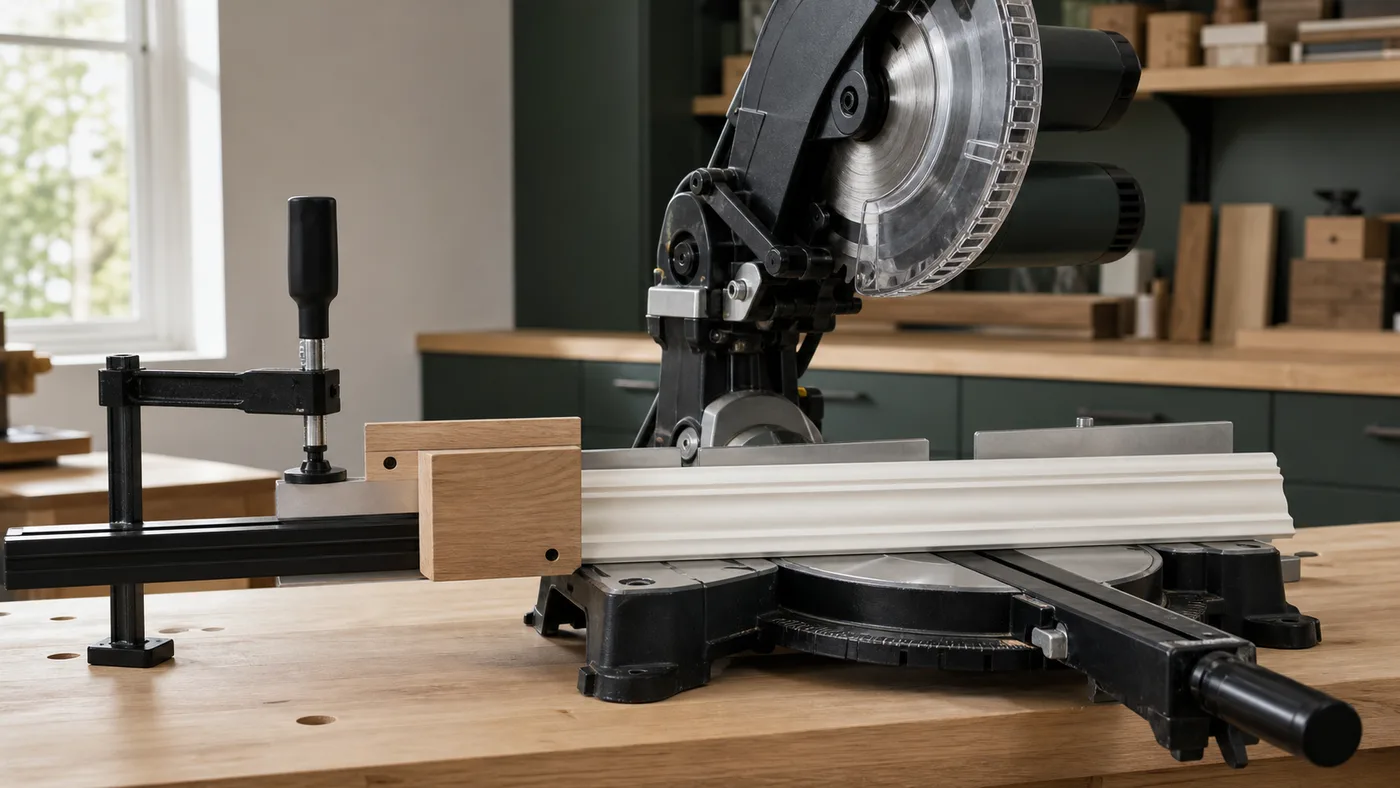
A permitted sacrificial backer can support the exit fibers. Check its fasteners, thickness and full guard and bevel clearance before creating a slot. A stop helps repeat length only while the reference remains clean and the offcut is not trapped.
Honest fit for the job
A miter saw is the practical choice for most framers, but not the most precise tool made. If you frame in volume or chase perfect museum-grade corners, a dedicated miter trimmer or guillotine beats any powered miter saw—worth knowing before you buy.
How to cut picture-frame corners on a miter saw
Swap on a fine finish blade
The single biggest upgrade. Replace the standard blade with an 80- to 90-tooth carbide finish blade; a negative-hook blade is best for hardwood or delicate moulding because it pushes the wood down rather than lifting and chipping it. This alone takes corners from rough to clean.
Add a zero-clearance backer board
Attach a sacrificial backer only as the saw manual permits. With power disconnected, check its support, fastening and full movement clearance. A fresh slot may reduce tear-out, but it does not guarantee a clean edge or make short stock safe to cut.
Use a stop block for matched lengths
Opposite frame sides must be exactly the same length or the corners gap. Clamp a stop block to the fence or an extension wing and cut both matching pieces against it—don't measure each one by hand. A 1 mm difference between opposite sides is enough to open a visible corner.
Cut, dry-fit, then glue
Make all eight 45° cuts, then dry-fit the four corners in a band clamp before any glue. If a corner gaps, a hair of micro-adjustment off 45° usually closes it. Only glue and pin once all four corners sit tight—frames are unforgiving once assembled.
Frequently asked questions
What kind of miter saw is best for cutting picture frames?
Start with a model whose documented capacity covers the molding. Use an approved fine-crosscut blade, align the saw and support the profile, then dry-fit a complete scrap frame. Neither blade size nor mechanism establishes a universal accuracy winner.
Can a miter saw really cut tight enough frame corners?
Yes, for most people—with the right setup. A quality miter saw, a fine finish blade, a zero-clearance backer board, and a stop block produce corners that close up tight. Purist framers point out that a dedicated miter trimmer or guillotine is more precise still, and for high-volume or museum-grade work that's true. For everyday framing, a well-set-up miter saw is more than good enough.
Is a miter saw or table saw better for picture frames?
For speed and repeatable 45° cuts on moulding, a miter saw is hard to beat—set the angle once and cut every piece. A table saw with a dedicated miter sled can be just as accurate and is more versatile for other work, but it's slower to set up for pure frame cutting. Most framers reach for a miter saw with a fine blade for frames.
What should you never cut with a miter saw?
Don't use a miter saw for rip cuts (cutting along the length of a board), full sheet goods, or any material it isn't rated for—metal on a wood blade, masonry, or tile. Don't cut pieces too small to clamp safely, and never free-hand tiny offcuts near the blade. For frames, that means cutting moulding to length, not trying to rip stock down.
What tooth count blade do I need for picture frames?
An 80- to 90-tooth carbide-tipped fine finish blade for a 10-inch saw. More teeth mean smaller bites and a smoother, tear-free cut on delicate moulding. A negative-hook grind is ideal because it shears the wood downward. The standard blade most saws ship with is too coarse for clean frame corners.