The Best Miter Saw for Crown Molding
Choose a crown-molding saw after measuring the profile and deciding whether it will be nested or cut flat. Those orientations require different capacity checks and angle settings.
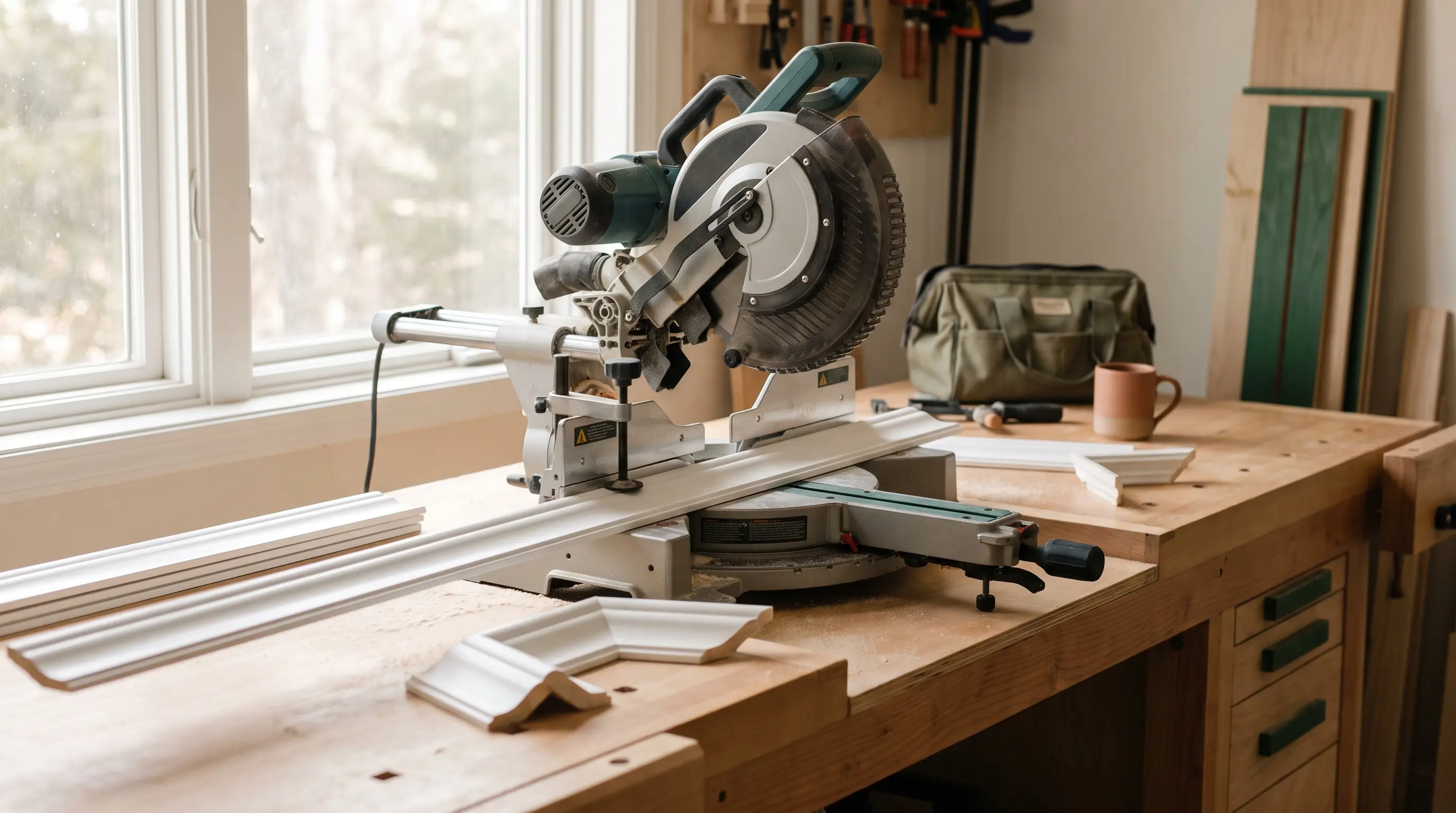
The best miter saw for crown molding is one whose listed capacity fits your profile in the way you will cut it. Nested means the crown stands upside down against the fence at its spring angle, and you cut a plain miter. Flat means it lies on its back, and you set a miter and a bevel together.
These are the five saws from our best miter saw guide, compared for that question. Their figures come from US manufacturer pages checked October 21, 2026. Listed nested capacity ranges from 5-1/4 to 7-1/2 inches, and one saw lists none. Picks are research-based, not lab-tested.
Just want the best all-round saw instead? See our best miter saw guide.
How this guide has been updated
- Added source-backed crown capacity and exclusion criteria, distinguishing nested and flat compound-cut setups.
- Removed unsupported price/rating comparisons, clarified selection criteria and added a project-fit checklist. Research-based; no new hands-on testing.
Share this page
Options are grouped by job and setup, not ranked by tested quality. Start with the capacity and fit checks below.
Will the actual crown profile fit in the chosen orientation?
The source column records manufacturer information. The fit and exclusion columns are our interpretation of those limits, not independent test results. Check the exact model, type and setup in its manual.
| Exact model | Documented limit and source | Fits this job | Rule it out when |
|---|---|---|---|
| DeWalt DWS779 | 7-1/2 in. crown nested against the tall sliding fences; bevel 0°–48° left and right. Spring angle for the figure not stated on the page. DeWalt DWS779 product page (US) | Tall crown cut nested, or flat with dual bevel, at a fixed bench. | Crown over 7-1/2 in. nested, and buyers who want a cut-line light built in. |
| DeWalt DWS780 | Same 7-1/2 in. crown nested against the tall sliding fences, plus the XPS cut-line light. DeWalt DWS780 product page (US) | Tall nested crown when you want a light-cast line on the mark. | Crown over 7-1/2 in. nested. If you would not use XPS, the DWS779 lists the same capacity. |
| Bosch GCM12SD | Webpage: 5-1/4 in. at 38° spring or 6 in. at 45°. Manual p51: 6-1/2 in. nested, with crown stops recommended. Figures differ; match the actual profile and version. Bosch GCM12SD manual — baseboard p43; crown p51 | Crown cut flat at compound angles, at a station near a wall without rear rails. | A borderline nested profile before Bosch confirms which documented capacity and setup apply. The webpage alone is not a universal 6-in. exclusion. |
| Makita LS1019L | 6-5/8-in. 45°-type crown with crown stopper (manual p2); 0–48° bevel left and right. Makita LS1019/LS1019L US manual — capacity table p2 | Crown up to 6-5/8 in. nested at a wall-side bench. | Crown over 6-5/8 in. nested, and carrying the saw ladder to ladder at a listed 57.9 lb. |
| Metabo HPT C10FCG2 | No dedicated crown figure. Manual: 1-5/8 × 4 in. at 45° left miter/45° left bevel; the product webpage instead lists 1-5/8 × 3-3/4 in. Confirm the applicable version with Metabo. Left-only bevel; 24 lb. Neither row establishes capacity at a 31.6°/33.9° crown setting. Metabo HPT C10FCG2 manual — sawing dimensions | Occasional small crown on a job where you carry the saw. | Any crown you need to nest before confirming capacity in the manual, and runs of flat cuts where repositioning for each opposite bevel slows you down. |
Write down the material, measured dimensions, required angles and available workspace. Check those requirements against each model’s linked documentation before ordering.
The 5 picks compared
| Option | Model | Best for | Blade | Type |
|---|---|---|---|---|
| Option 1 | DeWalt DWS779 | For Tall Crown Cut Nested | 12 in | Double-bevel sliding compound miter saw |
| Option 2 | DeWalt DWS780 | For Tall Crown Plus a Cut-Line Reference | 12 in (305 mm) | Double-bevel sliding compound miter saw |
| Option 3 | Bosch GCM12SD | For Cutting Crown Flat | 12 in. | Dual-bevel sliding (axial-glide) compound miter saw |
| Option 4 | Makita LS1019L | For Crown up to 6-5/8 in. on a 10-Inch Slider | 10 in | Dual-bevel sliding compound miter saw |
| Option 5 | Metabo HPT C10FCG2 | Light Saw for Occasional Small Crown | 10 inch | Single-bevel compound miter saw |
Best for: Crown up to 7-1/2 inches cut nested against DeWalt’s tall sliding fences, with dual bevel for flat compound cuts, when you do not need the DWS780’s XPS light.
- Crosscut capacity
- 2x14 dimensional lumber at 90°; 2x10 at 45° miter
- Molding against the tall sliding fences
- 6-3/4 in. base vertical; 7-1/2 in. crown nested
- Bevel range
- 0°–48° left and right
- Miter stops
- 10 positive stops on a stainless-steel detent plate (range not stated on the current US page)
- Motor
- 15 amp, 3,800 rpm no-load speed
- Weight
- Not listed on DeWalt’s current US product page
- Cut-line aid
- No XPS light or laser listed for this model
Pros
- DeWalt lists 2x14 lumber at 90° and 2x10 at a 45° miter, which covers wide shelving and stair-tread stock in one pass (DeWalt DWS779 product page).
- The tall sliding fences support 6-3/4-inch base standing up and 7-1/2-inch crown nested, matching the DWS780 (DeWalt DWS779 product page). Bosch also permits 6-3/4-inch base under its manual’s special placement rules.
- It bevels 0°–48° both ways, so you change the tilt rather than flip a long board for the opposite bevel (DeWalt DWS779 product page).
Cons
- No XPS shadow line or laser is listed, so mark the line and make a test cut in scrap (DeWalt DWS779 product page).
- Its rear slide rails need clear depth behind the saw. The current US page lists no weight, so confirm it before you plan to carry the saw between rooms (DeWalt DWS779 product page).
DeWalt DWS780
12 in (305 mm) · Double-bevel sliding compound miter saw
Best for: The same listed 7-1/2-inch nested crown capacity as the DWS779, plus XPS to show where the blade meets the molding. The light marks the cut; it does not set the angle.
- Crosscut capacity
- 2x14 dimensional lumber at 90°; 2x10 at 45°
- Molding against the tall sliding fences
- 6-3/4 in. base vertical; 7-1/2 in. crown nested
- Bevel range
- Dual bevel; degree range not stated on the current US page
- Miter range
- 60° right / 50° left
- Motor
- 15 amp, 3,800 rpm no-load speed
- Weight
- Not listed on DeWalt’s current US product page
- Cut-line aid
- Integrated XPS LED cut-line indicator, described by DeWalt as adjustment-free
Pros
- DeWalt describes XPS as adjustment-free cut-line indication. It shows where the blade will land on your mark. It does not square the fence or blade, so a scrap test still decides the setting (DeWalt DWS780 product page).
- It miters 60° right and 50° left (DeWalt DWS780 product page).
- It lists the same 2x14 crosscut, 6-3/4-inch vertical base and 7-1/2-inch nested crown capacity as the DWS779 (DeWalt DWS780 product page).
Cons
- Like the DWS779, it needs depth behind the bench for the rails, and the current US page lists no weight (DeWalt DWS780 product page).
- DeWalt says the dust system captures over 75% of dust. That is the maker’s claim under its own conditions; we have not measured it (DeWalt DWS780 product page).
Best for: Crown cut flat at the common 31.6° miter and 33.9° bevel, both listed Bosch stops. Bosch’s webpage gives 5-1/4 or 6 inches by spring angle; manual page 51 states 6-1/2 inches. Confirm your profile and setup before relying on either limit.
- 3-1/2 in. x 13-1/2 in.Crosscut capacity (0° miter, 0° bevel)
- 3-1/2 in. x 9-1/2 in.Crosscut capacity (45° miter, 0° bevel)
- 65 lbWeight
- Crosscut capacity (0° miter, 0° bevel)
- 3-1/2 in. x 13-1/2 in.
- Crosscut capacity (45° miter, 0° bevel)
- 3-1/2 in. x 9-1/2 in.
- Molding against the fence
- Base: 3-7/8 in. standard placement; up to 6-3/4 in. with manual p43 setup. Crown: webpage 5-1/4 or 6 in.; manual p51 says 6-1/2 in. Confirm profile/setup.
- Bevel range
- 47° left and 47° right; stops at 0°, 33.9°, 45° and 47°
- Miter range
- 52° left, 60° right; stops include 31.6° and 45°
- Motor
- 15 amps, 4,000 rpm no-load speed
- Weight
- 65 lb
- Cut-line aid
- None listed
Pros
- The Axial-Glide arm replaces rear slide rails. Bosch calls it a space-saving design (Bosch GCM12SD product page).
- Bosch lists 3-1/2 x 13-1/2 inches at 0° and 2 x 13-1/2 inches at a 45° left bevel. That covers wide baseboard laid flat for a bevel-cut corner (Bosch GCM12SD specifications).
- Its 31.6° miter and 33.9° bevel stops match the usual flat-cut settings for 52/38 crown on a square corner (Bosch GCM12SD specifications).
Cons
- Tall base requires a special setup: angled cuts on the left side, permitted orientation and a C-clamp clear of the head and guard. Crown figures differ between the webpage and manual; confirm your exact profile (Bosch manual pp43,51).
- At 65 lb with no cut-line light listed, it is a station saw. Plan on marking and test cuts (Bosch GCM12SD specifications).
Makita LS1019L
10 in · Dual-bevel sliding compound miter saw
Best for: Crown up to 6-5/8 inches nested, on a bench pushed against a wall. Makita’s US manual specifies 45°-type crown with its crown stopper for that figure.
- 0–60° left and rightMiter range
- 57.9 lbsWeight
- Crosscut capacity (90°)
- 2-13/16 × 12 in. OR 3-5/8 × 11 in. (0° miter/0° bevel; manual p2)
- Crosscut capacity (45° miter)
- 2-13/16 × 8-1/2 in. OR 3-5/8 × 7-3/4 in. (0° bevel; manual p2)
- Molding
- 5-1/4-in. base with horizontal vise; 6-5/8-in. 45°-type crown with crown stopper (manual p2)
- Bevel range
- 0–48° left and right (dual-bevel)
- Miter range
- 0–60° left and right
- Motor
- 15 amp direct-drive, 3,200 rpm
- Weight
- 57.9 lbs
- Standout feature
- 2-steel-rail sliding system that Makita says lets the saw sit flush against a wall; built-in laser
Pros
- Makita says its rail system shrinks the footprint so the saw can sit flush against a wall (Makita LS1019L press release).
- Makita’s manual lists 5-1/4-inch standing base with the horizontal vise and 6-5/8-inch 45°-type crown nested with the crown stopper (LS1019L US manual, p2).
- It bevels 0–48° and miters 0–60° both left and right (Makita LS1019L product page).
Cons
- At a listed 57.9 lb, compact describes the bench depth, not easy carrying (Makita LS1019L product page).
- The full table pairs 3-5/8-inch height with 11-inch width, not the 12-inch width shown for thinner stock. Do not combine maxima from different rows (Makita manual p2).
Best for: Occasional small crown where carrying a 24-lb saw matters. Metabo HPT lists no crown capacity, and its left-only bevel means repositioning the molding for opposite flat cuts.
- 1-5/8 in. x 5-21/32 in.Crosscut capacity (45° left bevel)
- 0–52° left and rightMiter range
- 15 amp, 5,000 rpm no-loadMotor
- Crosscut capacity (90°)
- 2-5/16 in. x 5-21/32 in., or 3-1/2 in. x 3-31/32 in.
- Crosscut capacity (45° miter)
- Manual: 2-5/16 × 4 in. at 45° left miter/0° bevel. Webpage differs; confirm supplied manual.
- Crosscut capacity (45° left bevel)
- 1-5/8 in. x 5-21/32 in.
- Bevel range
- 0–45°, left only (single bevel)
- Miter range
- 0–52° left and right
- Motor
- 15 amp, 5,000 rpm no-load
- Weight
- 24 lbs
- Cut-line aid
- Xact Cut LED shadow line
Pros
- Metabo HPT lists 24 lb, the lowest documented weight of these five saws (Metabo HPT C10FCG2 product page).
- Its alternate 90° capacity of 3-1/2 x 3-31/32 inches covers a nominal 4x4 in one square cut on paper. Measure your posts, because real lumber varies (Metabo HPT C10FCG2 product page).
- The Xact Cut LED shadow line marks the cut line on the work (Metabo HPT C10FCG2 product page).
Cons
- Its widest square cut is 5-21/32 inches. A 2x8 (7-1/4 inches actual) or wider shelf board needs a saw with more capacity (Metabo HPT C10FCG2 product page).
- It bevels left only, and Metabo HPT lists no baseboard or crown capacity. Expect to flip trim for opposite bevels (Metabo HPT C10FCG2 product page).
What separates a good pick from the rest.
Nested-crown capacity
Cutting nested means standing the molding upside down against the fence at its spring angle, then making a plain miter with no bevel. Listed nested capacity on these picks runs from 5-1/4 to 7-1/2 inches. Bosch’s webpage and manual differ. Makita’s manual specifies 45°-type crown and its stopper; DeWalt’s product page does not give the spring angle.
Dual-bevel tilt
When you cut crown flat, a dual-bevel saw tilts both ways, so you change the tilt instead of moving the molding for the opposite corner. That saves handling. A single-bevel saw still works, but you reposition the piece for the opposite bevel. Nested cuts use no bevel at all.
Angle stops and test cuts
Crown joints show small angle errors. Stops at the common settings help you repeat them: Bosch lists a 31.6° miter stop and a 33.9° bevel stop. A cut-line light shows where the blade lands; it does not set the angle. Prove every setting on scrap first.
Sliding reach and flat-cutting
If your crown is too big to nest, you cut it flat using compound miter and bevel angles. The molding then needs crosscut width at those angles, so check the saw’s capacity at a compound setting.
Footprint and moving the saw
Rail sliders need depth behind the bench; Bosch’s arm and Makita’s rail layout are designed for wall-side stations. Listed weights run from 24 lb (Metabo HPT) to 57.9 lb (Makita) and 65 lb (Bosch). DeWalt’s current US pages list none.
How to cut crown molding on a miter saw
Nested vs flat
There are two ways to cut crown. Nested means standing it upside-down against the fence the way it hangs on the wall, then cutting a miter: 45° for a square corner, or the setting derived from the actual corner. The crown must fit in that orientation with the required stops. Flat means laying it flat on the table and using compound angles, which may fit larger crown within the compound-cut table and needs two settings at once.
The two crown angles: 31.6° and 33.9°
To cut common US crown (a 52°/38° spring angle) flat on a 90° corner, set the miter to 31.6° and the bevel to 33.9°. DeWalt gives 31.62° and 33.85° for that crown. If you nest the crown instead, you use a 45° miter and no bevel.
Why 31.6 degrees?
It isn't arbitrary — 31.6° is the miter angle the math works out to for cutting a 52°/38° crown flat on a 90° corner. Different spring angles or out-of-square corners change the numbers, so use a crown-angle chart and test the setting on scrap.
Inside vs outside corners
Most rooms are inside corners; outside corners (like around a column) are the mirror image. With a dual-bevel saw you cut both by changing the tilt and miter direction without flipping the molding. Always mark which end is up and label your cuts — it's the easiest place to go wrong.
Frequently asked questions
What kind of miter saw do I need for crown molding?
One whose listed capacity fits your crown in the way you will cut it. Nested, DeWalt lists 7-1/2 inches (DWS779, DWS780), Makita 6-5/8 inches (LS1019L) and Bosch’s webpage and manual give different nested figures. Confirm Bosch’s applicable profile/setup; Makita’s figure requires 45°-type crown and a stopper. Crown too tall to nest may fit flat at compound angles; check the width and thickness at both angles. Dual bevel can reduce repositioning.
What angle do you set a miter saw for crown molding?
It depends on how you cut it. Nested against the fence at a square corner, use a 45° miter with no bevel. Other corners need different miter settings. Flat, DeWalt gives a 31.62° miter and 33.85° bevel for 52°/38° crown on a 90° corner. Some saws, such as the Bosch GCM12SD, have stops near those angles. Always test on scrap first.
Why 31.6 degrees for crown molding?
31.6° is the miter angle the geometry works out to for cutting a standard 52°/38° spring-angle crown flat on a 90-degree corner (paired with a 33.9° bevel). It's not a magic number — change the crown's spring angle or the corner's angle and the setting changes too. That's why a crown-angle chart or built-in crown stops helps.
Can you cut crown molding with a 10-inch miter saw?
Yes, within its listed capacity. Makita’s manual lists 6-5/8 inches for 45°-type crown with the crown stopper on the 10-inch LS1019L. The 10-inch Metabo HPT C10FCG2 lists no crown figure. For taller crown, check whether it fits the compound-cut table laid flat, or choose a suitable larger-capacity saw.
Single or dual bevel for crown molding?
For flat cuts, dual bevel saves handling: you change the tilt instead of moving the molding for the opposite corner. It is not more accurate by itself. A single-bevel saw like the Metabo HPT C10FCG2 (0–45° left) still cuts crown, but you reposition the piece for the opposite bevel. Nested cuts need no bevel.
Do you cut crown molding upside down?
When you cut it nested, yes — you stand the crown upside-down and angled against the fence, in the same position it sits between the wall and ceiling but flipped. The saw table acts as the ceiling and the fence as the wall. Cutting flat is the alternative, where the molding lies flat and you dial in the compound miter and bevel angles instead.