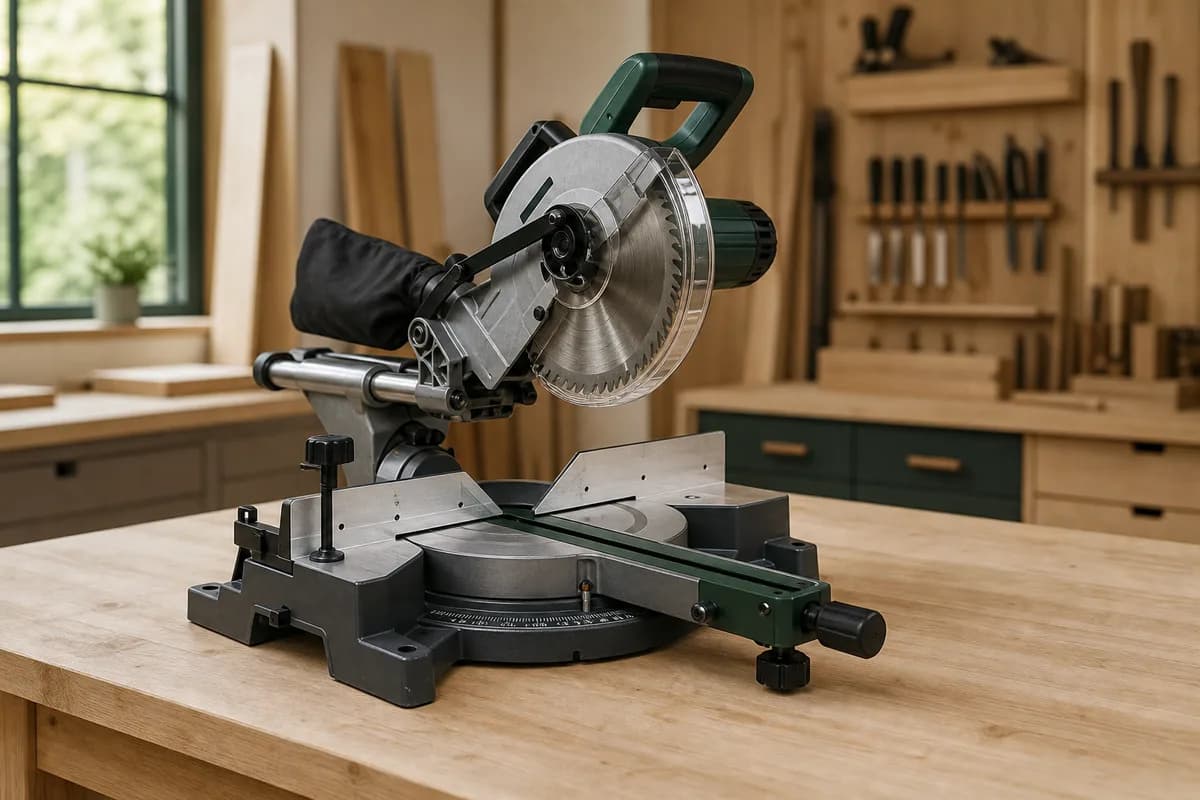
Strong fit
What it does well
- Baseboards and trim
- Repeatable crosscuts
- Miter, bevel, and compound angles
- Workshop or jobsite cut stations
A miter saw is a length-and-angle tool. It shortens a board across its width while the stock rests against the table and fence. Rotating the table changes the miter; tilting the head changes the bevel. Those adjustments solve different parts of a joint, so a dual-bevel label does not tell you how wide a board the saw can cut.
Separate the recurring job from the occasional oversized piece. A fixed-head model may cover short trim and ordinary narrow boards. A slider extends crosscut reach, but its moving head, stock supports and extraction hose also need room. Check the capacity at the intended angle rather than assuming the square-cut maximum applies everywhere.
| Your task | What to check | Where to compare |
|---|---|---|
| Shorten boards to repeated lengths | Crosscut capacity, supported stock and repeatable reference | Miter saw |
| Cut opposing bevels in long trim | Bevel range, fence clearance and actual profile orientation | Single versus dual bevel |
| Make a long board narrower | Ripping workflow and suitable work support | Table or guided circular saw |
Suppose your project has tall baseboard and wide shelf boards. Record the baseboard height when it stands against the fence and the shelf width when it lies flat. Then check both against the model’s documentation. A generous vertical-trim figure does not establish enough flat crosscut width, and a wide slider does not automatically clear tall nested molding.
Use this page to choose the machine category. Use the buying guide for model selection and the operating guide for the complete setup. A miter saw is not a substitute for a ripping machine, and a different blade does not authorize a material the saw manufacturer excludes.
For the safety context, see OSHA: miter saw operation and guarding and the exact machine manual.
Share this page
What is the widest and tallest stock you cut?
Do you need sliding capacity?
Will the saw stay in one workshop or travel?
Do your projects require single or dual bevel?