Saw comparisons
Miter Saw vs Radial Arm Saw: Which Fits a Modern Shop?
A practical comparison for deciding whether to retain a correctly guarded radial arm saw or move repeat crosscuts and compound angles to a modern miter saw.
The quick answer
Choose a miter saw for repeat crosscuts, miters, bevels and compound trim or construction cuts when you want simpler setup, current product support and a machine that can move between a bench and jobsite. Keep or choose a radial arm saw only when its larger crosscut envelope or specialized stationary workflow solves a real shop need and the exact machine is complete, correctly guarded, aligned and operated under its own manual.
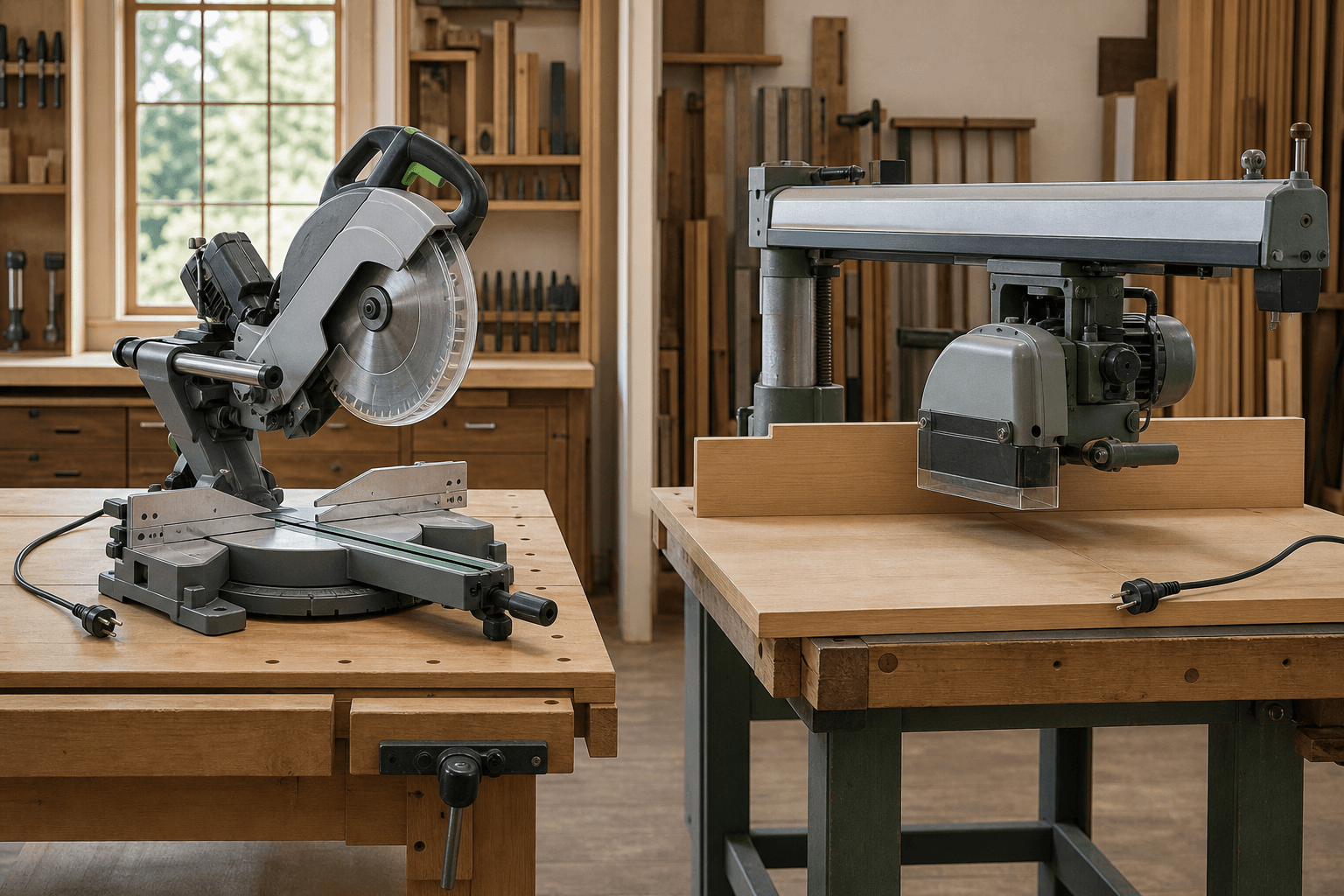
A sliding miter saw replaces much of the crosscut role that once made a radial arm saw attractive, but the mechanisms are not interchangeable. The miter saw pivots or slides a guarded head through stock registered on a table and fence. A radial arm saw moves a carriage-mounted motor and blade along an overhead arm; that different motion brings different guarding, feed, adjustment and kickback controls.
How this guide has been updated
- Article published with product references and related reading.
Share this page
Use this article with our best miter saw shortlist, then check the safe operating guide before planning the cut.
Relevant options
Three current miter-saw alternatives by replacement scenario
Research-based recommendations, not hands-on tests. Compare the exact model, package and manufacturer specifications before ordering.
Best simple crosscut replacement
DeWalt DWS713
Best for: Common trim, blocking and dimensional-lumber crosscuts in a shop or mobile renovation setup.
- 10-inch fixed compound design
- Published 2x6 capacity at 90°
- 14 positive miter stops
Review context: DeWalt documents a fixed 10-inch single-bevel compound saw with 2x6 capacity at 90 degrees, 2x4 at 45 degrees and 14 positive miter stops.
Consider: The fixed head and mainly left bevel cannot reproduce the width or multi-operation versatility associated with a radial arm saw.
Official specificationsChecked August 28, 2026
Best accessible wide-cut replacement
SKIL MS6305-00
Best for: A home workshop that needs wide board crosscuts and dual bevel without moving to a 12-inch blade.
- 10-inch dual-bevel sliding design
- Published 2x12 capacity at 90°
- Published 2x8 capacity at 45°
Review context: SKIL publishes 2x12 capacity at 90 degrees and 2x8 at 45 degrees for this 10-inch dual-bevel slider, plus a 50-degree miter range in both directions.
Consider: Conventional sliding rails need rear clearance, and the machine remains a crosscut saw rather than a replacement for radial-arm ripping or dado operations.
Official specificationsChecked August 28, 2026
Best high-capacity stationary replacement
Bosch GCM12SD
Best for: A permanent station needing broad 12-inch capacity without conventional rails projecting behind the saw.
- 12-inch dual-bevel Axial-Glide design
- Published 3-1/2 x 13-1/2-inch square capacity
- 65-pound manufacturer-listed weight
Review context: Bosch documents a 3-1/2 by 13-1/2-inch square capacity, dual bevel and an Axial-Glide articulated arm. It is the closest of these examples to a planned high-capacity crosscut station.
Consider: At a listed 65 pounds it is not a casual carry saw, and it still cannot perform radial-arm operations outside a miter saw’s approved use.
Official specificationsChecked August 28, 2026
What is the core mechanical difference?
A miter saw brings the blade down through the work from a pivot. A sliding model adds controlled forward-and-back travel for wider boards. The table rotates for miters and a compound model tilts for bevels. Its practical role is crosscutting stock placed across the fence; it is not a rip saw.
A radial arm saw suspends the motor and blade from a carriage that travels along a horizontal arm. The arm and head can be configured for multiple operations on machines whose manuals allow them. That versatility also means more adjustments and safety devices must be correct. Never transfer a miter-saw feed sequence, guard assumption or blade selection to a radial arm saw.
Which cuts does each machine handle best?
For batches of 2x4 blocking, casing, baseboard and picture-frame molding, a modern miter saw provides direct detents and a familiar crosscut station. A fixed 10-inch model may cover common narrow stock; a 10- or 12-inch slider extends reach for shelving, stair parts and wider framing material.
A correctly configured radial arm saw can provide substantial stationary crosscut reach and, where its exact manufacturer documentation permits, other operations. Do not treat that theoretical versatility as permission to improvise ripping, dadoing or molding work. Every operation needs the specified blade, guards, anti-kickback devices, fence, table and feed direction.
Compare measured capacity instead of machine reputation
Older radial arm saws are often praised for wide crosscuts, but capacity varies by arm length, blade, carriage travel, table and guard setup. Condition and missing parts can reduce usable capacity further. Measure nothing with the machine energized; identify the exact model and obtain its current or archived manufacturer documentation.
Current miter-saw capacity is easier to compare from product tables. SKIL publishes 2x12 capacity at 90 degrees and 2x8 at 45 degrees for the 10-inch MS6305-00 slider. Bosch publishes a 3-1/2 by 13-1/2-inch square capacity for the 12-inch GCM12SD. Buy the smallest documented envelope that clears recurring stock at the required angles.
Which saw is more accurate?
Neither machine type guarantees accuracy. Repeatability depends on the rigidity and condition of the arm or head, bearings, locks, table, fence, detents, blade, stock support and setup. A worn radial carriage or damaged table can drift; a misaligned new miter saw can also produce poor joints.
For finish work, disconnect power, inspect and align the machine according to its manual, then prove square, miter and bevel settings in representative scrap. Use a stop only on the safely supported reference side and keep the cutoff free. If results change through a batch, stop and diagnose the machine rather than steering the stock by hand.
Footprint and portability favor different shops
A radial arm saw is a permanent station: the column, arm, carriage, table, fence, stock support and operator area require dedicated space. Moving an unknown older machine can disturb alignment or expose missing mounting and guarding problems. Plan it as fixed machinery unless the manufacturer says otherwise.
A fixed miter saw can be relatively light and shallow; DeWalt documents 2x6 square capacity for the fixed 10-inch DWS713. A slider adds operating depth, although the Bosch Axial-Glide arm avoids conventional rear rails. Portability still includes the stand, supports, extraction, cord or batteries—not just tool weight.
The cutting motion changes the safety system
OSHA’s radial-saw guidance describes upper and lower guarding, anti-kickback devices for ripping and controls that return the cutting head to its starting position. Those requirements reflect a carriage that travels on an arm. If an inherited saw lacks a guard, return system, table, fence or identification, do not energize it while searching for an improvised replacement.
OSHA’s miter-saw guidance emphasizes guard coverage, sharp blades, safe hand distance and eye and face protection. Keep stock against the table and fence, clamp where directed and wait for complete blade stop before raising the head. Never perform freehand or rip cuts on a miter saw.
Why are radial arm saws less common—and are they obsolete?
Sliding compound miter saws, table saws and track saws divide many tasks among purpose-focused machines with current retail support and more familiar workflows. That helps explain why radial arm saws are less common in home shops; it does not prove every existing machine is useless or unsafe by definition.
Radial arm saws are not completely obsolete. Original Saw Company currently lists industrial radial-arm models, showing that supported new machines still serve production crosscut applications. The important distinction is between a current documented industrial system and an unidentified used saw with unknown wear, modifications or missing guards.
Choose from three real workshop scenarios
For a remodeler carrying a saw between rooms and cutting common trim or framing stock, a miter saw is the direct fit. For a home shop needing up to 2x12 square capacity without a large 12-inch blade, a verified 10-inch slider is a practical modern replacement. For a permanent station needing broad capacity but limited rear rail clearance, a 12-inch articulated-glide miter saw can cover many legacy crosscut duties.
Retain a radial arm saw when it is a known, supported machine, its documented capacity is genuinely useful, every required guard and control is present, and a competent operator follows the exact procedure. If those conditions cannot be established, keep it disconnected and obtain qualified inspection or choose a current supported tool.
A five-question decision check
List the widest and tallest recurring crosscut, every miter or bevel, whether the machine must move, the available station envelope and which current manuals and parts exist. Then compare the complete systems rather than assuming the older machine has unlimited capacity or the newer machine is automatically safer.
The best decision may involve more than one tool: a miter saw for repeated board crosscuts, a track saw for sheet goods and a table saw for controlled ripping. Do not force a single machine to perform an operation its manufacturer does not approve merely to save floor space.
- Can the exact machine make every recurring cut within its published capacity?
- Are all guards, locks, fences, returns and controls present and functional?
- Does the shop safely support the stock and full machine motion?
- Is current service, parts and manual information available?
- Would a purpose-built second tool handle any remaining operation more safely?
At a glance
Where each machine still fits
- Miter saws offer current support and portable options
- Sliding models cover many wide crosscut duties
- Radial arm saws can retain value in documented stationary workflows
- The decision is based on real capacity and guarding
Limits that must stay explicit
- Legacy radial saw condition varies widely
- A miter saw cannot rip stock
- Wide miter-saw sliders need substantial space
- No mechanism guarantees alignment or accuracy
Frequently asked questions
Why do people not use radial arm saws as often anymore?
Sliding miter saws, table saws and track saws now divide many crosscut, rip and sheet-goods tasks among purpose-focused machines with current support. Radial arm saws remain in some documented stationary and industrial workflows.
What are the disadvantages of a radial arm saw?
It requires dedicated space, operation-specific setup and guarding, and careful alignment of the arm, carriage, table and fence. Used machines may have unknown wear, modifications, missing guards or limited parts support.
Does anyone still make a radial arm saw?
Yes. Industrial manufacturers such as Original Saw Company currently list radial arm saws. That does not make an unidentified legacy machine equivalent to a new supported industrial system.
Why would I want a radial arm saw?
A documented, correctly guarded radial arm saw can provide substantial stationary crosscut reach and specialized production capability. Choose it only when those abilities solve a recurring need that simpler supported machines do not.
Sources and verification
Specifications and material guidance were checked on the dates shown. Always confirm the current manual for your exact saw, blade and decking product.
- OSHA radial-arm saw guarding and controlsChecked August 28, 2026
- OSHA miter-saw guarding and safety measuresChecked August 28, 2026
- Original Saw Company radial arm saw rangeChecked August 28, 2026
- DeWalt DWS713 official specificationsChecked August 28, 2026
- SKIL MS6305-00 official specificationsChecked August 28, 2026
- Bosch GCM12SD official specificationsChecked August 28, 2026