Material and capacity
Miter Saw for 4x4 Posts: Capacity, Angles and Safer Cuts
A model-specific guide to cutting nominal 4x4 posts without assuming every 10- or 12-inch miter saw has the same capacity.
The quick answer
A miter saw can crosscut a standard surfaced 4x4 in one pass only when the exact model publishes enough capacity for the post at the chosen miter and bevel. A North American nominal 4x4 is commonly 3.5 by 3.5 inches after drying and planing, but rough, wet, wrapped or laminated posts can be larger. Measure the actual piece before relying on a label.
Several 12-inch models explicitly document 4x dimensional-lumber capacity at 90 degrees. That does not mean every 12-inch saw—or a 10-inch saw with a similar-looking guard—will clear the post. Compare the manual’s maximum cut height and width, make a full unplugged clearance check, and use another documented method when the post falls outside the approved envelope.
How this guide has been updated
- Article published with product references and related reading.
Share this page
Use this article with our best miter saw shortlist, then check the safe operating guide before planning the cut.
Relevant options
Three verified saws with relevant 4x4 capacity
Research-based recommendations, not hands-on tests. Compare the exact model, package and manufacturer specifications before ordering.
Best explicit angle-capacity documentation
Bosch GCM12SD
Best for: A fixed workshop cutting 4x4 posts at square and verified miter angles while minimizing rear rail travel.
- 3-1/2 x 13-1/2-inch capacity at 0° miter/bevel
- 3-1/2 x 9-1/2-inch capacity at 45° miter/0° bevel
- 12-inch dual-bevel Axial-Glide design
Review context: Bosch explicitly publishes 4x14 dimensional-lumber capacity at 90 degrees and 4x10 at a 45-degree miter, both at zero bevel. The Axial-Glide arm also avoids conventional rear-sliding rails.
Consider: At a manufacturer-listed 65 pounds, it is a stationary choice, and its 45-degree bevel height is not sufficient for a full 4x4.
Official specificationsChecked August 16, 2026
Best wide 4x4 crosscut range
Makita LS1219L
Best for: Post, railing and wide-board work where 4x4 capacity is part of a broader high-capacity cut list.
- Published 4x14 crosscut at 90 degrees
- 3-5/8 x 15-inch maximum 90-degree capacity
- 12-inch dual-bevel sliding design
Review context: Makita explicitly states that the LS1219L crosscuts 4x14 dimensional lumber at 90 degrees and publishes a 3-5/8 by 15-inch maximum 90-degree capacity.
Consider: Its roughly 65-pound weight, 12-inch blades and premium high-capacity format are excessive for someone who only makes occasional square post cuts.
Official specificationsChecked August 16, 2026
Best simpler fixed 12-inch option
DeWalt DWS715
Best for: Square crosscuts in measured surfaced posts where sliding width and dual bevel are not recurring needs.
- 3-5/8-inch maximum height at 0° miter
- 6-1/4-inch resulting width at that height
- 12-inch fixed single-bevel design
Review context: The official manual lists a 3-5/8-inch maximum height at zero miter and 6-1/4-inch resulting width, dimensions that cover a standard measured 3.5-inch surfaced post at a square setting.
Consider: The small height margin demands measurement, and the fixed single-bevel design does not provide the wide or compound-angle flexibility of the two sliders.
Official specificationsChecked August 16, 2026
Measure the post: nominal 4x4 is not the cutting dimension
The American Wood Council lists planed, kiln-dried nominal 4x4 softwood at 3.5 by 3.5 inches (89 by 89 mm). That standardized example explains why a saw with slightly more than 3.5 inches of vertical capacity may handle ordinary surfaced stock. It is not permission to assume every post matches the table.
A pressure-treated post can be wet, swollen, bowed or twisted. A rough-sawn cedar post may be closer to its nominal size. Measure both axes at the planned cut, then check whether the post can sit flat on the table and fully against the fence without being forced. Reject or change the method for stock that cannot register securely.
What size miter saw will cut through a 4x4?
A verified 12-inch miter saw is the most dependable one-pass category for this job, but model geometry—not diameter alone—decides the result. Bosch publishes 3.5 by 13.5 inches at 0-degree miter and bevel for the GCM12SD and labels it 4x14 dimensional-lumber capacity. Makita says the LS1219L crosscuts a 4x14 at 90 degrees.
Some fixed 12-inch saws can also clear a surfaced 4x4. The DeWalt DWS715 manual gives a maximum 0-degree cut height of 3-5/8 inches and resulting width of 6-1/4 inches. That provides little height margin beyond a standard 3.5-inch post, so measuring the actual workpiece and checking the current manual are essential. Do not infer the same result for another fixed saw.
A 90-degree cut does not prove 45-degree capacity
Changing miter or bevel changes the blade path and available height and width. Bosch publishes 3.5 by 9.5 inches at a 45-degree miter with zero bevel for the GCM12SD, while its 45-degree bevel capacities drop to 2 inches or less in height. The post therefore fits one angle configuration but not every compound setting.
For a square fence-post cutoff, keep miter and bevel at zero and verify both scales before the cut. For a 45-degree miter used in a decorative frame, check the separate 45-degree capacity row. A 45-degree bevel through a 4x4 is a different and often unsupported task; never substitute a headline 90-degree capacity.
Should you flip a 4x4 to finish the cut?
Do not treat flipping as a universal workaround. Two partial cuts can leave a step where kerfs fail to meet, and rotating a heavy post can disturb its reference face. More importantly, an improvised second pass may be outside the manufacturer’s documented procedure.
If the exact manual explicitly explains a multi-pass method, follow its workholding, orientation and capacity limits. Otherwise choose a saw or cutting method that completes the section within its approved capacity. For a one-off installed post, a supported circular saw used from documented reference faces, followed by an appropriate hand-saw finish when necessary, may be more controllable than forcing an undersized miter saw.
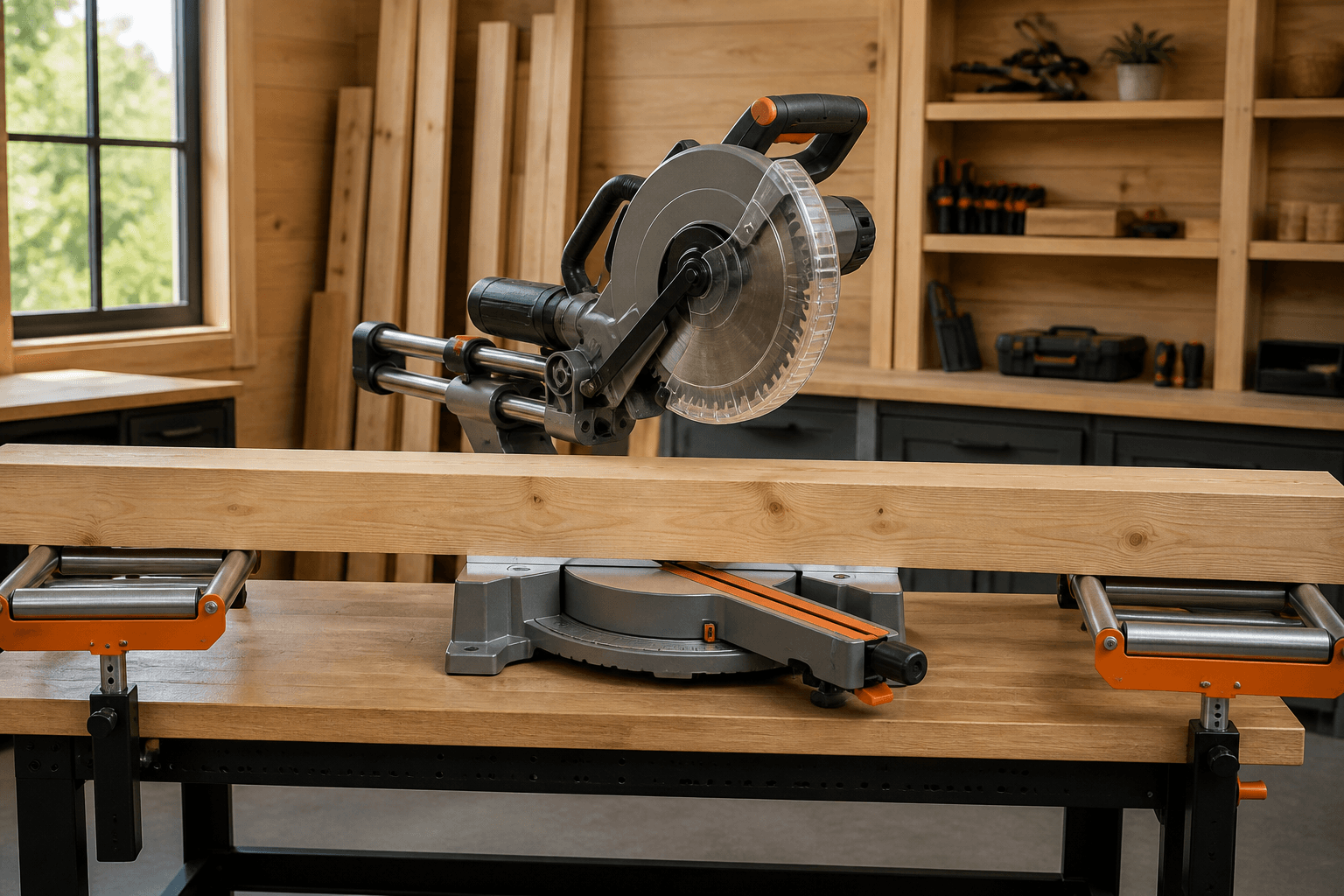
Support an eight-foot post before checking capacity
A post can fit under the blade and still be unsafe when its long end pulls the work away from the fence. Set rigid supports coplanar with the saw table on both working spans. Confirm the post remains stable without a person holding up the far end, and keep the intended offcut free rather than trapped against a stop.
For an eight-foot treated post, place supports close enough to prevent seesawing, then rehearse the entire blade and guard path with power disconnected. Use the model’s clamp where required and keep hands outside its marked no-hand zone. OSHA identifies guarding, safe hand distance, sharp blades, and eye and face protection as core miter-saw controls.
A practical one-pass 4x4 workflow
First measure the post at the cut and compare it with the exact capacity row for the planned miter and bevel. Inspect for fasteners, splits, severe checks, twist and contamination. With the saw unplugged, verify blade condition, guard movement, fence alignment, clamp clearance and stable support.
Mark all four faces from one squared reference, but make the cut from the orientation approved by the manual. Reconnect power, allow the blade to reach speed and feed the head steadily without forcing it. Release the trigger while the head remains down, wait for complete blade stop, then raise it and inspect the cut. Never reach beneath a moving or coasting blade to clear an offcut.
Match the method to the real post job
For four new 4x4 fence posts cut to equal length before installation, a verified 12-inch saw on a stable station can provide repeatability. Prove the first post against the layout, then use a stop arrangement that does not trap the cutoff. Recheck because wet posts can leave debris against the fence and alter registration.
For trimming an already installed fence post, carrying the post to a miter saw is impossible; a guided portable-saw method is the relevant decision. For a 6x6 pergola post, start over with the actual 5.5-inch section and an appropriate documented method. A saw that handles a 4x4 is not automatically suitable for a 6x6.
When should you not cut a 4x4 on a miter saw?
Do not proceed when the post exceeds the published capacity, cannot sit against both table and fence, contains unknown metal, or requires hands inside the manual’s no-hand zone. Never remove or tie back the guard, fit an unapproved blade, freehand the post, or pull warped stock into position near the blade.
Also stop when the needed compound angle is not listed, the saw or stand moves under the post’s weight, or the offcut will be pinched. Capacity is only one permission check: the material, blade, support, guard, clamp and cutting motion must all match the manufacturer’s instructions.
At a glance
Where a miter saw fits 4x4 work
- Verified 12-inch models can cut surfaced 4x4s in one pass
- Stable stations make repeat post lengths practical
- Published angle tables remove guesswork
- A larger saw can cover wider recurring stock too
Limits to verify before cutting
- Not every 12-inch model has identical capacity
- Wet or rough posts may exceed standard dimensions
- Bevel settings sharply reduce vertical capacity
- Large saws and long posts require substantial support space
Frequently asked questions
What size miter saw will cut through a 4x4?
A 12-inch miter saw with at least 3.5 inches of published 0-degree cutting height is the common one-pass choice for a standard surfaced 4x4. Verify the exact model and measure the actual post; blade diameter alone is not enough.
Can I cut a 4x4 with a miter saw?
Yes, if the measured post fits the exact saw’s published capacity at the selected miter and bevel, can register flat against table and fence, and can be fully supported and clamped as the manual directs.
What size saw do I need to cut a 4x4?
Choose by the model-specific capacity table. Verified 12-inch saws commonly cover a surfaced 3.5-by-3.5-inch post at 90 degrees, while some 10-inch saws and compound-angle settings do not.
What is the best tool for cutting 4x4 posts?
For repeat pre-installation crosscuts, a verified-capacity miter saw offers useful registration and repeatability. For an installed post or remote work, an appropriate guided portable-saw method may be more practical. The safest choice is the one whose documented capacity and workholding fit the actual job.
Sources and verification
Specifications and material guidance were checked on the dates shown. Always confirm the current manual for your exact saw, blade and decking product.
- American Wood Council North American softwood lumber dimensionsChecked August 16, 2026
- OSHA miter-saw guarding and safety measuresChecked August 16, 2026
- Bosch GCM12SD official specificationsChecked August 16, 2026
- Makita LS1219L official specificationsChecked August 16, 2026
- DeWalt DWS715 official instruction manualChecked August 16, 2026