Material and capacity
Miter Saw for 2x4 Lumber: Capacity, Angles and Safe Support
A capacity-first guide to square and angled 2x4 crosscuts without confusing blade size, sliding reach or rip cuts.
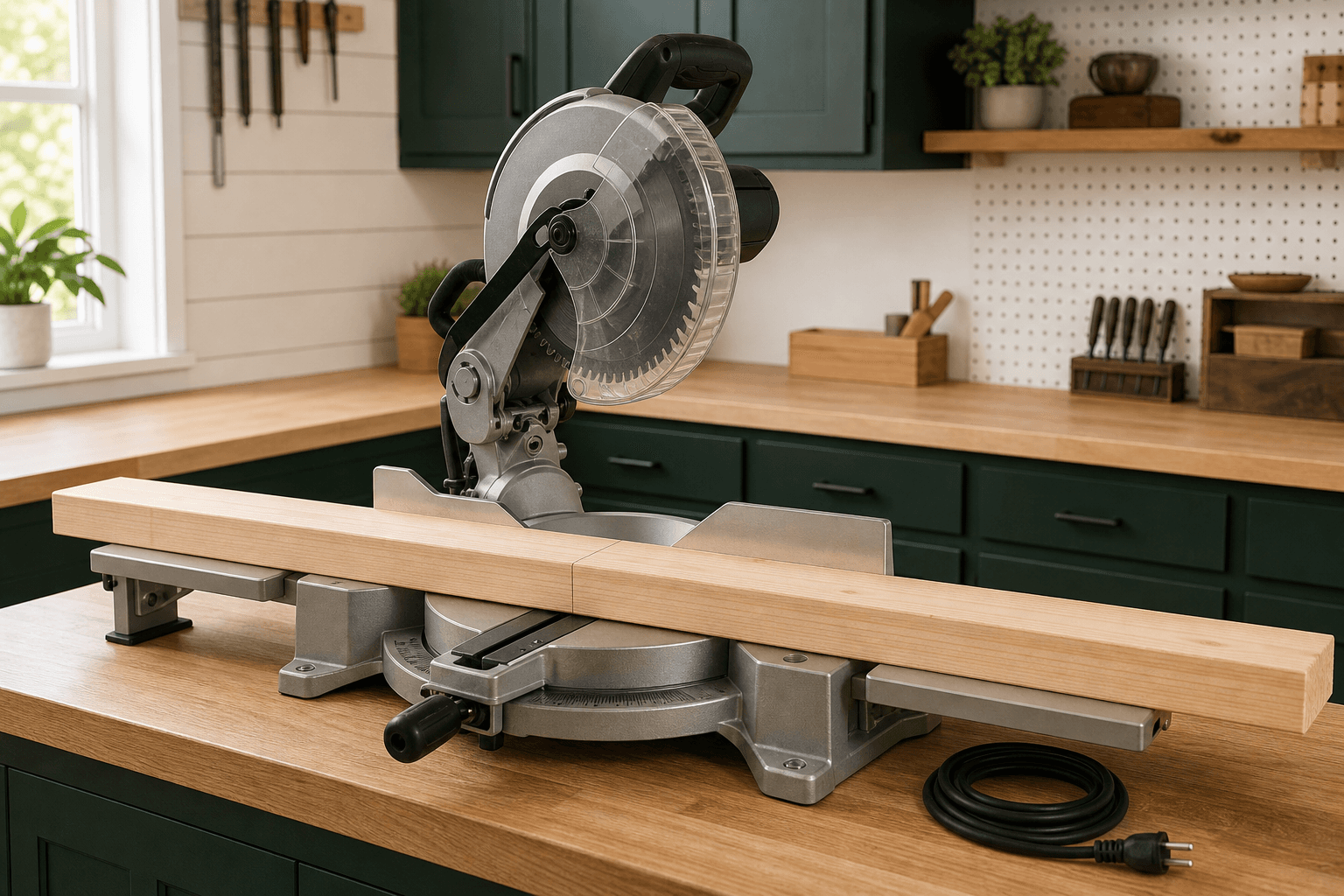
The quick answer
Yes, a suitable miter saw can crosscut a standard surfaced 2x4 in one pass at 90 degrees, and many 10-inch models also publish 2x4 capacity at a 45-degree miter. Confirm the exact model's capacity chart at the angle and bevel you need; blade diameter alone does not prove capacity.
Use a miter saw to cut across the board, not along its length. Support the board level with the saw table, keep it flat against the fence, mark the waste side, use the clamp where the manual requires it and keep hands outside the specified no-hand zone. For a lengthwise rip, use an appropriate table-saw or guided circular-saw system instead.
How this guide has been updated
- Article published with product references and related reading.
Share this page
Use this article with our best miter saw shortlist, then check the safe operating guide before planning the cut.
Relevant options
Three verified saw configurations for 2x4 work
Research-based recommendations, not hands-on tests. Compare the exact model, package and manufacturer specifications before ordering.
Best lightweight fixed option
Metabo HPT C10FCG2
Best for: Routine 2x4 square and miter crosscuts where portability matters more than wide-board sliding reach.
- Published 2x4 capacity at 45 degrees
- 24-pound manufacturer-listed weight
- 0-to-52-degree miter range left and right
Review context: Metabo HPT explicitly lists 2x6 capacity at 90 degrees and 2x4 capacity at 45 degrees. The fixed 10-inch format weighs a manufacturer-listed 24 pounds and includes a shadow cut line.
Consider: Its single-left bevel and fixed head offer less flexibility for wider boards and opposing bevel workflows.
Official specificationsChecked August 14, 2026
Best straightforward 10-inch workhorse
DeWalt DWS713
Best for: A stable shop or renovation station making repeated square and angled cuts in ordinary dimensional lumber.
- Published 2x4 capacity at 45 degrees
- 14 positive miter stops
- 10-inch fixed compound design
Review context: DeWalt documents 2x6 dimensional-lumber capacity at 90 degrees and 2x4 at 45 degrees, plus a vertical clamp and 14 positive miter stops.
Consider: It is a fixed single-bevel saw, so users cutting wider stock or frequent opposing bevels may outgrow its workflow.
Official specificationsChecked August 14, 2026
Best when wider stock is also on the list
SKIL MS6305-00
Best for: DIYers who cut 2x4s but also regularly need the added reach for shelving, wider framing stock or compound work.
- 10-inch dual-bevel slider
- Published 2x12 capacity at 90 degrees
- 50-degree miter range left and right
Review context: SKIL documents 2x12 capacity at 90 degrees, 2x8 at 45 degrees, dual bevel and a shadow line. That added capacity is useful beyond the basic 2x4 task.
Consider: Sliding reach and dual bevel add size and complexity that ordinary 2x4 crosscuts alone do not require.
Official specificationsChecked August 14, 2026
A 2x4 is a name, not the finished measurement
In common North American surfaced lumber, “2x4” is a nominal designation; the actual board is typically smaller than two by four inches. Still measure the piece in front of you. Rough-sawn, reclaimed, wet, warped or laminated stock can differ from ordinary surfaced framing lumber and may not sit safely against the table and fence.
Capacity tables often use dimensional-lumber labels such as 2x4, 2x6 or 2x12. When the manual also gives actual dimensions, use those numbers to compare unusual stock. Never force a bowed board flat near the blade or assume two pieces stacked together are covered by a single-board capacity claim.
What size miter saw cuts a 2x4?
Many 7-1/4-inch, 10-inch and 12-inch miter saws can crosscut a 2x4 at 90 degrees, but the approved orientation and angled capacity vary. A compact saw may be enough for ordinary square cuts; a larger blade or sliding mechanism is useful only when another recurring material actually needs the added height or width.
Metabo HPT documents 2x6 capacity at 90 degrees and 2x4 at a 45-degree miter for the fixed 10-inch C10FCG2. DeWalt gives the same dimensional-lumber headline capacities for the fixed 10-inch DWS713. Those are verified model examples, not a promise about every 10-inch saw.
How to cut a 45-degree angle on a 2x4
First decide whether you need a miter or bevel. A 45-degree miter rotates the table and cuts diagonally across the board's face; a 45-degree bevel tilts the head through its thickness. Each position changes capacity and clearance differently.
With power disconnected, set the intended angle, place the 2x4 flat against the table and fence, and move the saw through the full cut path. Confirm guard, motor, fence and clamp clearance. Restore power, let the blade reach speed, make a controlled crosscut and wait for complete blade stop before raising the head. Test paired scrap pieces when the angle must form a visible joint.
Do you need a sliding miter saw for 2x4s?
No. A slider is not required for an ordinary 2x4 crosscut when a fixed saw publishes adequate capacity. Sliding rails mainly add crosscut width for material such as shelving, stair parts or wider framing stock; they also add footprint, weight and another motion to control.
The SKIL MS6305-00 illustrates the difference: SKIL documents 2x12 capacity at 90 degrees and 2x8 at 45 degrees for this 10-inch slider. Buy that extra reach because your broader cut list needs it, not because a 2x4 alone demands it.
Support a long 2x4 without lifting it off the table
A board can fit beneath the blade yet remain unsafe because its far end drops, twists or levers the short end away from the fence. Place stable supports under the long spans so the board remains coplanar with the saw table. Do not use another person as a moving stand.
For an eight-foot stud, support both working spans where needed and check that the board does not seesaw before power is connected. Keep the cutoff free: a stop block should define repeat length without trapping the offcut between the stop and blade. Our long-board guide covers this setup in more detail.
Choose the blade for the lumber and finish
For ordinary clean construction lumber, use a sharp carbide crosscut blade that matches the saw's diameter, arbor, maximum RPM and approved application. A general-purpose included blade may be suitable for framing-quality cuts; visible furniture or trim joints can justify a manufacturer-approved fine-finish blade.
Inspect reclaimed 2x4s for fasteners and unknown inclusions before they reach the saw. Pressure-treated lumber can be wetter and heavier than dry interior stock; follow the lumber, blade and saw guidance, control dust and wash hands as the treatment supplier directs. Never assume a finish blade is approved for embedded nails.
Make repeat 2x4 cuts without accumulating error
Prove the first length with a tape and square, then use a properly positioned stop for a batch. Reference every board from the same end and check the stop periodically for movement or debris. A blade kerf removes material, so cutting successively on alternating sides of a pencil line can produce inconsistent lengths.
For ten equal blocking pieces, cut one sample, verify it in the actual opening and then lock the repeat reference. Keep the stop upstream of the blade or use a relieved arrangement so the cutoff is not pinched. If a piece becomes too short to clamp or control outside the no-hand zone, change the fixture or cutting method.
A 4x4 is a separate capacity question
Do not double the 2x4 conclusion and assume the saw can cut a 4x4. A 4x4 requires much more vertical capacity, and model approvals differ. Check actual post dimensions and the exact 90-degree capacity chart.
Do not rotate a post through several partial cuts unless the manufacturer explicitly documents that process and the post can remain registered consistently. Misaligned faces, unstable rotation and hidden treatment checks can turn a capacity workaround into a poor or unsafe cut.
What should you never cut with a miter saw?
Never rip a 2x4 lengthwise on a miter saw, work freehand, defeat the guard, fit an unapproved blade or wheel, cut prohibited material, or hold pieces too small for safe control. Do not cut badly twisted stock that cannot register against both table and fence.
A miter saw is optimized for supported crosscuts and angles. If the task is to turn one 2x4 into two long narrow strips, choose a rip-capable saw and appropriate fence or guide. If the board contains unknown metal, coatings or structural damage, identify or reject it before cutting.
At a glance
Where a miter saw fits 2x4 work
- Fast repeatable 2x4 crosscuts
- Common 90- and 45-degree capacities
- Useful stops for blocking and framing batches
- Compact fixed models can be sufficient
Limits that still control the setup
- Not suitable for lengthwise rip cuts
- Angle changes reduce some capacities
- Long studs still need level support
- Rough, wet or warped stock needs extra assessment
Frequently asked questions
Can I cut a 2x4 with a miter saw?
Yes, when the exact saw publishes capacity for the board at the intended miter and bevel. Support it level, hold it against the fence and follow the model-specific clamp and hand-clearance rules.
What saw is best for cutting 2x4s?
A fixed 10-inch compound miter saw is sufficient for many repeat crosscuts. Use a circular saw for portable/in-place work and consider a slider only when wider recurring stock needs its extra reach.
How do you cut a 45-degree angle on a 2x4?
Identify miter versus bevel, verify the saw's capacity at that setting, make an unplugged clearance dry run, support and clamp the stock as directed, then make a controlled cut and wait for full blade stop.
What should you never cut with a miter saw?
Do not make rip or freehand cuts, defeat guarding, use prohibited materials or accessories, or cut pieces that cannot be controlled with hands outside the specified no-hand zone.
Sources and verification
Specifications and material guidance were checked on the dates shown. Always confirm the current manual for your exact saw, blade and decking product.
- Metabo HPT C10FCG2 official specificationsChecked August 14, 2026
- DeWalt DWS713 official specificationsChecked August 14, 2026
- SKIL MS6305-00 official specificationsChecked August 14, 2026
- DeWalt DWS713 instruction manualChecked August 14, 2026