Buying advice
Miter Saw Capacity Explained: How Much Do You Actually Need?
A practical way to size a miter saw without paying for capacity your projects will never use.
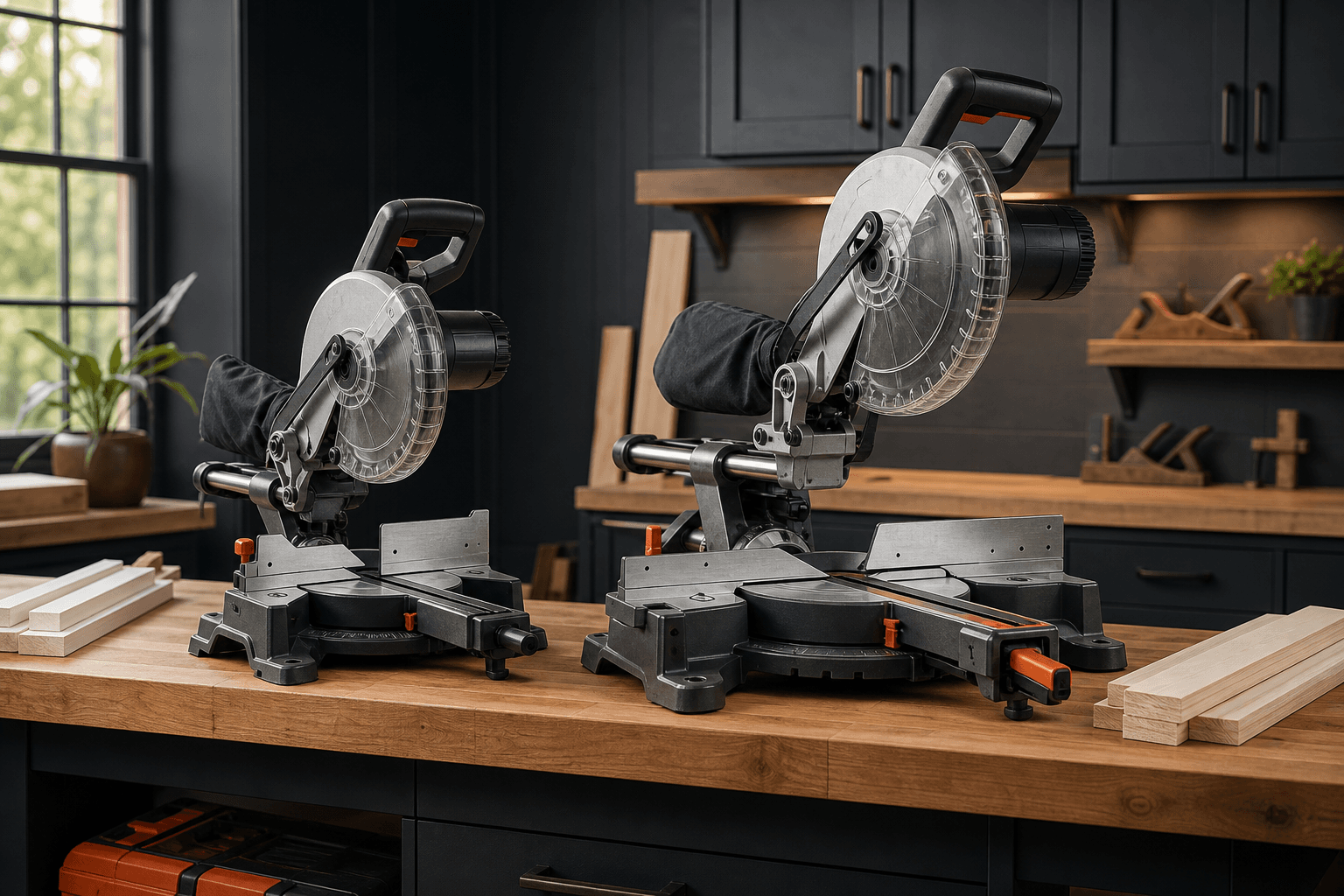
Read four different capacities, not one maximum
Crosscut capacity is a width-and-height pair at a stated angle. Vertical baseboard capacity describes a profile standing against the fence. Nested crown capacity describes molding supported at a specified spring angle. None is interchangeable with blade diameter.
Start with the largest cut you repeat. Write down actual stock width and thickness, miter angle, bevel angle and orientation. A headline 12-inch blade or 14-inch width is not enough to approve that cut.
How this guide has been updated
- Rebuilt around actual stock dimensions, separate capacity types, angle conditions and a pass-or-fail cut list.
Use this article with our best miter saw shortlist, then check the safe operating guide before planning the cut.
Relevant options
Miter saws worth comparing
Research-based recommendations, not hands-on tests. Compare the exact model, package and manufacturer specifications before ordering.
Best all-around capacity
DeWalt DWS779
Best for: Renovators and serious DIYers who regularly cut wide boards, dimensional lumber and tall trim.
- 12-inch sliding compound saw
- Up to 2×14 crosscut capacity at 90°
- Dual bevel with tall fences
Review context: Manufacturer specifications and the trusted reviews used in our roundup consistently point to its large 12-inch sliding capacity and solid repeat-cut setup.
Consider: It is heavy and omits the DWS780’s XPS shadow-line system, so portability and cut-line guidance deserve consideration.
Best for tight bench depth
Bosch GCM12SD
Best for: Crown molding and stationary workshops where a conventional rear rail system would consume too much space.
- 12-inch dual-bevel saw
- Axial-Glide space-saving mechanism
- 6½-inch nested crown capacity
Review context: Bosch specifications and independent review coverage highlight the Axial-Glide arm, wide crosscut capacity and useful nested-crown support.
Consider: At roughly 65 pounds it is primarily a shop saw, and it does not include an integrated laser or shadow light.
Best compact 10-inch option
Makita LS1019L
Best for: Compact shops that want strong trim capacity without moving to a full 12-inch blade.
- 10-inch dual-bevel sliding saw
- Wall-flush two-rail design
- Built-in laser guide
Review context: The wall-flush rail arrangement, direct-drive motor and documented molding capacities make this a useful bridge between compact size and larger-saw capability.
Consider: It is compact front to back but not lightweight, so buyers should distinguish bench footprint from portability.
Measure the stock: nominal lumber is not its finished size
A nominal 2x4 is commonly about 1-1/2 by 3-1/2 inches after surfacing; a nominal 4x4 is commonly about 3-1/2 inches square. Rough, wet, specialty and composite products can differ. Measure the board you will cut and compare both dimensions with the exact model’s table.
Illustrative case: a board 11-1/4 inches wide and 3/4 inch thick needs both dimensions to fit at the planned angle. A capacity listed for a thinner board at the same width is not an automatic match.
Square capacity does not establish capacity at 45 degrees
Turning the miter table changes the path through the board. Adding bevel changes the required clearance again. Read the separate capacity entry for the intended combination; do not convert a square-cut marketing number into a compound-cut guarantee.
For a simple flat board with parallel edges, the geometric path across its width at 45 degrees is about 1.414 times its width. That explains why angled capacity can become restrictive, but it is not a substitute for the saw’s tested and documented capacity chart.
| Planned part | Record before comparing | Manual entry to confirm |
|---|---|---|
| Shelf | Actual width and thickness; square cut | Crosscut pair at 0° miter and 0° bevel |
| Angled trim | Profile and required miter | Capacity and fence clearance at that miter |
| Standing baseboard | Actual height and profile | Vertical base capacity in the stated position |
| Nested crown | Profile size and spring angle | Nested capacity and support instructions |
Read the conditions attached to the maximum
A manufacturer may state maximum capacity using a special fence arrangement or another documented setup. Confirm the model, type, blade and exact instructions before relying on that maximum. Never improvise extra capacity by removing a guard, lifting the stock or exceeding the published stops.
A board fitting under the blade is only one check. The table and fence must register the stock, the clamp must clear the complete motion, and long material needs stable support at table height. The offcut must remain free of a trapping arrangement.
Use a pass-or-fail cut list before ranking saws
Imagine a station for square shelf crosscuts, standing baseboard and occasional flat bevels. Give each candidate three separate pass-or-fail entries. If one fails a recurring cut, decide whether a different approved cutting process is practical before keeping that saw on the shortlist.
Only after the cuts pass should you compare rail depth, carrying weight, battery supply and controls. A forward-rail 10-inch slider and a fixed 12-inch saw may solve different parts of the list. The larger blade is not automatically the more capable system for your work.
- Record actual dimensions and orientation for every recurring cut.
- Find the matching row and any special setup in the exact manual.
- Check stock support, guard and clamp clearance before powered testing.
- Compare convenience features only among models that pass the cut list.
At a glance
What the capacity checklist resolves
- Separates crosscut, vertical and nested capacities
- Uses measured stock and the actual angle
- Makes capacity a pass-or-fail decision before feature comparisons
Limits of a paper comparison
- A chart cannot confirm a damaged or modified saw
- Special maximum-capacity setups need their full instructions
- Safe stock control can rule out a cut that physically fits
Frequently asked questions
Can every 12-inch miter saw cut a 4x4?
Do not assume so. Measure the post and check the model’s width-and-height capacity at the intended miter and bevel. A square-cut rating does not establish a 45-degree rating.
Does a sliding saw always have more capacity?
Slide travel primarily adds crosscut reach. Compare vertical, nested and angled capacity separately; another model can have a different strength.
Can I flip an oversized board to finish the cut?
Do not use flipping as a general workaround. Use only a method explicitly permitted for the exact saw and stock, or select a different suitable tool and process.
Does a 120-degree corner need a 60-degree saw setting?
For a flat equal-width joint on a saw whose zero is square, the starting setting is 30 degrees per piece. The 60-degree half-angle describes the physical cut face. Verify a paired scrap joint.