Saw comparisons
Compound Miter Saw vs Miter Saw: What Is the Difference?
A terminology-first comparison that separates table rotation, head tilt and sliding reach before you buy.
The quick answer
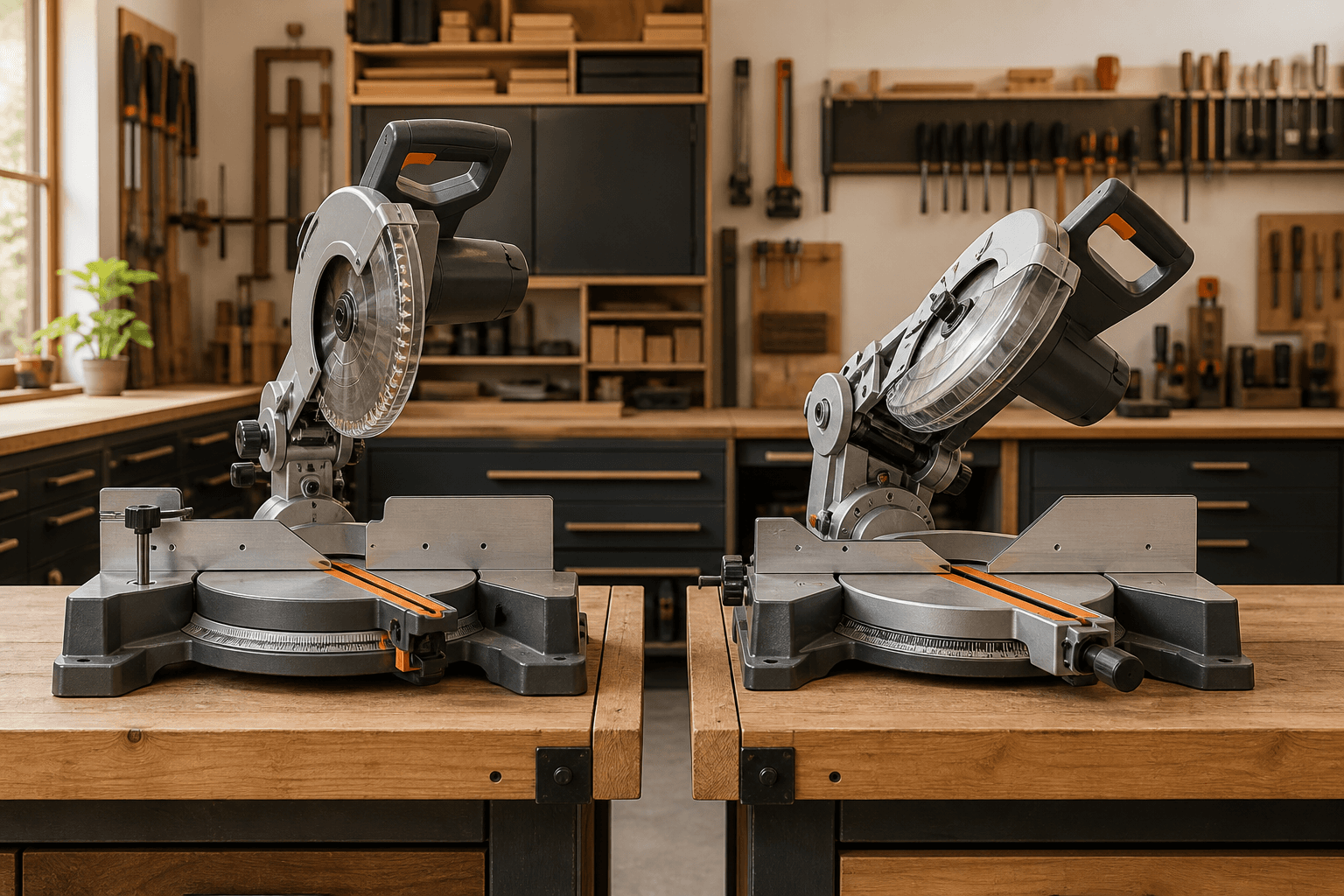
A basic miter saw rotates its table to cut an angle across the face of a board. A compound miter saw adds a head that tilts for bevel cuts; using miter and bevel together makes a compound cut. In current shopping language, “miter saw” is also the broad category name, so many products called miter saws are already compound models.
For most home users buying new, a fixed 10-inch single-bevel compound saw is the practical baseline because it covers square crosscuts, miters and one bevel direction without requiring a heavy slider. Buy dual bevel for frequent opposing bevels and sliding reach only when recurring stock exceeds the fixed saw’s published crosscut width.
How this guide has been updated
- Article published with product references and related reading.
Share this page
Use this article with our best miter saw shortlist, then check the safe operating guide before planning the cut.
Relevant options
Three verified compound configurations
Research-based recommendations, not hands-on tests. Compare the exact model, package and manufacturer specifications before ordering.
Best lightweight single-bevel example
Metabo HPT C10FCG2
Best for: Home and mobile work using common trim and dimensional lumber within fixed 10-inch capacity.
- 24-pound manufacturer-listed weight
- 0-to-45-degree left bevel
- Published 2x6 capacity at 90 degrees
Review context: Metabo HPT identifies this as a fixed single-bevel compound saw with 0-to-45-degree left bevel, 52-degree miter range both ways and a 24-pound listed weight.
Consider: It does not slide or bevel right, so wider boards and repeated opposing bevels need a different workflow.
Official specificationsChecked August 22, 2026
Best straightforward compound workhorse
DeWalt DWS713
Best for: A stable shop or renovation station making miters, occasional bevels and common dimensional-lumber cuts.
- 10-inch fixed compound design
- 14 positive miter stops
- Published 2x4 capacity at 45 degrees
Review context: DeWalt calls the DWS713 a 10-inch single-bevel compound saw and publishes 14 miter stops, 2x6 capacity at 90 degrees and 2x4 at 45 degrees.
Consider: The fixed head and predominantly left bevel are less efficient for wide shelves and repeated bevels on both sides.
Official specificationsChecked August 22, 2026
Best all-feature comparison example
SKIL MS6305-00
Best for: DIYers whose projects genuinely require wide crosscuts and beveling in both directions.
- 10-inch dual-bevel sliding design
- Published 2x12 capacity at 90 degrees
- Published 2x8 capacity at 45 degrees
Review context: SKIL combines a 10-inch blade, dual bevel and sliding travel, with published 2x12 capacity at 90 degrees and 2x8 at 45 degrees. It illustrates that sliding and compound describe different capabilities.
Consider: The wider operating envelope and added mechanisms are unnecessary when common narrow stock and one bevel direction cover the work.
Official specificationsChecked August 22, 2026
Separate the three motions before comparing saws
Table rotation creates a miter: for example, two 45-degree face angles that form a square picture-frame corner. Head tilt creates a bevel through the board’s thickness. Setting both at once creates a compound miter, commonly used when molding is cut flat or a box has sloping sides.
Sliding is a fourth, independent feature. It moves the head across wider stock but does not define whether the saw is compound. A machine can be fixed and compound, sliding and compound, single bevel or dual bevel. Read the full configuration instead of assuming one feature implies the others.
- Miter: turntable rotates left or right.
- Bevel: head tilts relative to the table.
- Compound: miter and bevel are used together.
- Sliding: head travels forward and back for width.
Why would you need a compound miter saw?
Choose compound capability when your projects include bevels or combined-angle joints. Crown molding laid flat is the classic example: the saw needs a miter angle and bevel angle simultaneously. Beveled frame edges, sloped-sided boxes and some trim transitions also use the tilted head.
DeWalt’s DWS713 manual defines a compound miter as a cut using miter and bevel at the same time and instructs users to make scrap trials when fitting compound work. For plain decking cutoffs, 2x4 blocking and simple picture-frame face miters, the bevel may remain at zero even though the machine can tilt.
What are the three common miter-saw types?
A useful buying breakdown is fixed single-bevel compound, fixed dual-bevel compound and sliding compound. A fixed single-bevel saw tilts mainly one way and is usually lighter. A fixed dual-bevel saw tilts both ways without adding sliding travel. A sliding compound saw adds wide-board reach and may be single or dual bevel.
Traditional non-compound miter saws still explain the terminology, but they are less prominent in current full-size product ranges. Do not buy an old or specialized basic model merely because your first project needs only miters; compare guarding, condition, capacity, parts support and the value of having a controlled bevel adjustment for future work.
What size miter saw is best for home use?
A fixed 10-inch compound saw is a sensible default when common trim and dimensional lumber fit its capacity. Metabo HPT publishes 2x6 capacity at 90 degrees and 2x4 at 45 degrees for the 24-pound C10FCG2. DeWalt publishes the same dimensional-lumber headline capacities for the DWS713.
Choose a 10-inch slider when a real cut list includes wider shelving or flooring. SKIL publishes 2x12 capacity at 90 degrees and 2x8 at 45 degrees for the MS6305-00. Move to a 12-inch format only when verified vertical or crosscut capacity—not the assumption that bigger is better—solves recurring crown, stair, post or wide-board work.
Single bevel or dual bevel?
Single bevel is enough when you make occasional tilted cuts and can safely reorient the stock without losing the reference face. Dual bevel saves flipping for repeated opposing cuts, which is valuable in crown, installed trim and production workflows where orientation errors cost time and material.
The bevel direction does not change miter range or automatically add width. DeWalt lists the DWS713 as single bevel with a principal left range; SKIL lists the MS6305-00 as dual bevel and sliding. Compare each feature independently against the joints you actually make.
Does compound capability reduce accuracy?
No feature guarantees or prevents accuracy. A tilting assembly adds settings that must lock securely, but repeatability still depends on fence and table alignment, detents, blade condition, stock registration, support and controlled feed. A basic saw with a damaged fence can be less reliable than a calibrated compound model.
Before finish work, disconnect power and move the saw through the planned miter and bevel to check guard, motor, fence and clamp clearance. Lock both controls, make a trial cut in representative scrap and verify the joint. If the angles vary, stop and inspect the locks and alignment rather than correcting the work by hand near the blade.
Can a miter saw do everything a chop saw can?
No. “Chop saw” is sometimes used casually for a miter saw, but dedicated abrasive or metal-cutting chop saws can be designed for different materials, wheels, speeds and clamping. A woodworking compound miter saw is not permission to install an abrasive wheel or cut ferrous metal.
Use only materials and blades approved by the exact saw manufacturer. A miter saw’s useful overlap is the downward crosscut motion; material rating, guarding, sparks, speed and workholding can be entirely different. Our chop-saw comparison explains the category boundary in detail.
Choose by four concrete project examples
For a 1.5-inch picture-frame molding, table miters and repeat stops matter while bevel stays at zero. For crown laid flat, compound settings are essential and should be proved in scrap. For 1x12 closet shelving, sliding width may matter more than dual bevel. For mobile 2x4 blocking, a lightweight fixed single-bevel compound saw can cover the cuts with less transport burden.
Write down the widest 90-degree cut, widest 45-degree cut, tallest molding orientation and whether opposing bevels repeat. The simplest current compound model that safely covers those four requirements is usually a better home purchase than a large slider selected from feature names alone.
Every configuration keeps the same core safety rules
Secure the saw to a stable surface, support stock level with the table, keep it against the fence, clamp where the manual directs and keep hands outside the specified no-hand zone. Guards must remain intact and automatically cover the blade as designed.
OSHA highlights guard coverage, sharp blades, safe hand distance and eye and face protection for miter-saw work. Disconnect power before adjustments and blade changes, make unpowered dry runs at unfamiliar compound settings, wait for complete blade stop before raising the head and never perform rip or freehand cuts.
At a glance
What compound capability adds
- Compound models add controlled bevel cuts
- Fixed 10-inch formats suit many home projects
- Dual bevel reduces stock flipping
- Sliding variants add wide-board reach
What still needs verification
- Feature names do not prove capacity
- Compound settings require two secure locks
- Dual bevel may be unused on simple work
- Sliding reach adds weight and footprint
Frequently asked questions
What are the three types of miter saws?
A practical current grouping is fixed single-bevel compound, fixed dual-bevel compound and sliding compound. Basic non-compound saws explain the category name but are less common in current full-size ranges.
Why would I need a compound miter saw?
It adds bevel capability and can combine bevel with table miter for crown molding laid flat, sloped boxes and other two-angle joints. Plain square and face-miter crosscuts do not require the tilt.
What size miter saw is best for home use?
A fixed 10-inch single-bevel compound saw is a balanced starting point when its published capacities cover your material. Add sliding reach or a 12-inch blade only for recurring cuts that require them.
Can a miter saw do everything a chop saw can?
No. Dedicated chop saws may use different wheels, speeds, guards and clamps for metal. Use only materials and accessories approved for the exact miter saw.
Sources and verification
Specifications and material guidance were checked on the dates shown. Always confirm the current manual for your exact saw, blade and decking product.
- DeWalt DWS713 official specificationsChecked August 22, 2026
- DeWalt DWS713 instruction manualChecked August 22, 2026
- Metabo HPT C10FCG2 official specificationsChecked August 22, 2026
- SKIL MS6305-00 official specificationsChecked August 22, 2026
- OSHA miter-saw guarding and safety measuresChecked August 22, 2026