Strong fit
What it does well
- Long rip cuts
- Repeatable stock sizing
- Workshop throughput
- Jig-assisted woodworking operations approved by the manufacturer
A table saw holds a spinning blade in a fixed table while the workpiece moves through the cut. Its strength is repeatable ripping and stock sizing in a prepared workspace.
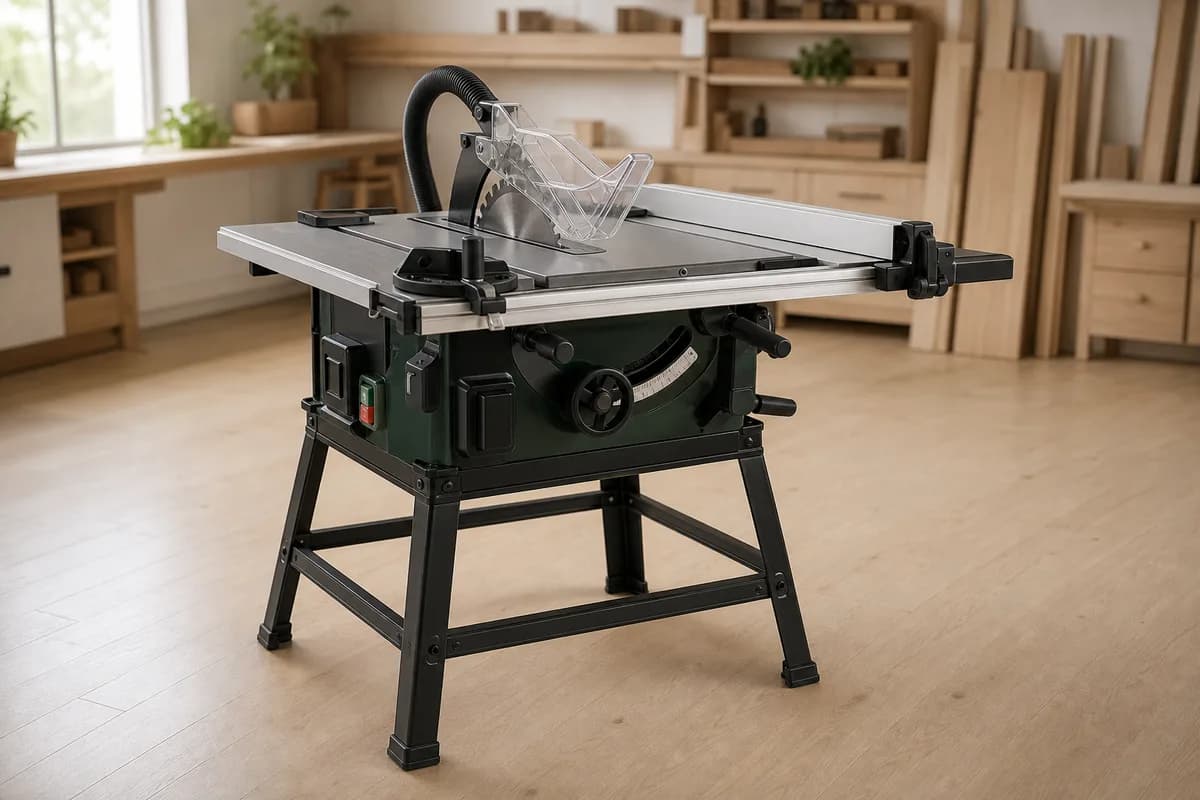
A table saw earns its place when you repeatedly make stock narrower or need a controlled straight-cut workflow. The board moves past a fixed blade. The table size alone does not describe the workspace: long stock needs an approach, support beyond the cut and a clear operator position.
Crosscutting is also possible with the correct documented accessory and method. It is a different operation from ripping, not permission to guide every piece between the rip fence and blade. Use the exact manual to select guards, guiding equipment and stock support for the operation.
| Your task | Why it may fit | Check before buying |
|---|---|---|
| Rip several boards to a common width | A repeatable width reference | Fence, guard system and material support |
| Break down full sheets | Capacity may suit repeat panel work | Panel handling, rip capacity and outfeed space |
| Crosscut long room trim | A separate miter station may be easier to support | Length and control of the stock, not motor size |
Start with a floor sketch showing the longest board both before and after the cut. Mark the door, storage, extraction hose and walking route. A folding table saw may fit in storage while the same saw has no usable operating path with the garage door shut. Resolve that layout before comparing a larger rip-capacity number.
For an occasional panel, a supported guided circular-saw setup may fit the room better. For repeated widths, a dedicated table-saw workflow can reduce repeated measuring. Neither choice is universally safer: guarding, material condition, training and the documented operation remain essential.
For the safety context, see OSHA: table-saw applications, support and guarding and the exact machine manual.
Share this page
Do you have enough infeed and outfeed space?
Will you cut full panels or mostly narrow stock?
How will you support and control long material?
Does portability matter more than table capacity?