Saw comparisons
Sliding vs Non-Sliding Miter Saw: Which One Do You Need?
A cut-list-first comparison that explains when extra sliding reach earns its space—and when a simpler fixed saw is the better tool.
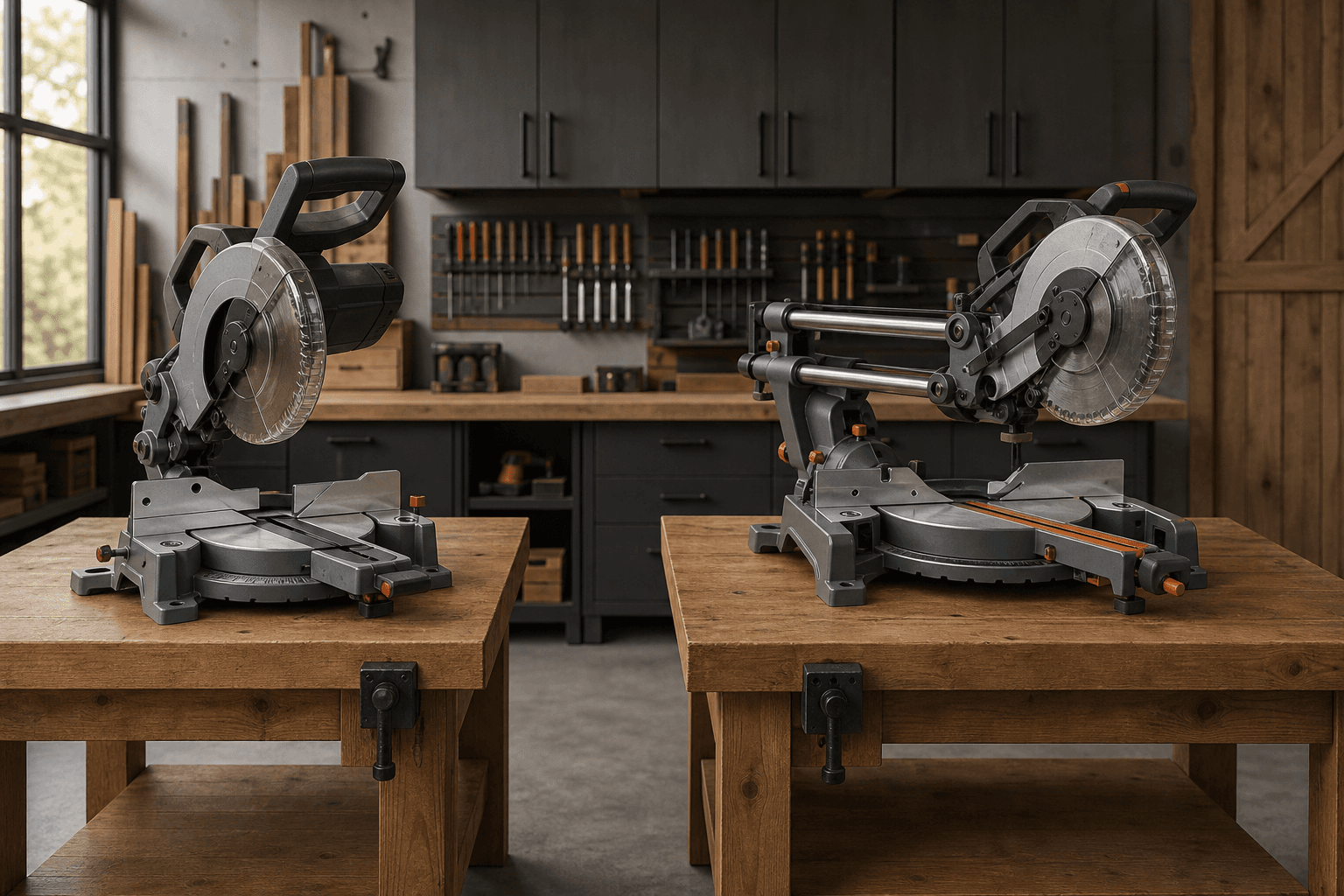
The quick answer
Choose a non-sliding—or fixed-head—miter saw when your recurring stock fits its published capacity and you value lower weight, shallower bench depth and a simpler cutting motion. Choose a sliding saw when you regularly crosscut boards too wide for a fixed model, such as shelving, stair parts or wider dimensional lumber.
Do not buy the mechanism in isolation. A fixed 10-inch Metabo HPT C10FCG2 publishes 2x6 capacity at 90 degrees, while the sliding 10-inch SKIL MS6305-00 publishes 2x12 at 90 degrees. Those model examples show the reach difference, but blade diameter, fences and machine geometry still determine the exact capacity. Compare your cut list with the current manual before buying.
How this guide has been updated
- Consolidated the overlapping guide into this article and added a practical decision checklist.
Use this article with our best miter saw shortlist, then check the safe operating guide before planning the cut.
Relevant options
Four verified fixed and sliding examples
Research-based recommendations, not hands-on tests. Compare the exact model, package and manufacturer specifications before ordering.
Best lightweight fixed example
Metabo HPT C10FCG2
Best for: Mobile trim, framing and workshop cuts that fit a fixed 10-inch capacity.
- 24-pound manufacturer-listed weight
- Published 2x6 capacity at 90 degrees
- 10-inch fixed single-bevel design
Review context: Metabo HPT lists this fixed single-bevel saw at 24 pounds with 2x6 capacity at 90 degrees and 2x4 at 45 degrees. It demonstrates why a slider is not mandatory for common narrow stock.
Consider: Its fixed head and single-left bevel limit wide-board reach and opposing bevel workflows.
Official specificationsChecked August 20, 2026
Best straightforward fixed workhorse
DeWalt DWS713
Best for: A stable renovation or shop station focused on dimensional lumber and trim within fixed-head reach.
- 10-inch fixed compound design
- 2x6 dimensional-lumber capacity at 90 degrees
- 14 positive miter stops
Review context: DeWalt documents 2x6 capacity at 90 degrees, 2x4 at 45 degrees and 14 positive miter stops. It is a useful fixed alternative when slide width is not required.
Consider: The fixed single-bevel layout offers less crosscut width and less opposing-bevel convenience than larger sliders.
Official specificationsChecked August 20, 2026
Best accessible 10-inch slider example
SKIL MS6305-00
Best for: DIYers who regularly crosscut wide shelves or dimensional lumber but prefer a 10-inch blade platform.
- Published 2x12 capacity at 90 degrees
- Published 2x8 capacity at 45 degrees
- 10-inch dual-bevel sliding design
Review context: SKIL publishes 2x12 capacity at 90 degrees and 2x8 at 45 degrees, plus dual bevel and a shadow line. It shows the width a slide can add without moving to a 12-inch blade.
Consider: The rails, wider operating envelope and added features are unnecessary when all recurring work fits a compact fixed saw.
Official specificationsChecked August 20, 2026
Best compact-depth high-capacity example
Bosch GCM12SD
Best for: A stationary shop needing wide 12-inch capacity without conventional rear rail travel.
- 3-1/2 x 13-1/2-inch capacity at 0°
- Axial-Glide articulated sliding mechanism
- 65-pound manufacturer-listed weight
Review context: Bosch publishes 4x14 dimensional-lumber capacity at 90 degrees and uses an Axial-Glide arm instead of conventional rails. Its manual also provides a clear push-toward-the-fence slide sequence.
Consider: At 65 pounds it is a planned workstation tool, and its capacity and cost are excessive for narrow mobile trim work.
Official specificationsChecked August 20, 2026
What actually changes when the head slides?
A fixed saw pivots down through the work from one hinge position. A sliding saw adds controlled forward-and-back travel so the blade can cross a wider board. The slide does not make the blade taller, automatically improve bevel range or turn the saw into a rip saw; it primarily expands crosscut width.
For a nominal 2x4 or narrow casing, both types may complete the cut in one pass. For a surfaced 1x12 shelf, many fixed 10-inch saws do not have enough width while a verified 10-inch slider may. Always compare the actual board dimensions at the intended miter and bevel because angled capacity shrinks.
Capacity: buy for the widest recurring cut
Start with the widest board you cut repeatedly, not the exceptional piece you might encounter once. SKIL documents 2x12 dimensional-lumber capacity at 90 degrees and 2x8 at a 45-degree miter for the MS6305-00 slider. Metabo HPT documents 2x6 at 90 and 2x4 at 45 for the fixed C10FCG2.
A larger 12-inch slider can extend the gap further: Bosch publishes 3.5 by 13.5 inches at zero miter and bevel for the GCM12SD. That capacity is useful for wide shelving and larger framing parts, but it comes with a manufacturer-listed 65-pound weight. If every planned cut is baseboard, casing and 2x4 blocking, paying for unused reach adds little value.
Is a non-sliding miter saw more accurate?
The fixed mechanism has fewer moving joints, but that does not guarantee a straighter cut. Accuracy depends on fence alignment, detent calibration, blade quality, bearing condition, stock support, clamping and feed pressure. A well-adjusted slider can make repeatable cuts; a loose or forced fixed saw cannot.
Sliding machines add rails or articulated joints that should move smoothly without play. Check the saw at 90 degrees and common miters, then make a supported scrap cut and verify it with an appropriate square. Do not try to correct a drifting cut by twisting the handle through the kerf. Stop, disconnect power and diagnose alignment, blade or workholding.
Footprint, weight and storage often decide the winner
A fixed saw usually occupies less front-to-back bench space and is easier to carry. Metabo HPT lists the C10FCG2 at 24 pounds. By contrast, the Bosch GCM12SD is listed at 65 pounds, although its Axial-Glide arm avoids the long rear travel of conventional rails.
Measure the full operating envelope rather than the base alone. Conventional rear rails need wall clearance; the handle, motor, guard, dust hose and stock also move at extreme miter and bevel settings. In a shared garage where the saw is stored after each project, a fixed machine may be more useful than a high-capacity slider that is awkward to lift.
Is it better to push or pull a sliding miter saw?
Follow the exact saw manual. For the Bosch GCM12SD, the documented slide-cut sequence brings the raised head forward, lowers it, then pushes down and back toward the fence. Bosch explicitly warns never to pull the saw toward the operator during a cut because the blade can climb onto the workpiece.
Do not transfer that short summary to a different mechanism without reading its instructions. With power disconnected, rehearse the full motion, verify guard and clamp clearance, and secure the stock as directed. During the cut, use steady pressure, never force resistance, and hold the head down until the blade stops completely.
What are the disadvantages of a sliding miter saw?
The main trade-offs are footprint, weight, price, more moving components and a cutting sequence that demands deliberate control. Wider capacity also encourages users to place longer and heavier stock on the station, increasing the need for level support on both sides.
A slider can be excessive for a trim installer whose work fits a compact fixed saw, yet invaluable for a cabinet shop crosscutting wide shelf boards. The disadvantage is not the slide itself; it is buying capacity that makes transport, storage or setup worse without solving a recurring cut.
- More bench depth on conventional rear-rail designs.
- Higher weight in many comparable blade sizes.
- Additional rails or joints to inspect and keep clean.
- Longer stock still requires independent level support.
- Slide-cut technique must follow the model manual.
Do not confuse sliding action with blade size or bevel type
A 10-inch slider may crosscut wider stock than a fixed 12-inch saw, while the 12-inch blade may offer more vertical capacity. Single versus dual bevel is another separate decision: dual bevel changes tilt direction, not whether the head slides.
Compare four rows for every candidate: 90-degree crosscut, 45-degree miter, left/right bevel and compound capacity. Then record blade diameter, arbor, maximum RPM, fence height and approved stock orientation. A headline such as “12-inch dual bevel” still does not reveal crosscut width.
Choose from four real project scenarios
For picture frames made from 1.5-inch molding, a fixed 10-inch saw can provide adequate reach; blade choice, stop accuracy and safe short-part control matter more. For 1x12 closet shelves, a verified slider prevents unsupported flip cuts. For repeated 2x deck framing, compare the exact 90- and 45-degree dimensional-lumber rows. For a mobile punch-list saw, weight and stored depth may outweigh occasional wide capacity.
Write the widest 90-degree cut, widest 45-degree cut, tallest nested profile and required bevel direction for your next three projects. Choose the smallest mechanism that covers those recurring cuts with safe support. If only one rare board exceeds the capacity, an appropriate guided circular-saw method may be more sensible than upsizing the permanent miter-saw station.
The support and guard rules do not change
Both types need a stable mounting surface, an intact self-adjusting guard, a sharp approved blade and hands outside the model-specific no-hand zone. Support long stock level with the table, keep it against the fence, clamp where required and ensure the offcut cannot be trapped.
OSHA identifies guard coverage, safe hand distance, sharp blades and eye and face protection as core miter-saw controls. Disconnect power before adjustments or blade work. Never use either type for a lengthwise rip, freehand operation or material and accessory combination the manufacturer prohibits.
Record the one cut that actually needs a slide
The shorter feature guide has been consolidated here. Keep a cut record with measured stock width, thickness and angle, then check both candidates against their manuals. A slide is useful when it solves a recurring capacity limit; it is not evidence of better alignment or finish.
Check the whole operating envelope with the machine disconnected: head travel, bevel sweep, clamps, extraction and the operator’s access. A rear-rail saw can fit on a bench yet fail the working-clearance check.
| Record | Fixed-head candidate | Sliding candidate |
|---|---|---|
| Recurring cut | Does the documented capacity cover it? | What additional required cut does the slide cover? |
| Working space | Base, head, stock and operator clearance | Include full rail or arm travel and hose movement |
| Handling | Complete tool and support arrangement | Added mechanism is worthwhile only if the work needs it |
At a glance
The useful differences
- Sliding saws add wide-board crosscut reach
- Fixed saws are often lighter and shallower
- Both formats can produce repeatable angles
- Model-specific capacity makes the choice measurable
Trade-offs to plan around
- Sliding models add weight and moving parts
- Fixed models can limit shelf and stair-part width
- Angle settings reduce published capacity
- Neither format replaces proper long-stock support
Frequently asked questions
Do you really need a sliding miter saw?
Only if recurring stock exceeds a suitable fixed saw’s published width at the needed angles. Wide shelving, stair parts and larger framing cuts often justify a slider; ordinary trim and 2x4 work may not.
What is the disadvantage of a sliding miter saw?
Sliding models commonly add weight, bench depth, cost and moving components. They also require a controlled model-specific slide-cut sequence and do not eliminate long-stock support.
Is it better to push or pull a sliding miter saw?
Follow the exact manual. Bosch, for example, instructs users to bring the raised head forward, lower it and push it back toward the fence, and warns against pulling through the cut.
What are the advantages of a sliding miter saw?
The main advantage is greater crosscut width with the same blade diameter. That can allow one-pass cuts in shelving and wider dimensional lumber that exceed a fixed saw’s capacity.
Sources and verification
Specifications and material guidance were checked on the dates shown. Always confirm the current manual for your exact saw, blade and decking product.
- Metabo HPT C10FCG2 official specificationsChecked August 20, 2026
- SKIL MS6305-00 official specificationsChecked August 20, 2026
- Bosch GCM12SD official specificationsChecked August 20, 2026
- Bosch GCM12SD instruction manualChecked August 20, 2026
- OSHA miter-saw guarding and safety measuresChecked August 20, 2026