Workshop planning
7 Miter Saw Station Ideas for Small Shops and Jobsites
Seven practical station layouts, plus a measurement-first way to choose between a fixed bench, mobile cabinet and portable stand.
The quick answer
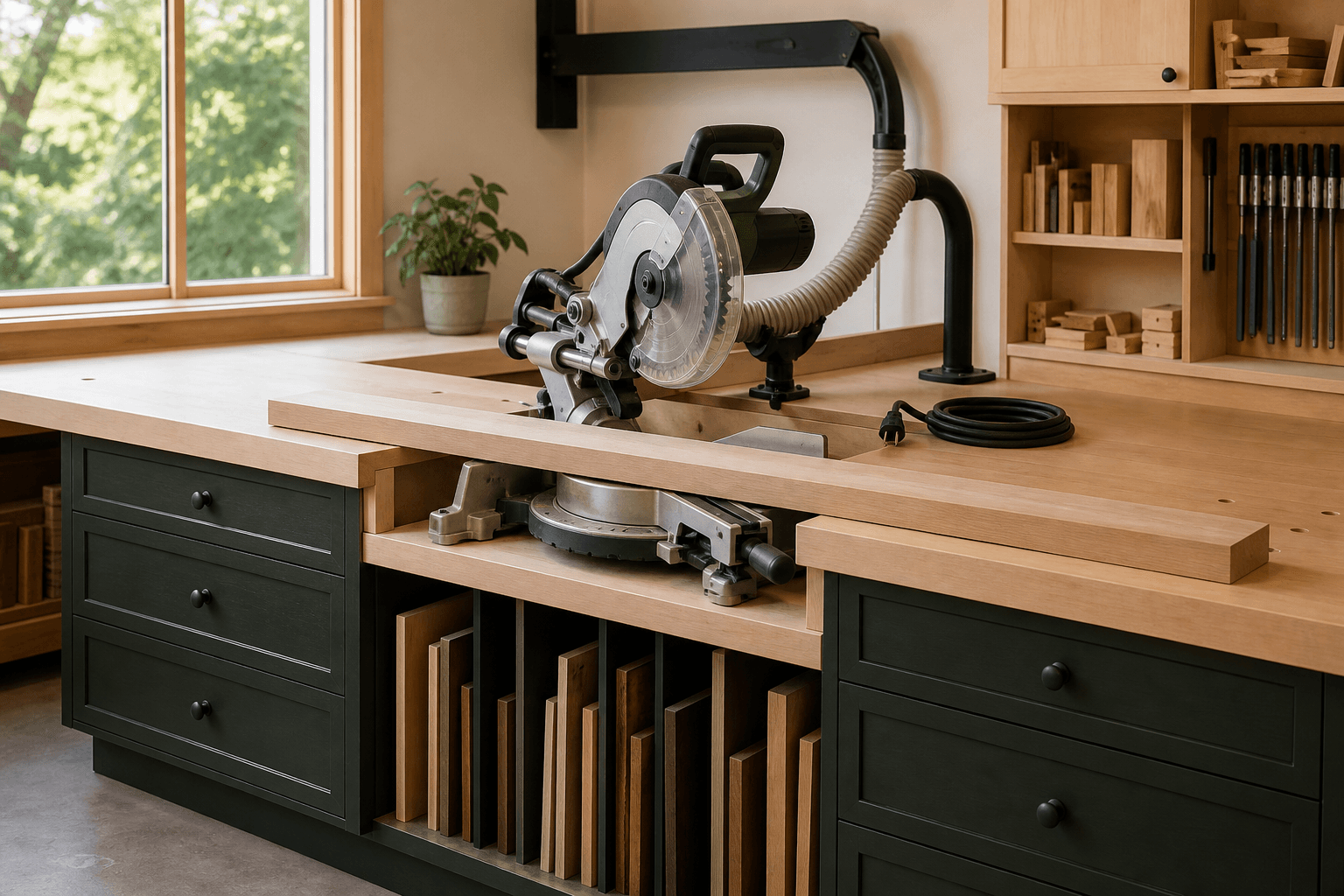
The best miter saw station is not a standard-size bench. It is a stable platform sized around your exact saw's full movement, the longest stock you routinely cut and whether the station must move. A fixed recessed bench is efficient for a dedicated shop; a locking mobile cabinet suits a shared garage; and a folding stand is usually the practical jobsite choice.
Before building, place the unplugged saw on a stable surface and measure its complete rear, side and overhead envelope at every miter, bevel and slide position. Include the dust hose, power connection, controls and your hand clearance. Then make the support wings coplanar with the saw table and secure the saw through the mounting points specified in its manual.
How this guide has been updated
- Article published with product references and related reading.
Share this page
Use this article with our best miter saw shortlist, then check the safe operating guide before planning the cut.
Relevant options
Three portable station foundations to compare
Research-based recommendations, not hands-on tests. Compare the exact model, package and manufacturer specifications before ordering.
Best for wide portable support
BORA Portamate PM-4000
Best for: A mobile trim or project station that needs broad material support without permanent cabinetry.
- Manufacturer-rated 500-pound capacity
- Up to 114 inches of material support
- Folding legs and universal tool mounts
Review context: BORA documents universal quick-attach mounts, a 36-inch work height and up to 114 inches of support. That makes it a practical starting point for long trim, subject to the saw's mounting pattern and the stock's support needs.
Consider: Its folding steel frame prioritizes capacity over cabinet storage, and the optional wheel kit is a separate consideration.
Official specificationsChecked August 8, 2026
Best compact transport option
DeWalt DWX724
Best for: Installers who value a lighter folding stand that fits in a vehicle and supports common long stock.
- 29.8-pound aluminum construction
- Supports material up to 10 feet
- Manufacturer-rated 500-pound capacity
Review context: DeWalt specifies a 29.8-pound aluminum stand with a 40-inch beam that extends to support material up to 10 feet. Repositionable supports and stops help adapt it to repeat work.
Consider: The compact beam provides less built-in storage and station surface than a shop cabinet, and exact saw compatibility still needs checking.
Official specificationsChecked August 8, 2026
Best straightforward collapsible stand
WEN MSA200
Best for: DIY users who need a folding garage or jobsite setup for a compatible miter saw.
- Manufacturer-rated 350-pound capacity
- 36-to-80-inch support-arm span
- Folds flat with quick-release brackets
Review context: WEN documents a 31-inch work height, adjustable support arms and quick-release mounting brackets. The arms extend from 36 to 80 inches for boards up to 8 feet.
Consider: Its manufacturer-rated capacity and support span are lower than the two larger stands here, so verify the combined saw and stock load as well as the mounting-hole dimensions.
Official specificationsChecked August 8, 2026
Seven useful miter saw station layouts
Choose a layout by workflow, not by how impressive it looks in a workshop photo. The following seven ideas solve different space, stock-support and mobility problems.
- Fixed wall bench with a recessed saw bay: best for a dedicated trim or furniture shop where long wings can stay clear.
- Mobile cabinet with locking or retractable casters: useful in a one-car garage where the station parks against a wall between projects.
- Portable folding stand: practical for deck, framing and trim jobs where the saw and support must travel together.
- Modular benchtop base: mount the saw to a rigid removable platform that can be secured to an existing bench when needed.
- Fold-down support wings: useful in a narrow shop only when the hinges, braces and latches keep both wings rigid and level under the expected load.
- Long-stock station with independent supports: suited to long baseboard, decking or dimensional lumber that would otherwise lever against the saw.
- Dust-first alcove: a fixed bay with a removable hood and hose path that leaves the guard, motor, controls and full saw movement unobstructed.
How deep should a miter saw station be?
There is no safe universal depth. Measure from the front edge needed to operate the controls to the farthest rear point reached by the rails, head, hose and cord. Repeat the measurement at the saw's maximum left and right miters and bevels. Add service access so a hose or plug is not crushed against the wall.
For example, a rear-rail sliding saw may need considerably more space behind the fence than a fixed saw or a forward-glide design. Do not copy another builder's bench depth unless the exact saw and dust connection match. A cardboard or painter's-tape outline of the full motion envelope is a cheap check before cutting cabinetry.
Design the station around stock support
The wings support the workpiece; they should not lift it above the saw table or let it sag below. Check them with a reliable straightedge across the saw table, and make any stop system removable or position it so a cutoff cannot become trapped between the blade and stop.
Consider a 12-foot baseboard: the saw table alone cannot keep it controlled. Level extensions or independent supports are needed on both working spans. DeWalt's saw manuals instruct users to support long work and warn against using another person as a substitute for a table extension. For awkward stock, rehearse the entire cut with the saw unplugged before powering it.
Creative storage that does not compromise the cut
Use shallow drawers for pencils, setup tools and stop-block hardware; vertical cubbies for short offcuts; and protected blade storage away from dampness and impact. Keep loose hardware, offcuts and drawer pulls outside the blade, guard and stock paths.
A useful small-shop example is a narrow drawer directly below each wing while the space beneath the saw remains open for mounting bolts and dust plumbing. Blade storage can sit in a separate closed drawer with dividers so teeth do not strike each other. Do not place frequently used accessories where you must reach across the saw to retrieve them.
How to build or upgrade a miter saw station
Start by disconnecting power and reading the mounting and clearance instructions for the exact saw. Build a rigid, level base; place the saw at a comfortable working height; and secure it through the manufacturer-designated mounting holes. Level the wings to the saw table rather than leveling the saw to an imperfect wing.
With power still disconnected, move the saw through every slide, miter and bevel position. Confirm that the guard closes freely, the motor and rails clear the hood, and the hose never pulls tight. Add a supported scrap board, check the fence and stop arrangement, and perform another dry run. Only then reconnect power and make a controlled test cut while following the saw manual.
Which station fits your workshop?
For a shared one-car garage, a mobile cabinet offers useful storage and can roll into open floor space, but the wheels must lock or retract so the station cannot move during a cut. For a small rental workshop, a modular base or folding stand avoids permanent cabinetry. For a dedicated trim shop, a wall bench with long, level wings makes repeated casing and baseboard cuts easier to organize.
On a deck job, a portable stand is generally more useful than a cabinet. A 5/4x6 deck board may fit the saw easily, but its length still requires stable support. At a fixed shop station, a dust hood can improve collection around the saw, although it never replaces the guard, the tool's dust connection or appropriate personal protection.
What can you make once the station is dialed in?
A stable station supports repeatable crosscuts for picture frames, cabinet face frames, shelving, baseboard, casing and deck components that fall within the saw's published capacity. The station improves stock control; it does not expand the saw's rated cutting envelope.
For example, a stop block can organize a batch of equal face-frame rails when the work remains flat against the fence and the offcut is not trapped. Wide panels, rip cuts and material outside the capacity chart need another appropriate tool and support method.
At a glance
What a well-planned station improves
- Stable, level support for long stock
- Repeatable organization for batch cuts
- Storage tailored to the actual workflow
- A layout that can match fixed or mobile work
What still needs careful checking
- A copied bench may not clear your saw
- Wings need periodic level checks
- Mobile bases require reliable locking
- Dust hoods must preserve full tool movement
Frequently asked questions
How deep should a miter saw station be?
Deep enough for the exact saw, hose, cord and controls to clear through every slide, miter and bevel position. Measure the complete unplugged motion envelope; there is no universal depth that safely fits every model.
How do you make a miter saw station?
Build a rigid level base, secure the saw through its specified mounting holes, set both support wings coplanar with the saw table, and perform a full unpowered motion and stock-support check before making a test cut.
What are some creative storage ideas for a miter saw?
Use shallow accessory drawers, protected divided blade storage and vertical offcut cubbies below the wings. Keep every drawer, handle and stored item outside the blade, guard, mounting and dust paths.
What are some useful things you can make with a miter saw?
Within the saw's rated capacity, a stable station is useful for picture frames, face frames, shelving, baseboard, casing and repeat deck components. It is not intended for rip cuts or stock outside the published capacity.
Sources and verification
Specifications and material guidance were checked on the dates shown. Always confirm the current manual for your exact saw, blade and decking product.
- DeWalt DWX724 product specificationsChecked August 8, 2026
- DeWalt DWS780 instruction manualChecked August 8, 2026
- DeWalt DW717 instruction manualChecked August 8, 2026
- BORA PM-4000 official specificationsChecked August 8, 2026
- WEN MSA200 official specificationsChecked August 8, 2026