Buying advice
Best Miter Saw for Small Projects: Choose by Cut, Not Size Alone
A compact-project decision guide comparing three verified 10-inch saws and the cuts they actually suit.
The quick answer
For most small DIY projects, a fixed 10-inch compound miter saw is the sensible starting point. It handles common crosscuts, miters and a single bevel without the weight, rear-rail space and cost of a large slider. Choose a sliding saw only when your real cut list includes boards wider than a verified fixed-saw capacity.
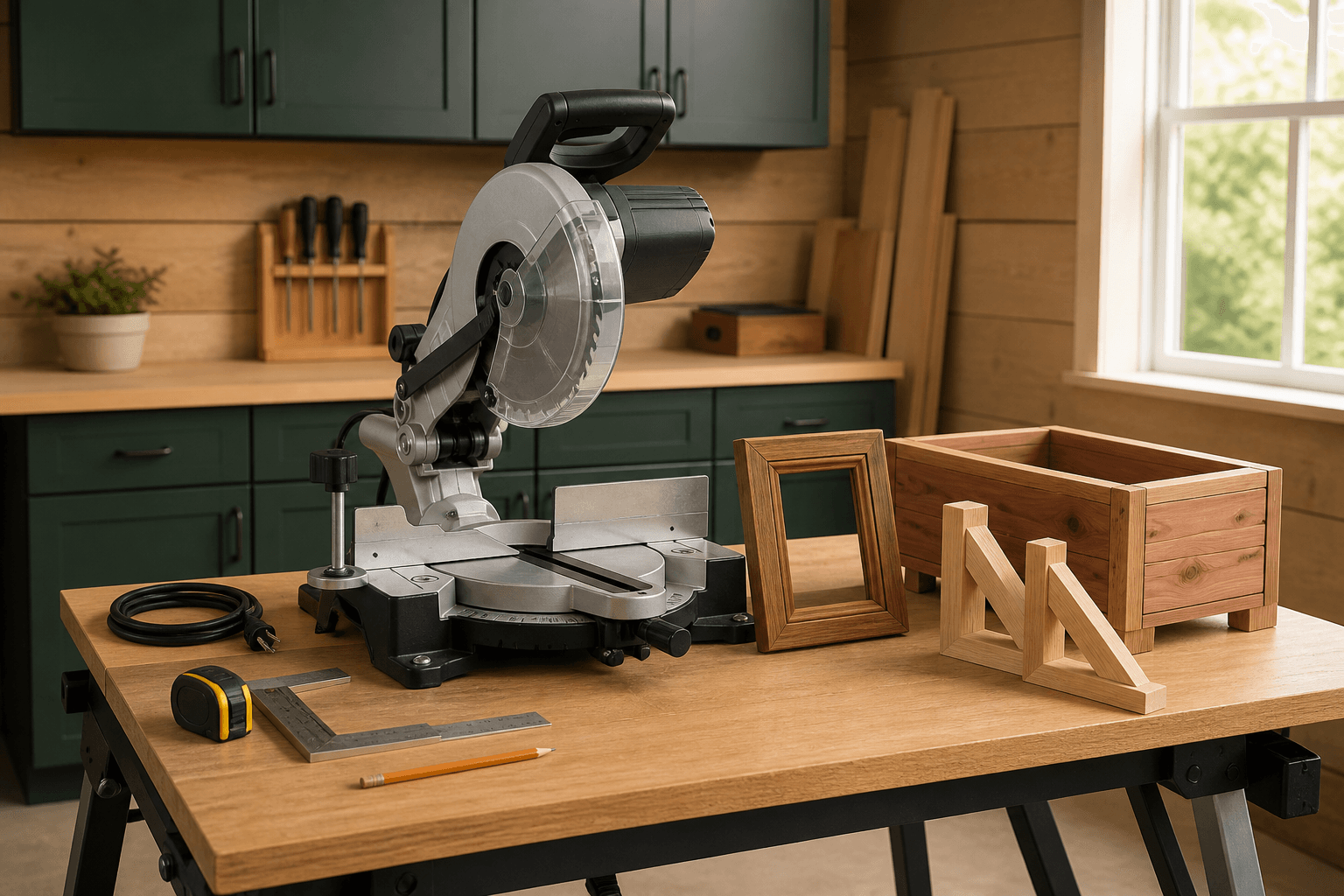
A small project does not always need a mini saw. Picture-frame molding, planter-box boards, shelf cleats and ordinary trim are often easier to support on a full-size 10-inch table and fence. Compare the exact material dimensions with the manufacturer's capacity chart, then reserve budget for a suitable blade, stable mounting, stock support and clamps.
How this guide has been updated
- Article published with product references and related reading.
Share this page
Use this article with our best miter saw shortlist, then check the safe operating guide before planning the cut.
Relevant options
Three verified 10-inch saws for compact project work
Research-based recommendations, not hands-on tests. Compare the exact model, package and manufacturer specifications before ordering.
Best lightweight feature set
Metabo HPT C10FCG2
Best for: A shared garage or mobile DIY bench where low carry weight and a shadow cut line are useful.
- 24-pound manufacturer-listed weight
- 0-to-52-degree miter range left and right
- Shadow-line cut indicator
Review context: Metabo HPT lists a 24-pound fixed 10-inch saw, 2x6-class 90-degree capacity and an XACT CUT shadow line. Its published application list includes trim, flooring, deck and woodworking tasks.
Consider: The single-left-bevel design and fixed head provide less workflow flexibility and width than a dual-bevel slider.
Official specificationsChecked August 12, 2026
Best documented DIY capacity
DeWalt DWS713
Best for: Frames, planter components and common trim where a fixed saw and tall fence fit the cut list.
- 10-inch fixed compound design
- 2x6 dimensional-lumber capacity at 90 degrees
- 14 positive miter stops
Review context: DeWalt documents 2x6 dimensional-lumber capacity at 90 degrees, 14 positive miter stops and vertical support for 4-1/4-inch baseboard. The manual also describes secure bench or plywood-base mounting.
Consider: It bevels mainly to the left and does not slide, so wide shelf stock may require another approved cutting method.
Official specificationsChecked August 12, 2026
Best simple direct-drive option
Makita LS1040
Best for: Woodworking and cabinet-detail projects that fit a compact fixed-saw capacity and benefit from straightforward controls.
- 27.3-pound manufacturer-listed weight
- Miter range to 45 degrees left and 52 degrees right
- Maximum 90-degree capacity listed at 2-3/4 by 5-1/8 inches
Review context: Makita lists a 15-amp direct-drive motor, nine common positive miter stops and a 27.3-pound tool weight. Its exact capacity is published by cut orientation rather than inferred from blade size.
Consider: The fixed, single-left-bevel layout lacks the width and fast opposing-bevel workflow of larger sliding dual-bevel machines.
Official specificationsChecked August 12, 2026
Start with four real project cut lists
Write down width, thickness, longest piece, joint angle and visible finish before comparing machines. The saw only needs to cover the cuts that belong on a miter saw; sheet breakdown, rip cuts and tiny unsupported parts need another method.
For a small picture frame made from 1-1/2-inch molding, repeatable 45-degree miters and a clean finish blade matter more than sliding width. A cedar planter from nominal 1x6 boards needs verified crosscut width and outdoor-appropriate joinery. A utility shelf may require crosscutting a 1x8 board, which can exceed some fixed 10-inch capacities and point toward a slider or a different supported cutting method.
- Picture frame: four pieces, paired 45-degree miters, matched opposite lengths.
- Planter box: repeat square crosscuts in boards that fit the published 90-degree capacity.
- Shelf brackets: short parts must remain large enough to clamp and control outside the no-hand zone.
- Room trim: tall baseboard or nested molding must fit the fence and approved orientation.
Fixed or sliding: let board width decide
A fixed compound saw is lighter, shallower and mechanically simpler. DeWalt publishes a 2x6 dimensional-lumber capacity at 90 degrees for the DWS713; Makita lists a 5-1/8-inch maximum 90-degree width at its stated height for the LS1040. These examples show why blade diameter alone does not establish crosscut width.
If your recurring project uses 1x8 shelving, compare the actual dressed width with the exact capacity table. Do not flip a wide board to finish a cut unless the saw manual explicitly documents that method and the work can be registered consistently. An occasional wide panel may be safer and more accurate with a supported circular-saw guide than by buying a larger miter saw for every task.
What is the best miter saw for a small shop?
Measure storage footprint and operating envelope separately. A compact fixed saw may sit against a wall, but the handle, dust bag, bevel control and long stock still need clearance. Mounting the saw to a rigid plywood base can make storage easier when the manual permits it; DeWalt documents that option for the DWS713 and requires the base to sit flush on the support.
In a shared garage, a 24-to-27-pound fixed saw is easier to move than many 12-inch sliders. The Metabo HPT C10FCG2 is listed at 24 pounds, while Makita lists the LS1040 at 27.3 pounds. Weight is only one factor: carry points, cord storage, blade guard protection and a clear path matter too.
Features worth paying for on small projects
Prioritize a rigid fence, repeatable detents, a usable clamp location and an accurate cut reference. A shadow line can show both sides of the blade kerf; a laser is only useful when calibrated and visible. Neither replaces marking the waste side or making a test cut.
Single bevel is adequate for many frames, planter boxes and flat trim because the work can be planned around one tilt direction. Dual bevel becomes more valuable for repeated crown or complex installed trim where flipping the stock risks orientation errors. Sliding capacity earns its footprint only when it solves frequent board-width constraints.
- Verified capacity for the actual stock and angle.
- Stable mounting holes and a flat base.
- Fence height for the chosen molding orientation.
- Clamp access with hands outside the danger zone.
- Blade availability in the exact diameter and arbor.
- Dust connection that fits the workshop plan.
The blade can matter more than the motor
The included blade may be intended for general wood cutting rather than a presentation-ready edge. For visible frame or trim joints, choose a manufacturer-approved fine crosscut blade that matches diameter, arbor, maximum RPM, material and saw application. More teeth alone do not guarantee a cleaner cut.
Example: Metabo HPT lists both 60-tooth fine-finish and 80-tooth ultra-fine-finish optional 10-inch blades for the C10FCG2. That is model-specific manufacturer guidance, not a universal instruction to fit an 80-tooth blade to every saw. Make a supported test cut in representative scrap and inspect both faces before cutting finished stock.
A safe first-project workflow
Secure the unplugged saw to a stable, level surface and check fence, table, guard, blade and controls according to the manual. Support the stock level, mark the visible face and waste side, and rehearse the full cut with power disconnected. Confirm that the clamp, motor and guard clear the chosen miter or bevel.
For a four-sided frame, prove one paired corner in scrap before cutting final lengths. Cut the two matching long sides from one stop-block reference and the two short sides from another, but position the stop so the offcut cannot be trapped between it and the blade. Release the trigger and wait for a complete stop before raising the head.
What should you never cut with a miter saw?
Never use a miter saw for rip cuts, freehand work, stock the manual prohibits, or pieces too small to hold or clamp with hands outside the specified no-hand zone. Do not improvise an abrasive wheel, defeat the guard or cut unknown material because it fits beneath the blade.
A tiny molding return is a good example of a small project part that may be too small for direct hand control. Use a documented jig or clamping method that preserves guard travel and hand distance, or choose another appropriate tool. The word small describes the project, not permission to work close to the blade.
Which type fits your next three projects?
Choose a fixed 10-inch compound saw when your next projects are picture frames, narrow planter boards, small boxes, shelf cleats and ordinary trim that fit its verified capacities. Choose a compact slider when wider shelving or flooring crosscuts appear repeatedly. Choose a cordless compact saw when transport and unavailable mains power matter enough to accept battery-platform and capacity trade-offs.
Before buying, list the widest 90-degree cut, widest 45-degree miter, tallest nested profile and required bevel direction across three planned projects. The smallest saw that covers those recurring cuts with safe support is usually a better small-workshop choice than the largest machine your bench can hold.
At a glance
Why a compact 10-inch saw often works
- Smaller fixed footprint
- Common 10-inch blade availability
- Enough capacity for many craft and trim cuts
- Easier storage than a large slider
Trade-offs to plan around
- Fixed models limit wider shelf boards
- Single bevel can require workpiece flipping
- Included blades may not suit fine trim
- Short parts still need proper workholding
Frequently asked questions
What is the best miter saw for DIY projects?
For many DIYers, a fixed 10-inch compound saw is the balanced starting point. Verify that its 90-degree, miter, bevel and molding capacities cover your actual project stock before buying.
What is the best miter saw for a small shop?
Choose the smallest stable saw that covers recurring cuts. A compact fixed saw saves bench depth; a compact slider is justified when wider boards occur often enough to need its extra crosscut reach.
What should you never cut with a miter saw?
Do not make rip or freehand cuts, use prohibited materials or accessories, defeat guards, or cut pieces too small to control with hands outside the manual's no-hand zone.
Is there a mini miter saw?
Mini craft saws exist, but they have limited material, capacity and workholding ranges. Common wood frames, planter boards and trim often benefit from the table, fence, clamp and blade options of a verified 10-inch saw.
Sources and verification
Specifications and material guidance were checked on the dates shown. Always confirm the current manual for your exact saw, blade and decking product.
- Metabo HPT C10FCG2 official specificationsChecked August 12, 2026
- DeWalt DWS713 product pageChecked August 12, 2026
- DeWalt DWS713 instruction manualChecked August 12, 2026
- Makita LS1040 official specificationsChecked August 12, 2026
- Lowe's DIY miter-saw project examplesChecked August 12, 2026