Blade selection
What Saw Blade Should You Use for Composite Decking?
A manufacturer-first guide to cleaner composite decking cuts with the right circular or miter saw blade.
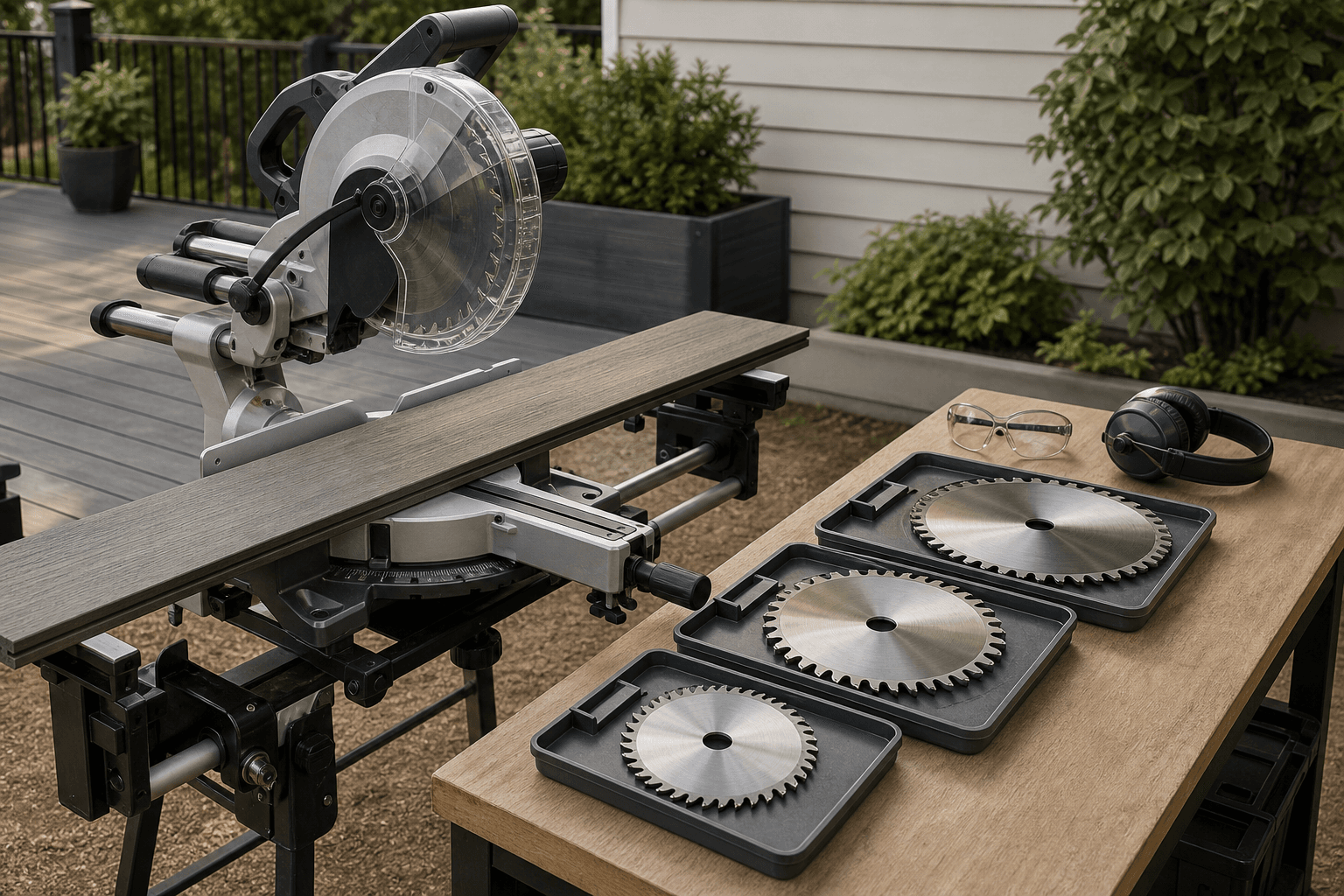
The quick answer
Use a sharp carbide blade that your decking manufacturer approves and that exactly matches the saw's permitted diameter, arbor and maximum speed. For Trex decking, the manufacturer recommends the co-developed Diablo TrexBlade family: 44 teeth at 7-1/4 inches, 72 teeth at 10 inches and 84 teeth at 12 inches. That is a Trex-specific example, not a universal tooth-count rule for every composite board.
Start with the board maker's installation guide, then choose the saw by cut: a circular saw for portable square cuts and long trimming work, or a miter saw for repeatable crosscuts and picture-frame miters. If the decking guide and a generic blade recommendation disagree, follow the decking and saw manufacturers.
How this guide has been updated
- Article published with product references and related reading.
Use this article with our best miter saw shortlist, then check the safe operating guide before planning the cut.
Relevant options
Two manufacturer-matched TrexBlade examples
Research-based recommendations, not hands-on tests. Compare the exact model, package and manufacturer specifications before ordering.
Best for a 7-1/4-inch circular saw
Diablo D0744CD TrexBlade
Best for: Portable square cuts and guided edge trimming on Trex boards with a compatible 7-1/4-inch circular saw.
- 7-1/4-inch diameter
- 44 modified triple-chip-grind teeth
- 5/8-inch arbor and 10,000 max RPM
Review context: Trex identifies the co-developed blade family for its composite decking, and Diablo documents this compact model for composites and plastics. It is the size-specific choice, not a substitute for checking the saw manual.
Consider: Its 7-1/4-inch diameter is intended for compatible circular saws and cannot replace a 10- or 12-inch miter-saw blade.
Official specificationsChecked August 4, 2026
Best for a compatible 12-inch miter saw
Diablo D1284CD TrexBlade
Best for: Repeat crosscuts and picture-frame miters on Trex boards at a stable 12-inch miter-saw station.
- 12-inch diameter
- 84 modified triple-chip-grind teeth
- 1-inch arbor and 5,000 max RPM
Review context: The 84-tooth model is the 12-inch member of the Trex-recommended family. Its modified triple-chip geometry is designed around composite decking and plastic rather than general framing cuts.
Consider: It requires a compatible 12-inch saw and 1-inch arbor, and its specialty geometry is not the default blade for wet pressure-treated framing lumber.
Official specificationsChecked August 4, 2026
Start with the decking manufacturer, not a generic tooth count
Composite decking is a category, not one material recipe. Wood-plastic composite, capped composite and PVC boards can have different cores and surface layers. A tooth count that works for one line may not be the documented choice for another.
For example, Trex explicitly recommends its Diablo TrexBlade range and lists matching 7-1/4-, 10- and 12-inch options. TimberTech's current CONCEALoc installation guidance is different and product-specific: it calls for a fine-tooth carbide finish blade, including at least 80 teeth on a 10-inch miter saw or 100 teeth on a 12-inch miter saw for that system. Check the current guide for the exact collection you are installing rather than merging both examples into one rule.
- Identify the exact decking brand, collection and installation method.
- Read the current cutting section of its installation guide.
- Match diameter, arbor, kerf and maximum RPM to the saw manual.
- Make a supported test cut on an offcut before cutting a finished board.
The five compatibility checks that matter
Diameter and tooth count are only the beginning. The arbor must seat correctly, the blade's maximum RPM must meet or exceed the saw's no-load speed, and the plate and kerf must suit the machine. Tooth geometry also affects how aggressively the blade enters a dense composite board.
Example: the Diablo D0744CD is a 7-1/4-inch, 44-tooth blade with a 5/8-inch arbor for compatible circular saws. The D1284CD is a 12-inch, 84-tooth blade with a 1-inch arbor for compatible 12-inch miter saws. They are not interchangeable just because both are designed for composite decking.
- Blade diameter: use only a size the saw manufacturer permits.
- Arbor: it must match without improvised bushings unless the maker approves them.
- Maximum RPM: the blade rating must never be below the saw speed.
- Kerf and plate: confirm compatibility with the guard, riving system and manual.
- Application: verify the blade is rated for the exact composite or PVC material.
Circular saw or miter saw: choose by the cut
Use a circular saw when the board is easier to support in place, when trimming a straight deck edge, or when carrying the saw to long stock is safer than carrying the stock to a station. Use a miter saw for batches of square crosscuts, railing components and repeated picture-frame angles that fall inside its published capacity.
A practical example: crosscut 12-foot field boards at a stable miter-saw station only when the board remains level and supported on both sides. For the final straight trim across installed board ends, use an approved circular-saw setup with a guide. Our deck-building workflow explains why the two tools complement each other instead of forcing one saw to handle every cut.
How to reduce chipping, melting and wandering
Support the board close to the cut, keep the finished face oriented as the decking maker specifies and let a sharp blade reach full speed before entering the material. Feed steadily without forcing the saw. A slow, stalled feed can build heat; an aggressive feed can deflect the blade or damage the cap.
Trim factory ends when the installation guide requires it. On a picture-frame corner, mark both mating boards from the same reference, make supported test cuts and confirm the joint before committing the full-length pieces. Do not assume a higher tooth count can correct a warped board, dull blade or unstable support.
- Use a sacrificial offcut to confirm edge quality and fit.
- Cut one board at a time unless the manufacturer documents another method.
- Keep the board flat against the miter-saw fence and table.
- Wait for the miter-saw blade to stop completely before raising the head.
A safe step-by-step cutting workflow
Disconnect power before installing or inspecting a blade. Confirm the rotation arrow, arbor fit, flange order and tightening procedure in the saw manual. Restore guards before reconnecting power. At the cutting station, wear eye and hearing protection and use the dust controls specified for the tool and material.
For a 5/4x6 composite board, place supports so the board cannot seesaw, mark the waste side, clamp only where the saw maker permits and keep both hands outside the no-hand zone. Make the cut with a controlled feed, let the blade stop, then inspect the offcut. Composite dust and scraps should be collected according to the decking manufacturer's instructions; never clear debris near a moving blade.
At a glance
Why a composite-specific blade helps
- Cleaner manufacturer-matched cuts
- Purpose-built tooth geometry
- Size options for circular and miter saws
- Less guesswork at picture-frame joints
What still needs checking
- One blade does not fit every saw
- Decking brands publish different guidance
- Specialty blades are less versatile for framing lumber
- A good blade cannot compensate for poor support
Frequently asked questions
What is the best miter saw blade for cutting composite decking?
The best blade is the one approved for your exact decking and compatible with the saw. For Trex, the co-developed Diablo TrexBlade is the manufacturer-recommended example; other brands may specify a different fine-tooth carbide blade.
How many teeth should a blade have for composite decking?
There is no universal number. Trex lists 44 teeth at 7-1/4 inches, 72 at 10 inches and 84 at 12 inches in its TrexBlade range, while a current TimberTech system guide specifies different minimums. Follow the exact decking guide.
What is the best way to miter composite decking?
Support one board flat, use a sharp approved blade, make a test cut, and confirm both picture-frame pieces from a common reference. Keep the finished face oriented as the board maker instructs and allow the blade to stop before lifting the saw head.
What is a good 12-inch miter saw blade for composite decking?
For Trex, the 12-inch, 84-tooth Diablo D1284CD is the matching manufacturer-recommended option. Confirm its 1-inch arbor, RPM rating and application against your exact saw and decking before installation.
Do you need a special blade to cut composite decking?
Not every manufacturer uses the word special, but you do need a sharp carbide blade that its instructions permit. A purpose-built composite blade can reduce guesswork, heat and edge damage when it also matches the saw.
Sources and verification
Specifications and material guidance were checked on the dates shown. Always confirm the current manual for your exact saw, blade and decking product.
- Trex: Cutting Composite DeckingChecked August 4, 2026
- Trex decking accessories and blade sizesChecked August 4, 2026
- TimberTech: How to Cut Composite DeckingChecked August 4, 2026
- TimberTech Composite CONCEALoc installation guidanceChecked August 4, 2026
- Diablo D0744CD official specificationsChecked August 4, 2026
- Diablo D1284CD official specificationsChecked August 4, 2026