Project planning
Can You Use a Miter Saw for Deck Building?
Use a miter saw for repeatable crosscuts and angles—but match its capacity and blade to every board, post and decking material first.
The quick answer
Yes. A miter saw is useful for repeatable square crosscuts and angle cuts on deck boards, railing parts, blocking and some framing lumber. It is not a complete deck-building saw: a circular saw is normally more practical for trimming joists in place, cutting long lines and handling stock that exceeds the miter saw’s published capacity.
Before cutting, compare the exact board dimensions and intended angle with the capacity table in the saw manual. A machine that crosscuts a 2x12 at 90 degrees may accept much less width at a 45-degree miter.
How this guide has been updated
- Article published with product references and related reading.
Use this article with our best miter saw shortlist, then check the safe operating guide before planning the cut.
Relevant options
Three miter saws to compare for deck projects
Research-based recommendations, not hands-on tests. Compare the exact model, package and manufacturer specifications before ordering.
Best broad-capacity value
DeWalt DWS779
Best for: A stationary deck station handling repeated 2x lumber, wide deck boards and occasional larger components.
- 12-inch sliding compound design
- Dual bevel for opposing angles
- Large dimensional-lumber capacity
Review context: DeWalt documents this as a 12-inch double-bevel sliding saw with dimensional-lumber crosscut capacity. The sliding format is relevant when deck-board width and angled cuts exceed a fixed saw’s reach.
Consider: The large capacity comes with substantial weight and rear-rail space, so it is better on a stable stand than carried around the frame.
Official specificationsChecked August 2, 2026
Best compact-depth 12-inch saw
Bosch GCM12SD
Best for: A deck-building station placed near a wall, trailer or other area where conventional rear rails consume working space.
- 12-inch dual-bevel design
- Axial-Glide arm
- Up-front controls and large capacity
Review context: Bosch highlights the Axial-Glide mechanism and large cutting capacity. That mechanism reduces rear travel while retaining wide crosscut capability.
Consider: At about 65 pounds it is a heavy stationary choice, and it does not replace the circular saw needed for in-place framing cuts.
Official specificationsChecked August 2, 2026
Best for large trim and railing work
Makita LS1219L
Best for: Decks with repeated wide miters, substantial railing components or finish-focused picture framing.
- 12-inch dual-bevel slider
- 60-degree miter range left and right
- Laser-equipped model
Review context: Makita documents a 12-inch dual-bevel slider, 60-degree miter range in both directions and large crown/base capacities. Those specifications provide useful margin, subject to the deck part’s exact dimensions.
Consider: Its roughly 65-pound weight and large overall size make it a planned workstation tool rather than an in-frame cutting solution.
Official specificationsChecked August 2, 2026
Match the saw to a real deck cut list
Treat the deck plan as a list of separate cuts. For example, a 5/4x6 deck board needs modest vertical capacity but may need a wide 45-degree cut for picture framing. A 2x6 joist usually needs a square crosscut. A nominal 4x4 guard post demands more vertical capacity, and a 6x6 beam may be outside the approved one-pass envelope of many miter saws.
Do not rotate a large post through several cuts unless the manufacturer documents that method and the work remains fully supported against the table and fence. When capacity or stock control is uncertain, change tools or have the material cut by an appropriate machine.
- 5/4x6 board: verify the 45-degree miter width when picture framing.
- 2x6 joist or blocking: verify the 90-degree crosscut and support long stock level.
- 4x4 post: check actual dimensions against the manual—not the blade-size label.
- Long rip or in-place trim: use a suitable circular or track-guided method instead.
Is a 10-inch or 12-inch miter saw better for a deck?
A sliding 10-inch saw can cover many deck-board and 2x framing crosscuts while being easier to move. A 12-inch slider adds useful margin for wide boards, posts and larger railing components, but it also adds weight, blade cost and jobsite footprint.
Example: if the project uses only 5/4x6 decking and 2x6 framing, verified 10-inch sliding capacity may be sufficient. If the plan includes repeated 4x4 cuts, wide stair parts or thick railing components, compare exact 12-inch model capacities instead of assuming every larger saw will make every cut.
Choose the blade for the deck material
Blade choice changes with material and finish. Lowe’s guidance notes that treated lumber commonly contains more moisture than construction lumber and benefits from a lower tooth count that clears debris more readily. That does not create one universal tooth-count rule: diameter, arbor, maximum RPM, hook angle and material rating must all match the saw manual and blade instructions.
Composite and capped boards can require different blades. TimberTech’s current picture-framing guidance calls for a fine-toothed carbide-tipped miter-saw blade for its deck boards and fascia. Check the exact decking manufacturer before applying that example to another composite product.
Build a stable outdoor cutting station
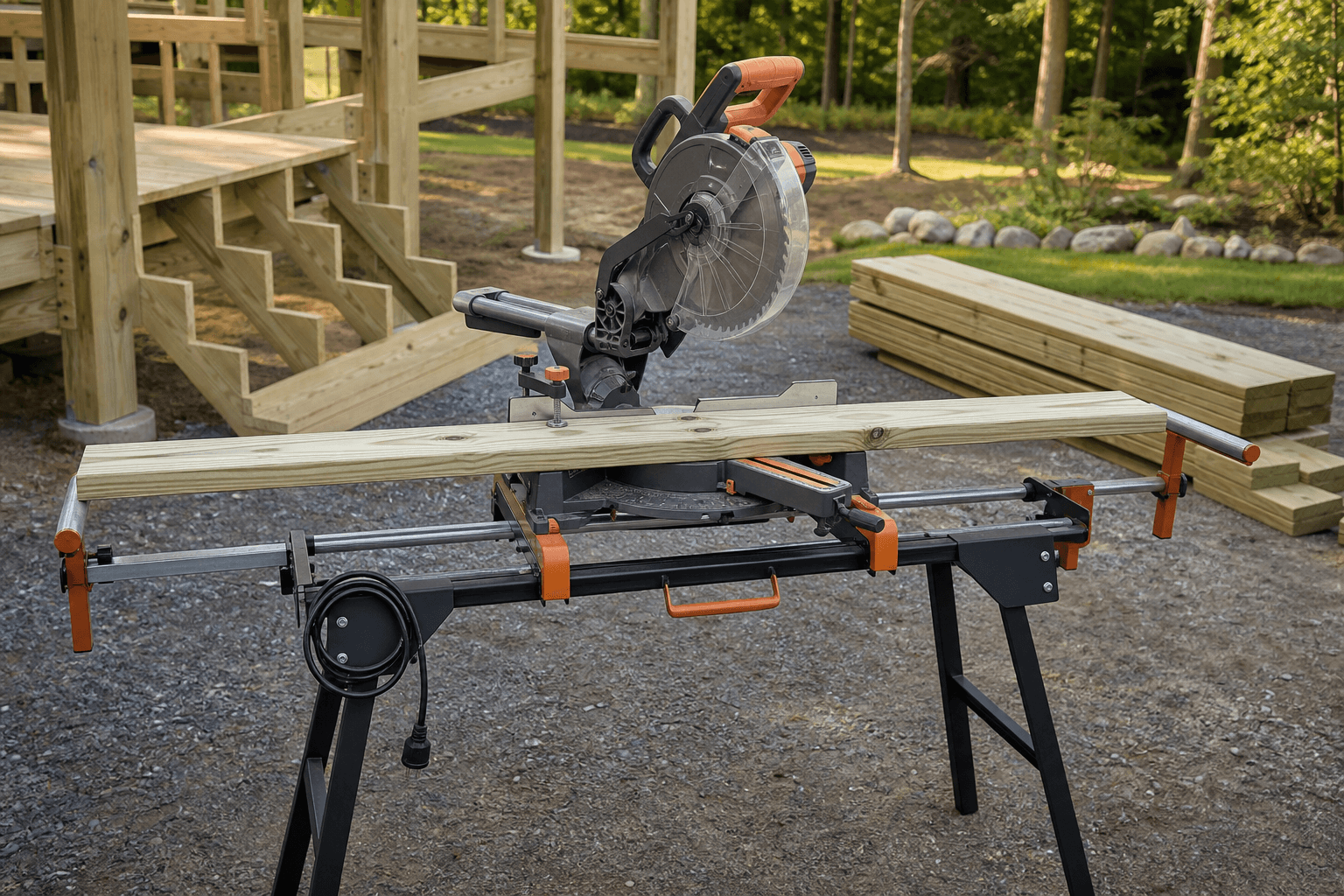
Place the saw on a level, stable stand and support long boards coplanar with the saw table on both sides. Keep the offcut controlled without trapping it between a stop and the blade. Route power and extraction outside walking paths, and do not operate a non-rated electric saw in rain, on wet ground or when wind moves the stock.
For a 12-foot deck board, support at the saw alone is not enough. Use stand extensions or suitable supports near both working spans, then confirm the board stays flat against the fence without seesawing. Keep hands outside the model-specific no-hand zone and wait for a complete blade stop before raising the head.
A practical two-saw workflow
Use the miter saw at a stable cutting station for batches: repeated blocking, square deck-board ends, railing pieces and verified miters. Use a circular saw with an appropriate guide for in-place joist trimming, long cutoffs and cuts that are safer with the material stationary on supports.
Example: mark and batch-cut ten equal blocking pieces with a stop positioned so no offcut is trapped. Install them, then use a circular saw and layout line for the final joist tails. This separates repeatable bench work from long in-place work instead of forcing one machine to do both.
At a glance
Where the miter saw earns its place
- Fast repeatable crosscuts
- Accurate common miters
- Useful for deck-board picture frames
- Efficient batch cutting for blocking
Where another tool is better
- Not intended for long rip cuts
- Capacity falls at some miter angles
- Large posts may exceed the approved envelope
- Long stock requires stable level support
Frequently asked questions
Can you cut deck boards with a miter saw?
Yes, when the board material, dimensions, blade and angle fall within the exact saw and blade instructions. Verify 45-degree capacity separately when cutting picture-frame borders.
Can you build a deck with only a miter saw?
A miter saw handles many crosscuts, but it is a poor fit for long rips and final in-place joist trimming. Most deck workflows also need a suitable circular saw or another approved guided cutting method.
Is a 10-inch miter saw big enough for deck building?
It can be for projects dominated by deck boards and 2x framing, especially if it slides. Check every planned board and angle against the model’s capacity table; 4x4 posts and wide miters may require more capacity.
What blade should you use for pressure-treated deck lumber?
Use a blade explicitly rated for the material and compatible with the saw. Moist treated lumber often benefits from fewer teeth and larger gullets for chip clearance, while some composite decking manufacturers specify a fine-tooth carbide blade.
Can a miter saw cut a 4x4 deck post in one pass?
Some models can and others cannot. Verify the actual post dimensions and the manufacturer’s 90-degree cutting capacity; do not infer one-pass capacity from blade diameter alone.
Sources and verification
Specifications and material guidance were checked on the dates shown. Always confirm the current manual for your exact saw, blade and decking product.
- DeWalt DWS779 product page and instruction manualChecked August 2, 2026
- Bosch GCM12SD official product pageChecked August 2, 2026
- Makita LS1219L official specification sheetChecked August 2, 2026
- Lowe’s miter-saw use and treated-lumber blade guidanceChecked August 2, 2026
- TimberTech picture-framing installation guidanceChecked August 2, 2026